USAPhO 2023, Полуфинал — A3. The Motive Power of Ice
2023 USA Physics Olympiad Exam · 25 т.
Внимание: Бележка към темата
The archive contains the complete question packet and the official interleaved solution packet. The separate official answer sheets referred to in the instructions are absent from this archive folder. Original printed errors are retained: A1(c)'s solution uses although the question defines ; A2(b.iii)'s solution writes radius although the question defines ; A3's key refers to “part (b)” in its part a.iii check, and B1's key calls the rod a “disc”. B2's printed energy expression uses although the question gives energy density in J/kg. The “this paper” references in B2 and B3 have no recoverable URI in the supplied PDF.
AAPT UNITED STATES PHYSICS TEAM — AIP 2023; USA Physics Olympiad Exam
DO NOT DISTRIBUTE THIS PAGE
Important Instructions for the Exam Supervisor
This examination has two parts. Each part has three questions and lasts for 90 minutes.
For each student, print out one copy of the exam and one copy of the answer sheets. Print everything single-sided, and do not staple anything. Divide the exam into the instructions (pages 2–3), Part A questions (pages 4–8), and Part B questions (pages 9–11).
Begin by giving students the instructions and all of the answer sheets. Let the students read the instructions and fill out their information on the answer sheets. They can keep the instructions for both parts of the exam. Also give students blank sheets of paper to use as scratch paper throughout the exam.
Students may bring calculators, but they may not use symbolic math, programming, or graphing features of these calculators. Calculators may not be shared, and their memory must be cleared of data and programs. Cell phones or other electronics may not be used during the exam or while the exam papers are present. Students may not use books or other references.
To start the exam, give students the Part A questions, and allow 90 minutes to complete Part A. Do not give students Part B during this time, even if they finish with time remaining. At the end of the 90 minutes, collect the Part A questions and answer sheets.
Then give students a 5 to 10 minute break. Then give them the Part B questions, and allow 90 minutes to complete Part B. Do not let students go back to Part A.
At the end of the exam, collect everything, including the questions, the instructions, the answer sheets, and the scratch paper. Students may not keep the exam questions. Everything can be returned to the students after April 19th, 2023.
After the exam, sort each student’s answer sheets by page number. Scan every answer sheet, including blank ones.
We acknowledge the following people for their contributions to this year’s exam (in alphabetical order):
Tengiz Bibilashvili, Kellan Colburn, Samuel Gebretsadkan, Abi Krishnan, Natalie LeBaron, Kye Shi, Brian Skinner, and Kevin Zhou.
Copyright ©2023 American Association of Physics Teachers
Instructions for the Student
You should receive these instructions, the reference table on the next page, answer sheets, and blank paper for scratch work. Read this page carefully before the exam begins.
You may use a calculator, but its memory must be cleared of data and programs, and you may not use symbolic math, programming, or graphing features. Calculators may not be shared. Cell phones or other electronics may not be used during the exam or while the exam papers are present. You may not use books or other outside references.
When the exam begins, your proctor will give you the questions for Part A. You will have 90 minutes to complete three problems. Each question is worth 25 points, but they are not necessarily of the same difficulty. If you finish all of the questions, you may check your work, but you may not look at Part B during this time.
After 90 minutes, your proctor will collect the questions and answer sheets for Part A. You may then take a short break.
Then you will work on Part B. You have 90 minutes to complete three problems. Each question is worth 25 points. Do not look at Part A during this time. When the exam ends, you must return all papers to the proctor, including the exam questions.
Do not discuss the questions of this exam, or their solutions, until after April 19th, 2023. Violations of this rule may result in disqualification.
Below are instructions for writing your solutions.
All of your solutions must be written on the official answer sheets. Nothing outside these answer sheets will be graded. Before the exam begins, write your name, student AAPT number, and proctor AAPT number as directed on the answer sheets.
There are several answer sheets per problem. If you run out of space for a problem, you may use the extra answer sheets, which are at the end of the answer sheet packet. To ensure this work is graded, you must indicate, at the bottom of your last answer sheet for that problem, that you are using these extra answer sheets.
Only write within the frame of each answer sheet. To simplify grading, we recommend drawing a box around your final answer for each subpart. You should organize your work linearly and briefly explain your reasoning, which will help you earn partial credit. You may use either pencil or pen, but sure to write clearly so your work will be legible after scanning.
Copyright ©2023 American Association of Physics Teachers
Reference table of possibly useful information
| for | |
| for | for |
Possibly useful integrals
You may use this sheet for both parts of the exam.
End of Instructions for the Student
DO NOT OPEN THIS TEST UNTIL YOU ARE TOLD TO BEGIN
Copyright ©2023 American Association of Physics Teachers
Условие
In the Carnot cycle, a gas is heated at constant temperature and cooled at constant temperature . Furthermore, no other heat transfer occurs, and all other steps of the cycle are reversible. The laws of thermodynamics state that any such cycle must have efficiency . Below we will explore two other heat engines, which recover this efficiency in certain limits.
a.
Consider the following heat engine involving one mole of ideal monatomic gas. The gas begins at temperature , pressure , and volume , and undergoes four reversible steps.
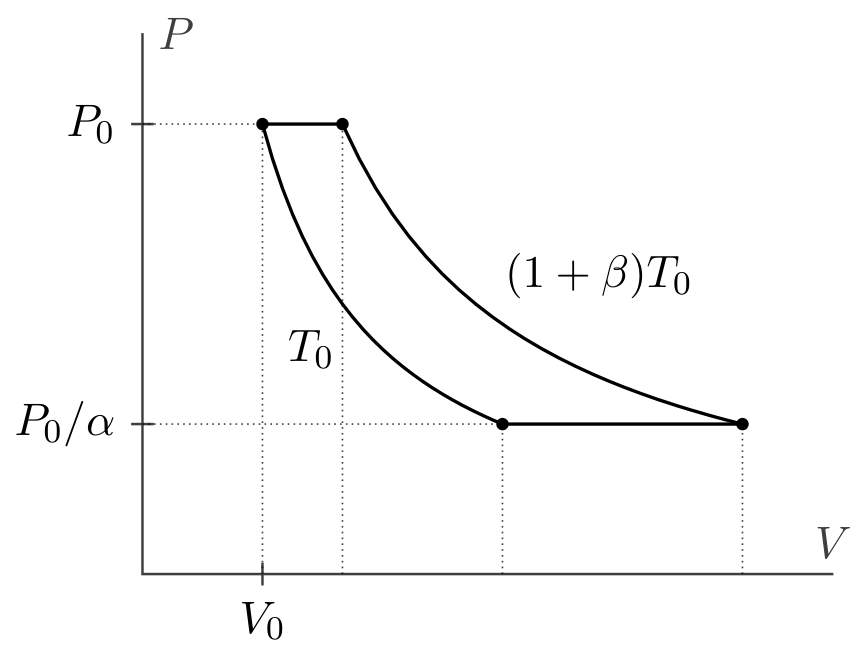
- The gas is expanded at constant pressure until its temperature rises to .
- The gas is expanded at constant temperature until its pressure falls to .
- The gas is contracted at constant pressure until its temperature falls back to .
- The gas is contracted at constant temperature until its pressure rises back to .
i. Which steps require heat to be transferred to the gas? For each such step, give the total heat input in terms of , , , and .
ii. Under what conditions on and would we expect the efficiency of this heat engine to approach that of a Carnot cycle working between the same maximum and minimum temperatures?
iii. Find the efficiency of this heat engine for general and .
The second half of the problem is on the next page.
b.
Now consider a heat engine built around the freezing and melting of water, which occurs at a pressure-dependent temperature . Initially, a volume of of water is squeezed underneath a piston, so that it experiences a total pressure , and the water is on the edge of freezing, with temperature . The engine then undergoes four reversible steps.
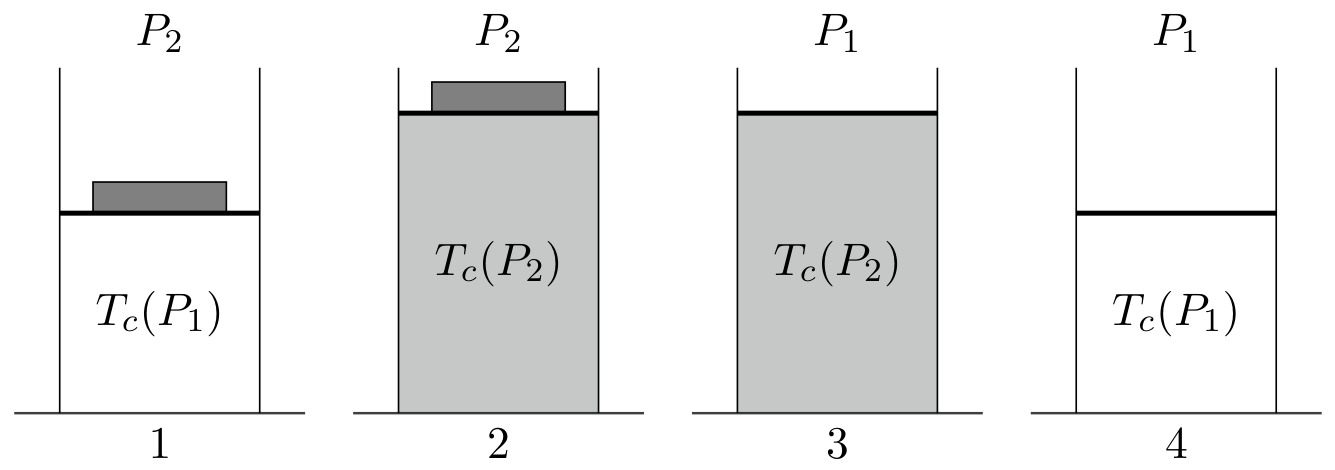
- A mass is slowly placed on the piston, raising the total pressure to .
- The water is cooled to temperature and frozen.
- The mass is slowly removed from the piston, lowering the pressure back to .
- The ice is heated back to temperature and melted.
Assume that water and ice are incompressible, with fixed densities and .
i. What is the net work done by this engine, in terms of , , , and the densities?
ii. Assume the latent heat per unit mass to melt ice is large, so that freezing and melting account for essentially all of the heat transfer in the cycle. What is the efficiency of the engine, in terms of , , , and the densities?
iii. Since we assumed all heat transfer occurs during melting or freezing, this cycle has the same efficiency as a Carnot cycle. In the limit where and are very close, use this fact to infer an expression for in terms of , , and the densities.
STOP: Do Not Continue to Part B
If there is still time remaining for Part A, you can review your work for Part A, but do not continue to Part B until instructed by your exam supervisor.
Once you start Part B, you will not be able to return to Part A.
Решение
Question A3 — The Motive Power of Ice
In the Carnot cycle, a gas is heated at constant temperature and cooled at constant temperature . Furthermore, no other heat transfer occurs, and all other steps of the cycle are reversible. The laws of thermodynamics state that any such cycle must have efficiency . Below we will explore two other heat engines, which recover this efficiency in certain limits.
a. Consider the following heat engine involving one mole of ideal monatomic gas. The gas begins at temperature , pressure , and volume , and undergoes four reversible steps: (1) expanded at constant pressure until its temperature rises to ; (2) expanded at constant temperature until its pressure falls to ; (3) contracted at constant pressure until its temperature falls back to ; (4) contracted at constant temperature until its pressure rises back to .
i. Which steps require heat to be transferred to the gas? For each such step, give the total heat input in terms of , , , and .
Solution: Heat is added to the gas in the first two steps. In the first step, we have heating at constant pressure, which has molar heat capacity , so
where we used the ideal gas law in the final step. In the second step, the heat added to the gas compensates for the work done while it expands, so
ii. Under what conditions on and would we expect the efficiency of this heat engine to approach that of a Carnot cycle working between the same maximum and minimum temperatures?
Solution: Since all the steps are reversible, we recover the Carnot efficiency when almost all the heat transfer happens at the same temperature, i.e. when . This holds when
We should also consider the other two steps, which have heat transfer
and
We have when
which is stricter than the previous condition. Thus, we recover the Carnot efficiency when .
iii. Find the efficiency of this heat engine for general and .
Solution: We calculate the net work throughout all four steps,
where the first and third terms are just the usual work, and the second and fourth use the form done in an isothermal process. Simplifying gives
Therefore, the efficiency of the process is
One way to check the answer is to note that the Carnot efficiency would be . Our general result reduces to this efficiency when the second term in the denominator is negligible, which is precisely the condition identified in part (b).
b.
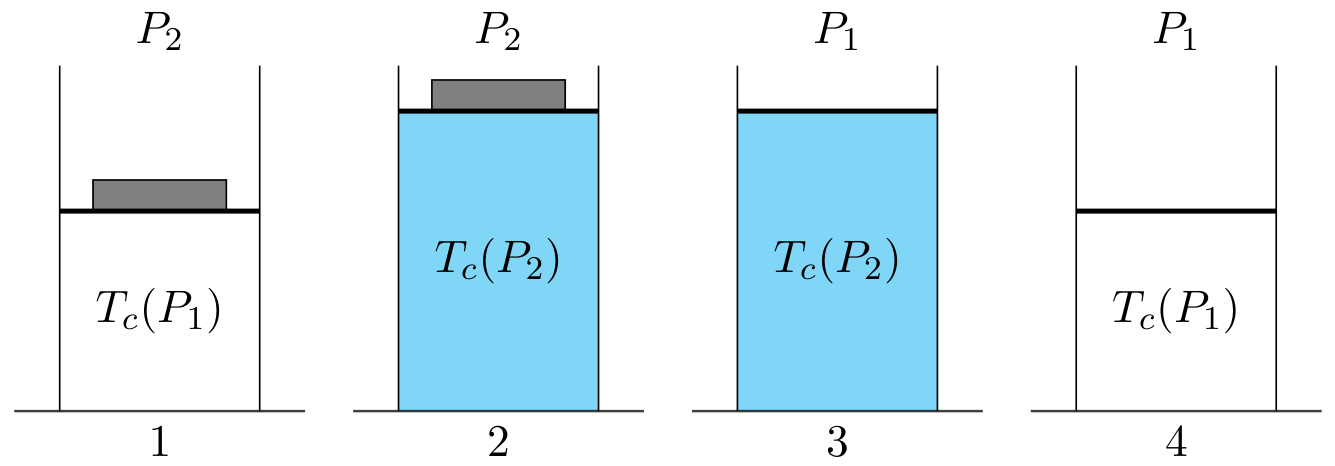
Now consider a heat engine built around the freezing and melting of water, which occurs at a pressure-dependent temperature . Initially, a volume of of water is squeezed underneath a piston, so that it experiences a total pressure , and the water is on the edge of freezing, with temperature . The engine then undergoes four reversible steps: (1) a mass is slowly placed on the piston, raising the total pressure to ; (2) the water is cooled to temperature and frozen; (3) the mass is slowly removed from the piston, lowering the pressure back to ; (4) the ice is heated back to temperature and melted. Assume that water and ice are incompressible, with fixed densities and .
i. What is the net work done by this engine, in terms of , , , and the densities?
Solution: The system expands at a pressure and contracts at a pressure , so the net work done is
Concretely, this work used to raise the mass, so it could also be calculated as .
ii. Assume the latent heat per unit mass to melt ice is large, so that freezing and melting account for essentially all of the heat transfer in the cycle. What is the efficiency of the engine, in terms of , , , and the densities?
Solution: The heat transferred in is used to melt the ice, , so
Note that the efficiency can also be expressed as , but in order to find directly, we would need to know how the latent heat varies with pressure, which isn't given in the problem.
iii. Since we assumed all heat transfer occurs during melting or freezing, this cycle has the same efficiency as a Carnot cycle. In the limit where and are very close, use this fact to infer an expression for in terms of , , and the densities.
Solution: The Carnot efficiency, for the same high and low temperatures, is
Combining this with the result of part (b) gives
and taking the limit of , the left-hand side becomes a derivative, so
This is equivalent to the well-known Clausius–Clapeyron equation, and this heat engine was first devised by the brothers Thomson and Kelvin.
Оригинал в Архива: 2023-USAPhO-Exam.pdf · официални решения: 2023-USAPhO-solutions.pdf