USAPhO 2023, Полуфинал — B1. Electric Roulette
2023 USA Physics Olympiad Exam · 25 т.
Внимание: Бележка към темата
The archive contains the complete question packet and the official interleaved solution packet. The separate official answer sheets referred to in the instructions are absent from this archive folder. Original printed errors are retained: A1(c)'s solution uses although the question defines ; A2(b.iii)'s solution writes radius although the question defines ; A3's key refers to “part (b)” in its part a.iii check, and B1's key calls the rod a “disc”. B2's printed energy expression uses although the question gives energy density in J/kg. The “this paper” references in B2 and B3 have no recoverable URI in the supplied PDF.
AAPT UNITED STATES PHYSICS TEAM — AIP 2023; USA Physics Olympiad Exam
DO NOT DISTRIBUTE THIS PAGE
Important Instructions for the Exam Supervisor
This examination has two parts. Each part has three questions and lasts for 90 minutes.
For each student, print out one copy of the exam and one copy of the answer sheets. Print everything single-sided, and do not staple anything. Divide the exam into the instructions (pages 2–3), Part A questions (pages 4–8), and Part B questions (pages 9–11).
Begin by giving students the instructions and all of the answer sheets. Let the students read the instructions and fill out their information on the answer sheets. They can keep the instructions for both parts of the exam. Also give students blank sheets of paper to use as scratch paper throughout the exam.
Students may bring calculators, but they may not use symbolic math, programming, or graphing features of these calculators. Calculators may not be shared, and their memory must be cleared of data and programs. Cell phones or other electronics may not be used during the exam or while the exam papers are present. Students may not use books or other references.
To start the exam, give students the Part A questions, and allow 90 minutes to complete Part A. Do not give students Part B during this time, even if they finish with time remaining. At the end of the 90 minutes, collect the Part A questions and answer sheets.
Then give students a 5 to 10 minute break. Then give them the Part B questions, and allow 90 minutes to complete Part B. Do not let students go back to Part A.
At the end of the exam, collect everything, including the questions, the instructions, the answer sheets, and the scratch paper. Students may not keep the exam questions. Everything can be returned to the students after April 19th, 2023.
After the exam, sort each student’s answer sheets by page number. Scan every answer sheet, including blank ones.
We acknowledge the following people for their contributions to this year’s exam (in alphabetical order):
Tengiz Bibilashvili, Kellan Colburn, Samuel Gebretsadkan, Abi Krishnan, Natalie LeBaron, Kye Shi, Brian Skinner, and Kevin Zhou.
Copyright ©2023 American Association of Physics Teachers
Instructions for the Student
You should receive these instructions, the reference table on the next page, answer sheets, and blank paper for scratch work. Read this page carefully before the exam begins.
You may use a calculator, but its memory must be cleared of data and programs, and you may not use symbolic math, programming, or graphing features. Calculators may not be shared. Cell phones or other electronics may not be used during the exam or while the exam papers are present. You may not use books or other outside references.
When the exam begins, your proctor will give you the questions for Part A. You will have 90 minutes to complete three problems. Each question is worth 25 points, but they are not necessarily of the same difficulty. If you finish all of the questions, you may check your work, but you may not look at Part B during this time.
After 90 minutes, your proctor will collect the questions and answer sheets for Part A. You may then take a short break.
Then you will work on Part B. You have 90 minutes to complete three problems. Each question is worth 25 points. Do not look at Part A during this time. When the exam ends, you must return all papers to the proctor, including the exam questions.
Do not discuss the questions of this exam, or their solutions, until after April 19th, 2023. Violations of this rule may result in disqualification.
Below are instructions for writing your solutions.
All of your solutions must be written on the official answer sheets. Nothing outside these answer sheets will be graded. Before the exam begins, write your name, student AAPT number, and proctor AAPT number as directed on the answer sheets.
There are several answer sheets per problem. If you run out of space for a problem, you may use the extra answer sheets, which are at the end of the answer sheet packet. To ensure this work is graded, you must indicate, at the bottom of your last answer sheet for that problem, that you are using these extra answer sheets.
Only write within the frame of each answer sheet. To simplify grading, we recommend drawing a box around your final answer for each subpart. You should organize your work linearly and briefly explain your reasoning, which will help you earn partial credit. You may use either pencil or pen, but sure to write clearly so your work will be legible after scanning.
Copyright ©2023 American Association of Physics Teachers
Reference table of possibly useful information
| for | |
| for | for |
Possibly useful integrals
You may use this sheet for both parts of the exam.
End of Instructions for the Student
DO NOT OPEN THIS TEST UNTIL YOU ARE TOLD TO BEGIN
Copyright ©2023 American Association of Physics Teachers
Условие
Consider a cylindrical solenoid with radius , length , and turns per unit length. It is made of one continuous wire, with the top connecting back to the bottom as shown at left.
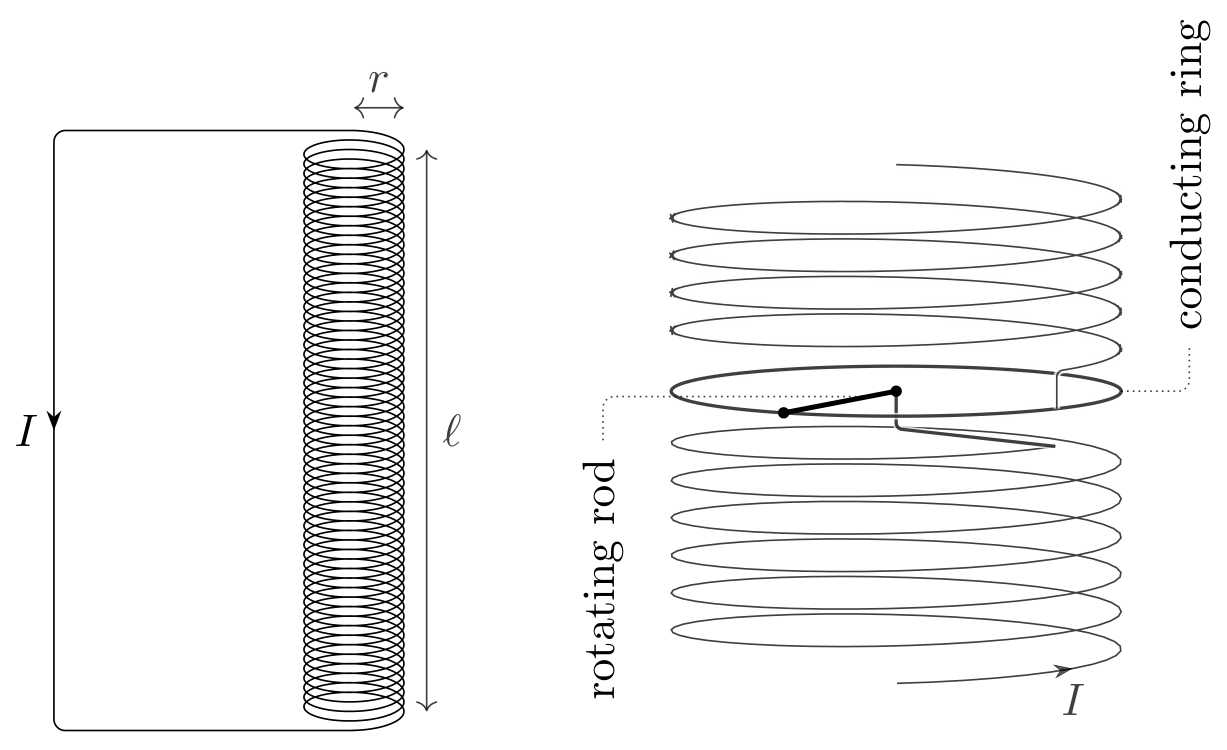
In the middle of the solenoid, part of the wire is replaced with the assembly shown at right. A uniform conducting rod of mass and radius is connected to the bottom half of the solenoid, and is free to rotate about the solenoid's axis of symmetry. The end of the rod slides on a fixed conducting ring, which is attached to the top half of the solenoid. This assembly and the solenoid form one continuous conductor, carrying total current .
a.
What is the inductance of this system? Assume , so that the magnetic field produced by the current in the rod and ring is negligible.
b.
When the rod is within a uniform vertical magnetic field , find the torque it experiences in terms of , , and .
c.
If the rod rotates with angular velocity , the electrons inside have a tangential velocity. Find the electromotive force across the rod in terms of , , and .
Now we will consider the dynamics of this system in some simple situations. For all the parts below, neglect energy losses due to friction, resistance, and radiation.
d.
First, suppose the system initially carries no current, and the entire system is inside a uniform external magnetic field parallel to the axis of the solenoid. If the rod is given a small initial angular velocity, its angular velocity will oscillate in time. Find the period of these oscillations.
e.
Next, suppose there is no external magnetic field, , and at time , the system carries current and the rod has zero angular velocity.
i. The rod's angular velocity approaches a value after a long time. What is ?
ii. Find in terms of , , , and . You may use the integrals on the reference sheet.
Решение
Part B
Question B1
Electric Roulette
a. Solution. The magnetic field produced is , so the flux through one turn of the solenoid is . There are turns in total, so the inductance is
b. Solution. The torque is due to the Lorentz force on the current as it travels radially outward, from the center of the disc towards its edge. Note that only the radial motion of the current contributes to the torque, so we would get the same torque if the current traveled in a straight line from the center to the rim. In this case, the total torque is
where the minus sign indicates that the torque tends to slow down the rotation, when is defined in the direction shown in the figure. (This is consistent with defining positive angular velocity and torque by the right-hand rule; if you defined it the other way around, this equation and several others below would pick up a sign flip. Since we didn't specify the sign convention in the problem text, either set of signs received full credit.)
c. Solution. At a radius , the tangential speed is , leading to a radially outward Lorentz force per charge of . (The electrons also have radial motion, but this does not contribute to the electromotive force; it instead contributes to the torque found in the previous subpart.) The emf is therefore
Now we will consider the dynamics of this system in some simple situations. For all the parts below, neglect energy losses due to friction, resistance, and radiation.
d. Solution. Using our results from above, the angular acceleration of the disc is
Kirchoff's loop rule is , which implies that
Taking the time derivative of our expression for gives
which is a simple harmonic motion equation. The period is therefore
e. Next, suppose there is no external magnetic field, , and at time , the system carries current and the rod has zero angular velocity.
i. Solution. The basic equations are similar, except now the magnetic field is sourced by the solenoid itself, so instead of we now have . The results are
Initially is positive, so is negative, which then causes to be negative. This remains true until falls to zero, at which point and both remain zero. In other words, the solenoid speeds up the rod until it has given all of its energy to it.
Now that we know this, we can find the answer just using energy conservation,
This equation is equivalent to
where
This is the angular velocity attained after a long time, when approaches zero. Again, the opposite sign would also receive full credit.
ii. Solution. Plugging the energy conservation equation into our equation for , and writing it in terms of , we have
Separating and integrating yields
Solving for gives
which has the right limiting behavior.
Оригинал в Архива: 2023-USAPhO-Exam.pdf · официални решения: 2023-USAPhO-solutions.pdf