WoPhO 2011, Теория — Задача 1.1
Eka Tjipta Foundation Problem. Theoretical 1: Motion of a Rolling Rod
Условие
In this problem, the motion of a uniform rod (stick) with length , ended with caster-wheels at both ends, will be investigated on a flat surface. The casters at each end of the rod can spin freely and independently (see Figure 1) and have a negligible mass compared to the rod. The friction between the rod and the caster-wheels is negligible. The diameter of the caster-wheels are a bit larger than the diameter of the rod, but both diameters are much smaller than the length of the rod. The gravitational acceleration is .
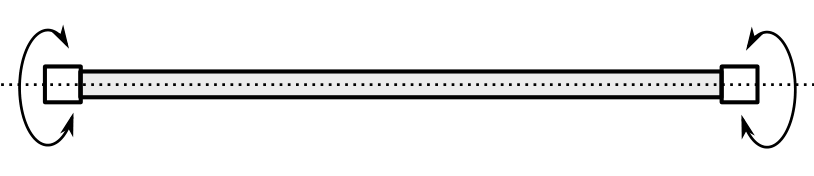
The rod is placed on a horizontal flat surface and pushed such that each end of the rod get different horizontal initial velocity ( and , pointing in the same direction) perpendicular to the axis of the rod. The casters roll without slipping on the surface.
(a) Calculate the initial velocity of the center of the rod and the initial angular velocity of the rod using , and ! [0,8 т.]
(b) Describe the motion of the center of mass of the rod! Determine the parameter(s) of its orbit! [0,8 т.]
(c) What should be the minimum value of the coefficient of static friction for the casters to not slip on the surface? [0,6 т.]
In the following sections the case of the inclined surface will be considered. The angle between the inclined surface and the horizontal plane is .
Отговори
(a)
(b)
The center of mass moves uniformly along a circle of radius R.
(c)
Решение
A) a) The initial velocity and the angular velocity of the rod is
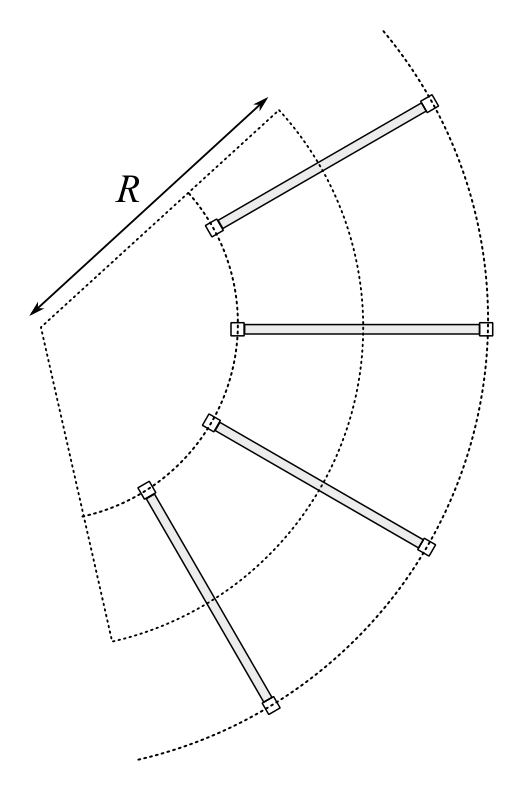
b) Since the mass and the radius of the castor-wheels are negligibly small, the force of static friction has only a component parallel to the rod (otherwise the component of the static friction perpendicular to the rod cause an infinitely large angular acceleration.). From this, it follows that the torque acting on the rod is zero, i.e. the angular velocity of the rod is constant:
Since all the forces acting on the rod is parallel of its axis, the magnitude of the velocity of the center of the rod remains constant:
and the direction of is always perpendicular to the rod. So the orbit of the center of mass will be a circle (see the upper Figure).
During one period () the center of the rod draw a whole circle, so one can write:
where is the radius of the circle. From this, it follows that the radius of the orbit of the center of mass is
c) The centripetal acceleration of the center of mass is , so the equation of motion of the rod reads
and the minimal coefficient of static friction for the slipless motion is
Оригинал в Архива: WoPhO_2011_Q11.pdf · официални решения: WoPhO_2011_S11.pdf