WoPhO 2011, Теория — Задача 1.2
Eka Tjipta Foundation Problem. Theoretical 1: Motion of a Rolling Rod
Условие
If is infinitesimally small, the motion of the rod slightly changes: the motion of the center of mass is approximately the same as in the previous section but a constant drift velocity added to the solution. Use a coordinate system as in Figure 2.
(a) Calculate the magnitude and the direction of as a function of the small , the initial velocities of the two ends of the rod ( and , pointing in the same direction) and the gravitational acceleration ! [1,9 т.]
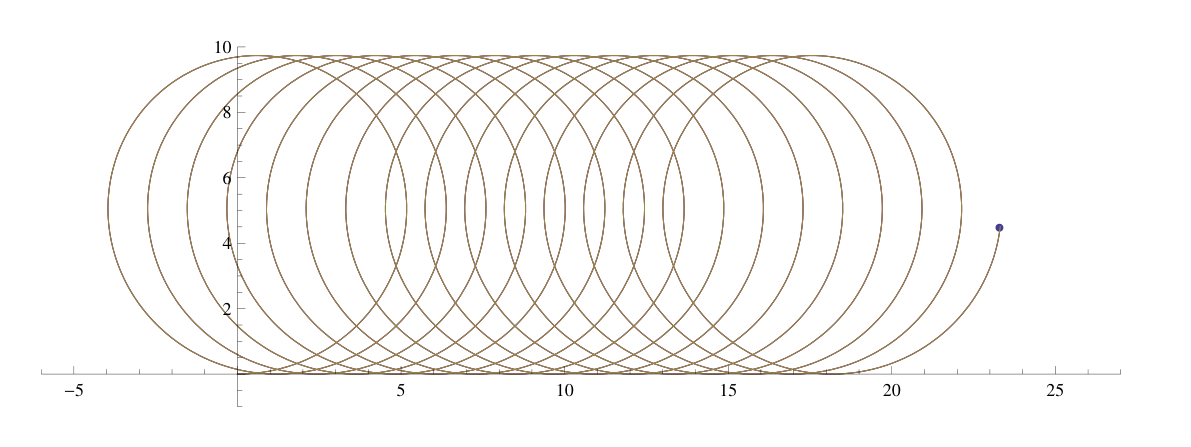
(b) Sketch the orbit of the center of mass of the rod! [0,5 т.]
Отговори
(a)
Direction: horizontal, i.e. perpendicular to the steepest line. The official solution prints "qL sin α" in the second expression; g is meant.
Решение
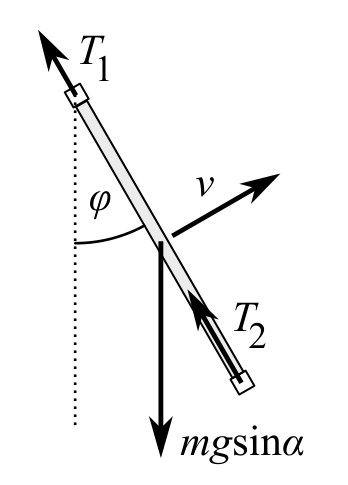
B) a) The figure shows the forces acting on the rod in the plane of the surface when the angle between the rod and the steepest line is . Since there is no torque acting on the rod, the angular velocity remains constant: . The equation of motion of the center of mass in the direction perpendicular to the rod is
Taking into account that (where is the initial angle between the rod and the steepest line), the equation of motion is analogous to the differential equation of a harmonic oscillator. So the magnitude of the velocity of the center of the rod as the function of time is given by
and its direction is always perpendicular to the rod. The - and -component of the velocity reads
Taking the time average of the components (so we can eliminate the circling motion of the center of the rod):
Now, it is obvious that the drift velocity is
and its direction is horizontal (i.e. it is perpendicular to the steepest line).
b) We can sketch the orbit of the center of mass:
Оригинал в Архива: WoPhO_2011_Q11.pdf · официални решения: WoPhO_2011_S11.pdf