WoPhO 2011, Теория — Задача 1.3
Eka Tjipta Foundation Problem. Theoretical 1: Motion of a Rolling Rod
Условие
If is finite, the details of the motion of the rod changes. Place the rod on the inclined plane along the steepest line of the surface (so the rod is parallel with the inclined edges of the plane). Consider that the initial velocity of the center of mass of the rod is perpendicular to the axis of the rod and the initial angular velocity is perpendicular to the surface as shown in Figure 2.
(a) Calculate the time evolution of the velocity of the center of mass of the rod in the Cartesian coordinate system shown in Figure 2. [0,8 т.]
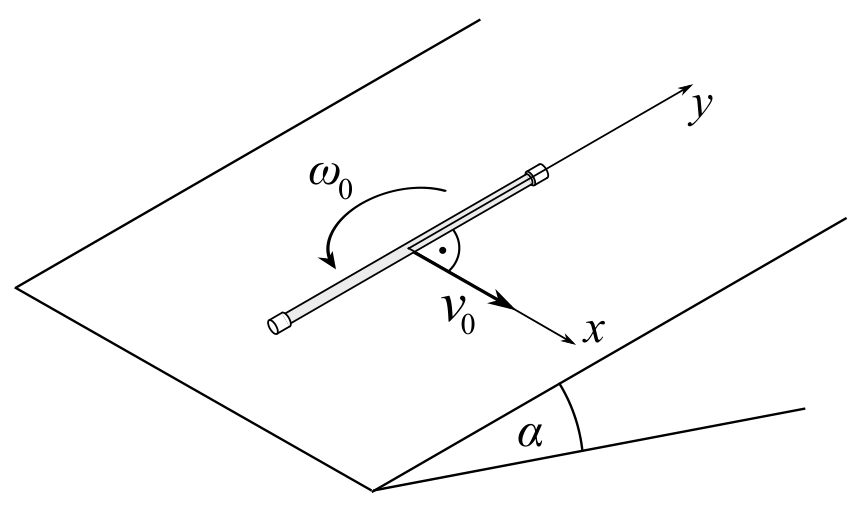
(b) Depending on the magnitude of the and , it can occur, that the center of the rod stops for a moment during its motion. Express the condition(s) for such a behavior using the parameters , , , and ! [0,8 т.]
(c) Determine the maximum displacement of the center of the rod in the direction of the steepest line (-direction) as function of and ! [1,2 т.]
Отговори
- (a)
- (b)
- (c)
Решение
C) a) Equations (1) and (2) are still valid, we only have to fit them to the initial conditions:
b) The velocity of the center of the rod is zero iff
Since , the condition of the stopping of the center of the rod reads
c) We have to distinguish the following two cases: the center of the rod stops for a moment during the motion or not. In the first case, the conservation of mechanical energy tells us that the maximal displacement along the direction is
In the second case (when ), the center of the rod has a finite velocity even at the highest point of its orbit. From the expression of one can see, that at the highest point of the orbit the velocity of the center of the rod is
so the conservation of mechanical energy reads
from which one can get the result
Оригинал в Архива: WoPhO_2011_Q11.pdf · официални решения: WoPhO_2011_S11.pdf