WoPhO 2012, Теория — Задача 1.7
Theoretical 1: Magnetic Monopole · 1,6 т.
Увод
Our everyday experience shows that the magnetic poles always exist in pairs North and South. Breaking a magnet results in the appearance of a new pair of opposite magnetic poles on the two broken ends. The fundamental laws of physics, however, do not contradict the existence of magnetically charged particles called magnetic monopoles. The magnetic monopole is an object possessing just one magnetic pole, either North, or South, which are analogues of the positive and negative electric charges respectively. Thus, the magnetic field of the monopole is similar to the electric field created by a static electric charge, i.e. its force lines begin or end at the point where the monopole is located. This property is in contrast to the closed force lines of the magnetic field created by permanent magnets (magnetic dipoles) and electric currents. The concept of magnetic monopole was introduced in 1932 by the famous physicist Paul Dirac. On the basis of quantum mechanics he proved that the existence of magnetic monopoles can explain the existence of the elementary electric charge. That is why the physicists do not cease their efforts to discover magnetic monopoles experimentally.
In the following questions you are going to establish some properties of the magnetic monopoles by analyzing simple model situations (though experiments). You may assume that all laws of physics known to you apply to the magnetic monopoles, except the statement for closed force lines of the magnetic field. The velocities considered in this problem are much smaller than the speed of light and, therefore, you may neglect the relativistic effects on time, length and mass.
Use the following physical constants in your solution:
- magnetic permeability of vacuum: ;
- electric permittivity of vacuum: ;
- speed of light: ;
- elementary electric charge: ;
- Planks constant: .
Условие
In his famous work on magnetic monopoles Paul Dirac has argued that if just one magnetic monopole existed in the Universe, all electric charges should be multiple of a specific elementary electric charge, whose magnitude is related to the magnetic charge of that monopole. Historically, it is the first hypothesis in physics, which explains the existence of the elementary electric charge.
Consider the system described in Question 6, assuming that all magnetic monopoles existing in the Nature have magnetic charges of the same magnitude, and respectively.
(a) By applying the concepts of quantum physics to the motion of electrically charged particle along the circular orbit, derive a relationship between the elementary electric charge , assumed to be the charge of the electron, and the magnetic charge of the monopole. Calculate numerically. [1,1 т.]
(b) The electron possesses a self magnetic moment of . By assuming that the magnetic properties of the electron are due to a pair of spatially separated point magnetic monopoles of opposite magnetic charges, and respectively; calculate the distance d between these monopoles. [0,5 т.]
Useful math :
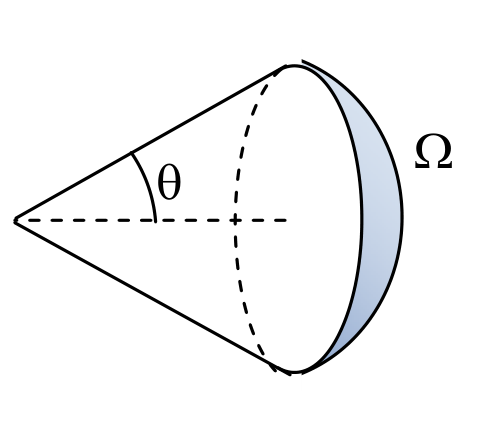
- The solid angle enclosed by a cone of half-opening angle (see the Figure 5) is:
- Depending on your approach to the solution you may need the following integral:
Отговори
- (a)
- (b)
Решение
a. According to the Bohr’s quantization rule, the change of the angular momentum along a specified axis is a multiple of the reduced Plank’s constant:
By utilizing the expression for , derived in the last question, we obtain:
This result implies that the electric charge is multiple of a universal elementary electric charge . If we identify the elementary electric charge with the charge of the electron, we can find the magnitude of the magnetic charge of the monopole:
b. If the magnetic moment of the electron is due to a pair of opposite magnetic charges then the following relation holds true:
Marking scheme
| Question | Element of the solution | Points | Comments |
|---|---|---|---|
| 7 a | Applies the Bohr's rule for quantization of the angular momentum | 0.5 | Alternatively: States that the perimeter of the orbit is a multiple of de Broglie wavelength |
| Expresses the electric charge as a multiple of | 0.2 | ||
| Provides correct expression for the magnetic charge of the monopole | 0.2 | ||
| Calculates numerically | 0.2 | ||
| Subtotal on Question 7 a | 1.1 | ||
| 7 b | Provides an expression for the magnetic dipole moment of the electron through the charge of the monopoles and the distance between them | 0.3 | |
| Calculates numerically | 0.2 | ||
| Subtotal on Question 7 b | 0.5 | ||
| Total score for the Problem | 10.0 |
Оригинал в Архива: WoPhO_2012_Q11.pdf · официални решения: WoPhO_2012_S11.pdf