WoPhO 2012, Теория — Задача 2. Vertical Well
Theoretical 2: Physics of the Oil and Gas Production
Условие
Often the reservoir can be modeled as a cylinder (see Figure 7). For this problem all properties were averaged out as in the previous part, so the reservoir is assumed homogeneous with uniform permeability . Oil can be viewed as an incompressible fluid with viscosity . Because the rocks above and below the reservoir are impermeable and the height of the cylinder is much less than its radius (), one can conclude that the fluid flows only in the radial direction.
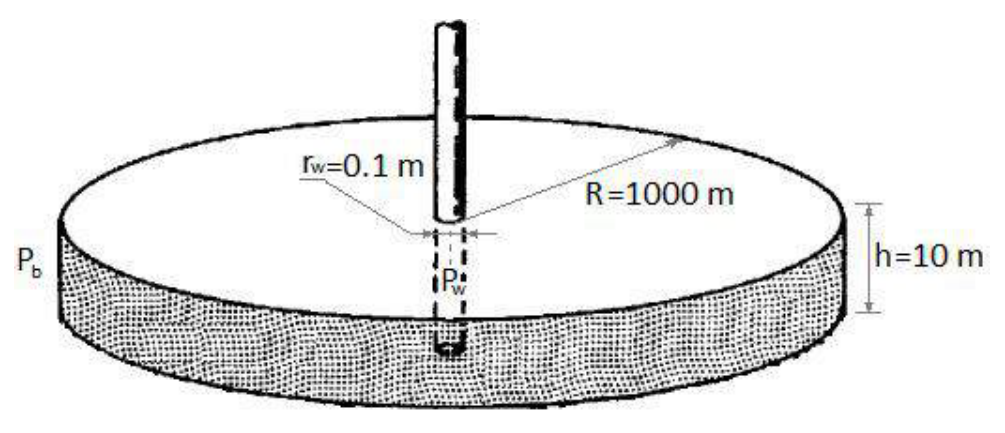
(a) Find the velocity of the oil inside the well with radius m, if the flow rate is 30 . Estimate the fluid velocity in the reservoir near the well . [0,4 т.]
(b) The calculated fluid velocity in the reservoir is rather small therefore the reservoir pressure can be treated as a constant for several months or even years, especially if the reservoir is connected with an underground source of water. Let be the pressure at the outer boundary of the reservoir and be the pressure at the bottom of the well. In this part assume that both and are constants (time-independent values), as well as the radial pressure distribution.
Calculate pressure drop , which is required to produce oil with flow rate . [1 т.]
(c) Make a sketch of pressure distribution in the reservoir as a function of the distance from the well. [0,4 т.]
Отговори
- (a)
- (b)
Решение
2.1
Velocity at the reservoir is very small, however it depends on the definition of the fluid velocity in the reservoir. Actually fluid particles moves a few orders of magnitude faster than Darcy’s velocity .
2.2 For incompressible fluid
Rearranging variables
Finally
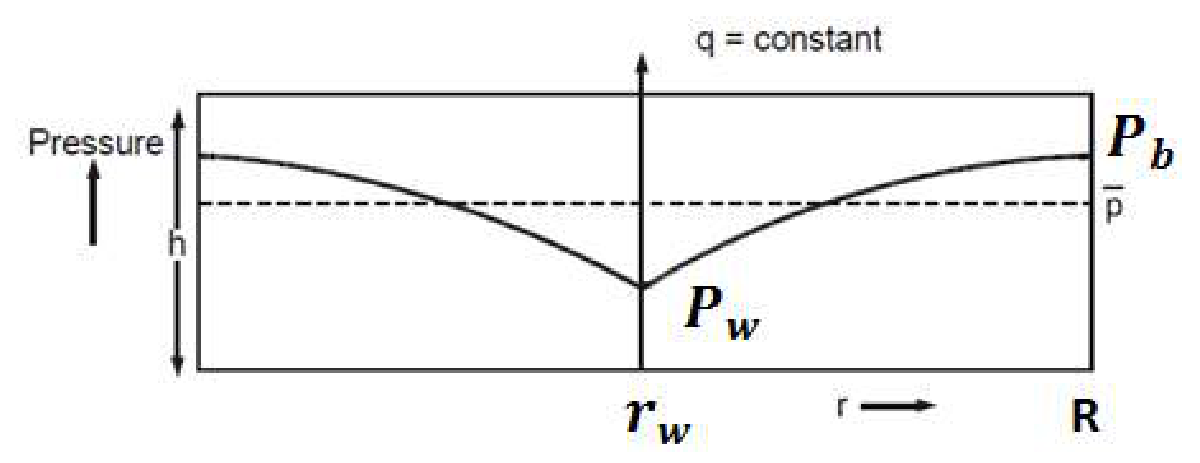
2.3
Оригинал в Архива: WoPhO_2012_Q12.pdf · официални решения: WoPhO_2012_S12.pdf