WoPhO 2012, Теория — Задача 3.2. The shape of tornado
Theoretical 3: Tornado
Внимание: Бележка към темата
The official solutions (Ver. 1.1, June 2012) label their sub-parts differently from the problem sheet: under [Q.2], (a) answers question 2(c), (b) answers 2(b), (c) answers 2(d) and (d) answers 2(e); under [Q.3], (a) answers question 2(a), and (b)–(e) answer 3(a)–3(d). The solutions are reproduced with their printed labels.
Условие
Inside the tornado’s core the water vapor condenses into liquid droplets as the air spirals into the core forming condensation funnel. The water vapor condenses when the temperature drops below certain point called dew point. This temperature drop is caused by pressure drop. Thus the region where the water vapor starts to condense marks a boundary of equal pressure called isobar boundary layer that stretches from the base of the cumulonimbus cloud down to the base of tornado (shown as red boundary in Figure 2). This is the boundary between region I and II.
Now only consider region I. Consider a reference point G (Fig. 2) very close to the ground () located at radius . The speed can be treated as the ground rotation speed of the tornado.
We further assume: (i) The tornado is stationary (only has rotation and no translation); (ii) The wind radial velocity is negligible. Velocity is only tangential (along the circle), not radial. (iii) The wind velocity is independent of altitude , it only depends on the radial position . (iv) We ignore turbulence very close to the ground. (v) We assume air mass density () is constant.
(a) Show that in both region I and II along :
[0,4 т.]
(b) In region I calculate the tangential wind velocity as a function of and in terms of and (velocity and radius at the core boundary)at any given altitude ()! [0,5 т.]
(c) Estimate the air speed at the base of tornado at point G! [0,5 т.]
(d) Derive the shape of the condensation funnel or the tornado core i.e. the function , express them in terms of and and altitude ! Plot or sketch this tornado shape in dimensionless quantities vs. , where is the height defined in Fig. 2! [2 т.]
(e) Most tornadoes look like funnel (the radius is larger at higher altitude) while some is more uniform in diameter like a pipe. Given everything the same, which one do you think has the higher ground rotation speed ? [0,5 т.]
Отговори
(a) Derived in the official solutions under [Q.3] (a), Eq. (16)–(17).
(b)
(c) 137 m/s
Official solution [Q.2] (a), Eq. (9).
(d)
Official solution [Q.2] (c), Eq. (15).
(e) The more uniform, pipe-like tornado has the higher ground rotation speed.
Official solution [Q.2] (d).
Решение
(a) Because point G is in the isobar boundary layer we have: . Using Bernoulli’s equation at point A and G, and assuming constant air mass density :
which is within the range of speed for a deadly tornado ( m/s).
(b) Due to conservation of angular momentum we have (using point G as a reference or any point P at altitude ) :
Thus:
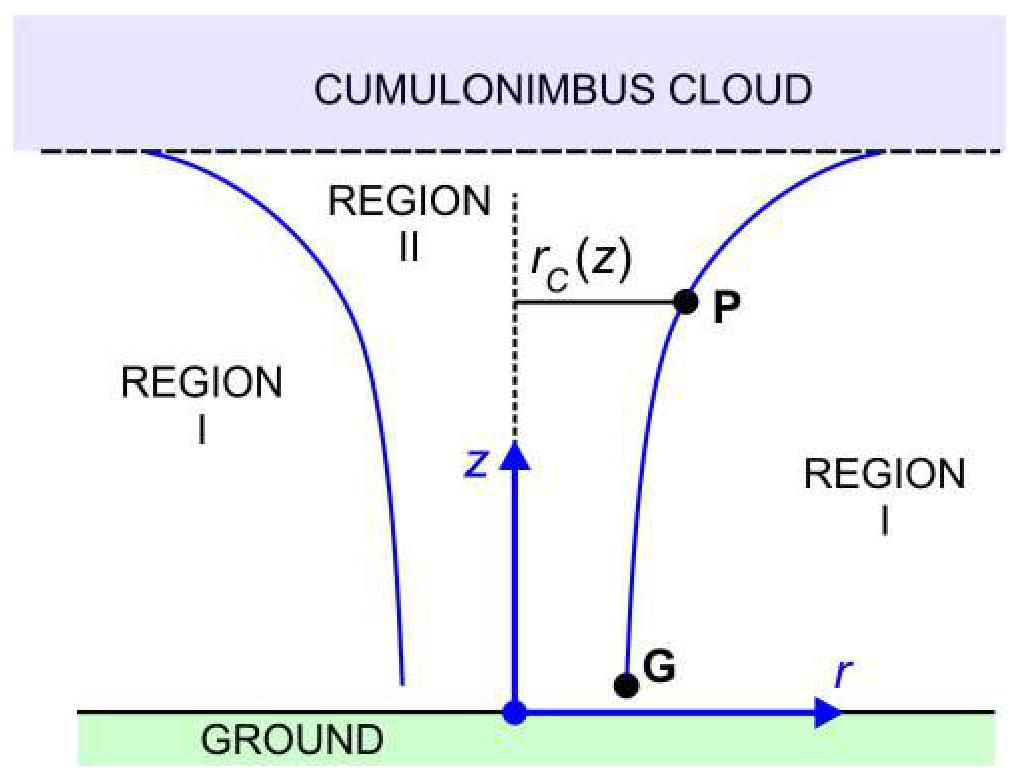
(c) Consider point P along the boundary between region I and II as shown above. This boundary layer is also an isobar boundary layer thus . We have:
From part (b) we have: . Note that is only a function of not altitude as stated in the problem. Thus we have:
Alternatively we can express the tornado shape as a function of radius versus altitude below and plot it in Figure 3 below.
As we can see, in comparison with a real life tornado picture, this equation describe the general feature of tornado shape remarkably well despite a very simple model.
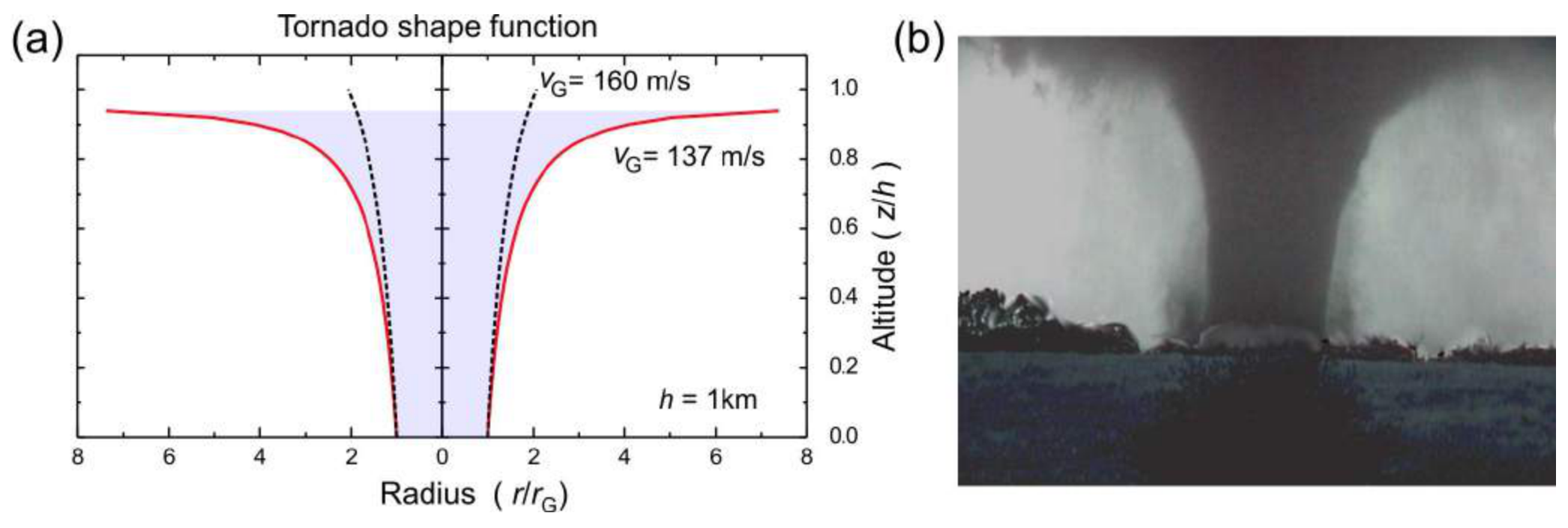
(d) Higher speed will make the term in Eq. (15) smaller, thus becomes a weaker function of , in other words the tornado shape becomes more uniform or pipe-like. This is also illustrated in Figure 3(a).
Оригинал в Архива: WoPhO_2012_Q13.pdf · официални решения: WoPhO_2012_S13.pdf