WoPhO 2012, Теория — Задача 3.3. The core of tornado
Theoretical 3: Tornado
Внимание: Бележка към темата
The official solutions (Ver. 1.1, June 2012) label their sub-parts differently from the problem sheet: under [Q.2], (a) answers question 2(c), (b) answers 2(b), (c) answers 2(d) and (d) answers 2(e); under [Q.3], (a) answers question 2(a), and (b)–(e) answer 3(a)–3(d). The solutions are reproduced with their printed labels.
Условие
We will try to calculate the pressure at the center of tornado. Now we will consider both region I and II.
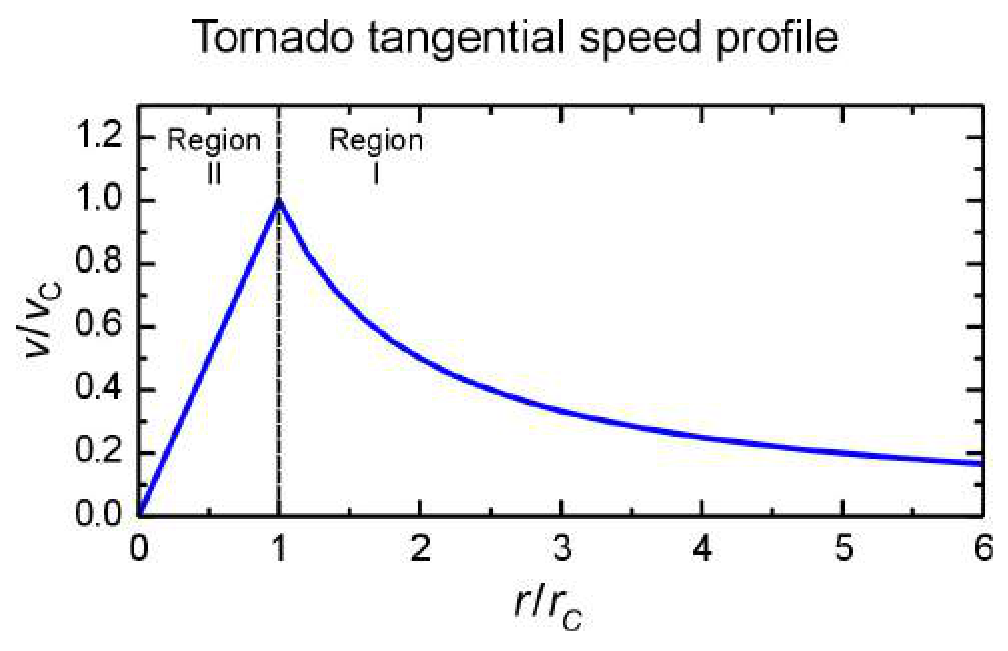
(a) In region II () the tornado core behaves as rigid body, derive expression for the (tangential) speed in this region. Plot the velocity profile from to ! [1,1 т.]
(b) Calculate the pressure at the center of the tornado (point C, at the same altitude as point G! Use from part 2(c)! [1,2 т.]
(c) Estimate the temperature at the center of the tornado (point C)! [0,5 т.]
(d) Based on your finding in (c) suggest in only few words what could be a possible source of tornado’s tremendous energy! [0,3 т.]
Отговори
(a)
Official solution [Q.3] (b), Eq. (18).
(b) 77477 Pa
Official solution [Q.3] (c): Pa.
(c) 268 K
Official solution [Q.3] (d): 268 K = -5 °C.
(d) Latent heat released by condensation of moisture sucked into the cold core.
Official solution [Q.3] (e).
Решение
(a) Consider a parcel of air rotating around the tornado as shown below:
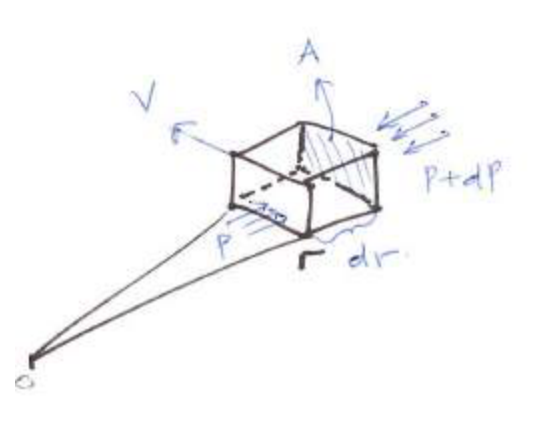
The differential pressure exerts the centrifugal force to the air parcel:
Thus we have:
(b) Because the core is approximated as a rigid body, the angular velocity is constant everywhere inside the core, given as: . Thus the velocity at any point inside the tornado:
So unlike in region I, in the core (region II) the velocity is proportional to the radius. The overall tangential velocity profile is given below:
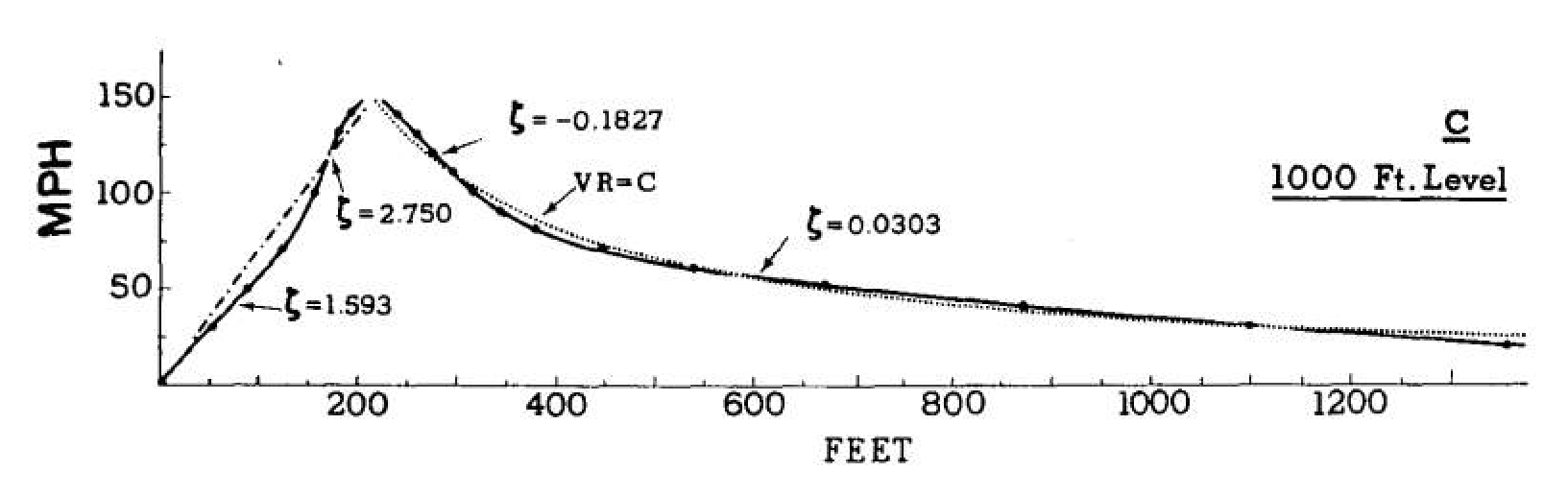
Note that this model is in reasonably good qualitative agreement with an actual tornado measurement as shown below:
(c) The pressure inside the tornado can be calculated with respect to a far away reference point on the ground where and using point G as a reference:
The pressure inside tornado is given as:
With the given data:
(d) Using ideal gas law and adiabatic assumption we have:
where is the heat capacity ratio which is for air : .
Assuming a far away point with pressure and temperature , the temperature at the core of tornado is:
Indeed it is very cold inside the tornado.
(e) Such a low temperature will cause condensation of moisture that get sucked into the tornado core, and the condensation will release latent heat. Multiplied by massive influx of air mass to the tornado –this latent heat could provide the tremendous energy for the tornado.
Оригинал в Архива: WoPhO_2012_Q13.pdf · официални решения: WoPhO_2012_S13.pdf