APhO 2007, Теория — Задача 3A. Average contribution of each electron to specific heat of free electron gas at constant volume
Theoretical Problem 3 · 5 т.
Условие
1. According to the classical physics the conduction electrons in metals constitute free electron gas like an ideal gas. In thermal equilibrium their average energy relates to temperature, therefore they contribute to the specific heat. The average contribution of each electron to the specific heat of free electron gas at constant volume is defined as
where is the average energy of each electron. However the value of the specific heat at constant volume is a constant, independent of temperature. Please calculate and the average contribution of each electron to the specific heat at constant volume . [1 т.]
2. (1) Experimentally it has been shown that the specific heat of the conduction electrons at constant volume in metals depends on temperature, and the experimental value at room temperature is about two orders of magnitude lower than its classical counterpart. This is because the electrons obey the quantum statistics rather than classical statistics. According to the quantum theory, for a metallic material the density of states of conduction electrons (the number of electronic states per unit volume and per unit energy) is proportional to the square root of electron energy , then the number of states within energy range for a metal of volume can be written as
where is the normalization constant, determined by the total number of electrons of the system.
The probability that the state of energy is occupied by electron is
where is the Boltzmann constant and is the absolute temperature, while is called Fermi level. Usually at room temperature is about several eVs for metallic materials (1eV= J). is called Fermi distribution function shown schematically in the figure below.
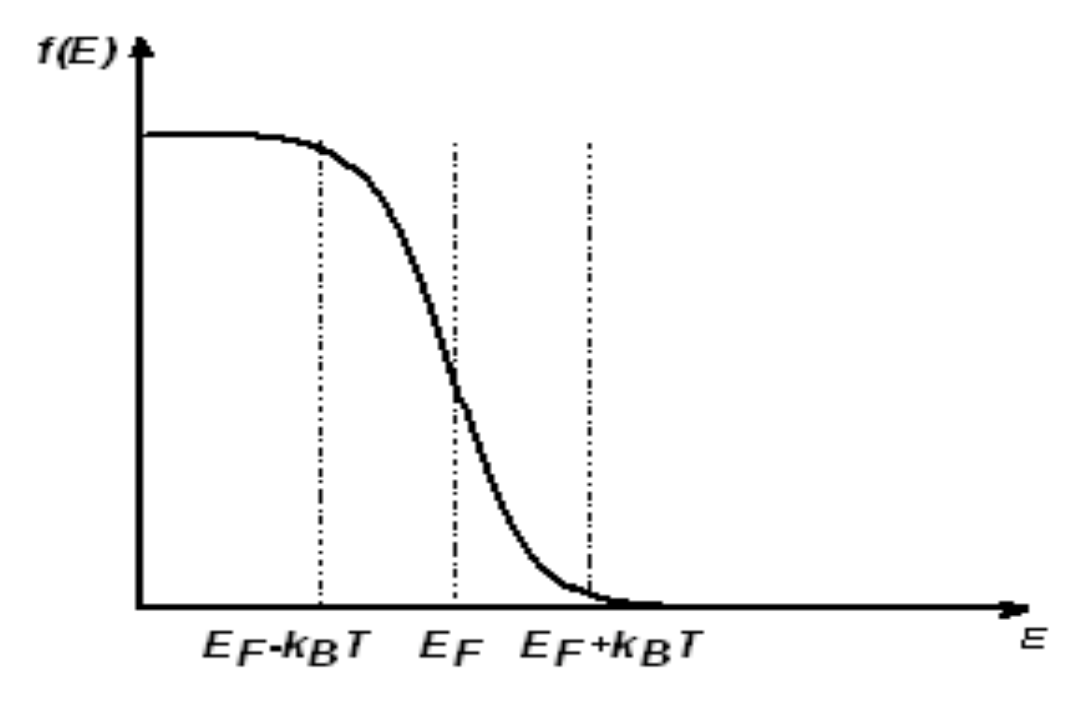
Please calculate at room temperature according to [3,5 т.]
2. (2) Please give a reasonable explanation for the deviation of the classical result from that of quantum theory. [0,5 т.]
Note: In your calculation the variation of the Fermi level with temperature could be neglected, i.e. assume , is the Fermi level at 0K. Meanwhile the Fermi distribution function could be simplified as a linearly descending function within an energy range of around , otherwise either 0 or 1, i.e.
At room temperature , therefore calculation can be simplified accordingly. Meanwhile, the total number of electrons can be calculated at 0K.
Отговори
- 1.
- 2. (1)
Решение
3A. Average specific heat of each free electron at constant volume
(1). Each free electron has 3 degrees of freedom. According to the equipartition of energy theorem, at temperature its average energy equals to , therefore the average specific heat equals to
(2). Let be the total energy of the electron gas, then
where is the total number of the electronic states, the electron energy.
Substitution of (1) for in the above expression gives
where represents the integral
Usually at room temperature . Therefore, with the simplified
can be simplified as
Therefore
However the total electron number
where is the Fermi level at 0K, leading to
Taking , and ,
(3). Because at room temperature =0.026eV while Fermi level of metals at room temperature is generally of several eVs, it can be seen from the above expression that according to the quantum theory the calculated average specific heat of each free electron at constant volume is two orders of magnitude lower than that of the classical theory. The reason is that with the temperature increase the energy of those electrons whose energy is far below Fermi level (several times of less than ) does not change obviously, only those minor electrons of energy near contribute to the specific heat, resulting in a much less value of the average specific heat.