GPhO 2016, Експеримент — Задача 1. Rolling cylinder
The 1st Gulf Physics Olympiad — Experimental Competition · 22 март 2016 г. · 7 т.
Указания
- The examination lasts for 5 hours. There are 2 problems worth in total 20 points.
- Initially the experimental equipment on table is covered. You must neither remove the cover nor open the envelope with the problems before the sound signal of the beginning of competition.
- You are not allowed to leave your working place without permission. If you need any assistance (malfunctioning equipment, broken calculator, need to visit a restroom, etc), please raise and keep your hand raised until an organizer arrives.
- Use only the front side of the sheets of paper.
- For each problem, there are dedicated Solution Sheets (see header for the number and pictogramme). Write your solutions onto the appropriate Solution Sheets. For each Problem, the Solution Sheets are numbered; use the sheets according to the enumeration. Always mark which Problem Part and Question you are dealing with. Copy the final answers into the appropriate boxes of the Answer Sheets. There are also Draft papers; use these for writing things which you don’t want to be graded. If you have written something that you don’t want to be graded onto the Solution Sheets (such as initial and incorrect solutions), cross these out.
- If you need more paper for a certain problem, please raise your hand and tell an organizer the problem number; you are given two Solution sheets (you can do this more than once).
- You need to estimate uncertainties only in those cases where you are specifically asked to do so.
- You should use as little text as possible: try to explain your solution mainly with equations, numbers, symbols and diagrams. Though in some places textual explanation may be unavoidable.
- Do not look into the laser beam or its reflections! It may permanently damage your eyes.
- After the signal signifying the end of examination you must stop writing immediately. Put all the papers into the envelope at your desk. You are not allowed to take any sheet of paper out of the room. If you have finished solving before the final sound signal, please raise your hand.
Условие
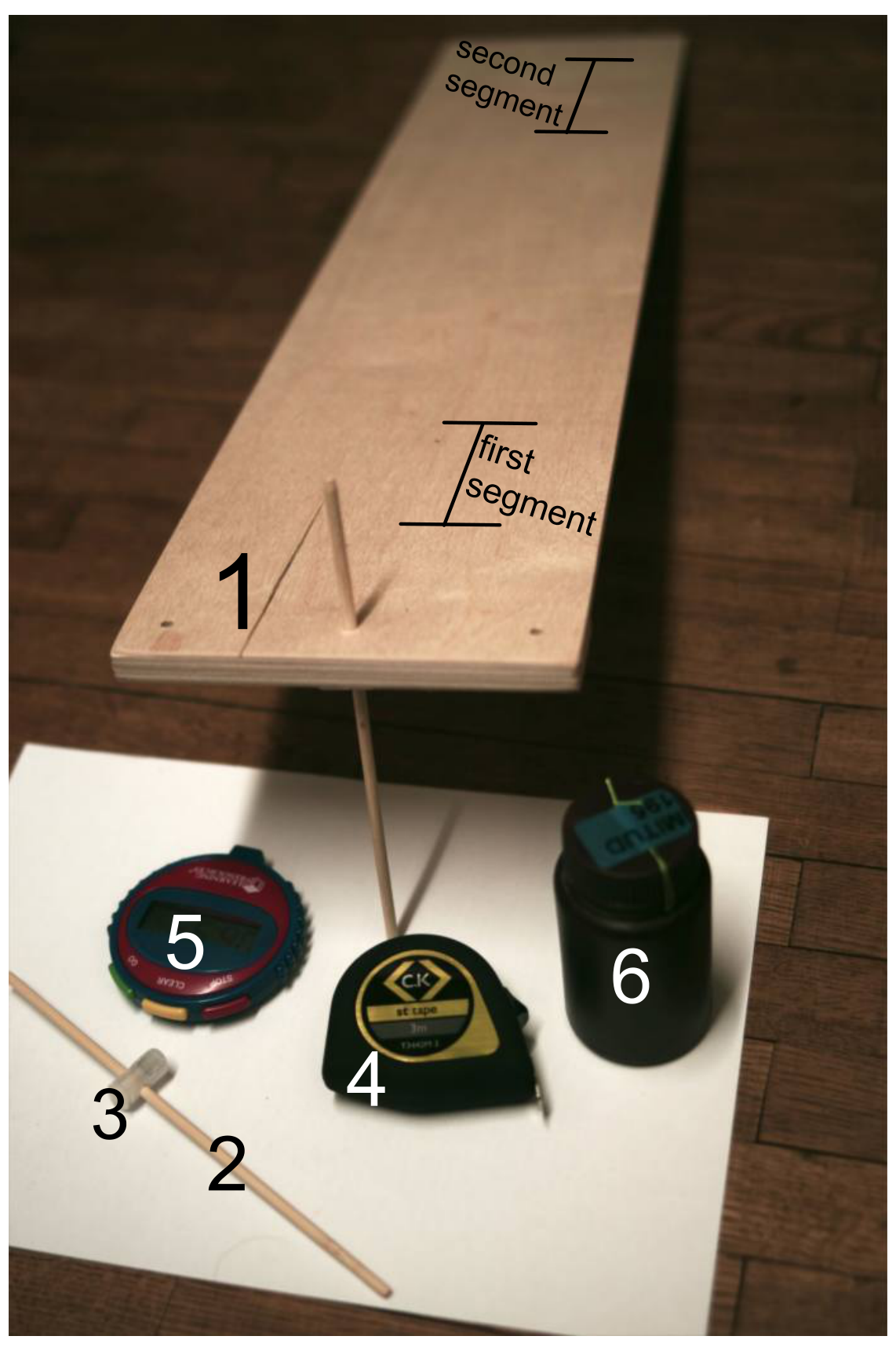
The setup comprises of 1 a wooden board with holes drilled into its one end (the highlighted numbers correspond to the numbers in the fig.), 2 two sticks which can be put through the board’s holes; this way one end of the board can be kept in an elevated position, 3 two clamps which can be mounted onto the sticks and will support the board beneath it, 4 measuring tape, 5 stopwatch (press “go” to start measuring, “stop” to record time, and “clear” to reset screen to zero), and 6 a cylindrical bottle with an unknown amount of unknown liquid. You are not allowed to open the bottle (the bottle is secured with a sticker which, once removed, cannot be fixed back).
Numerical values for your calculations: Mass of the bottle (together with the liquid inside) . Free fall acceleration .
The properties of the liquid inside the bottle depend on temperature. To avoid heating it, keep it in your hands as briefly as possible.
When the cylinder is put onto an inclined surface, there are four possibilities what can happen.
A, if the inclination angle (the angle between the surface normal and the vertical direction) is very small, , it will remain in a resting position.
B, for moderately small inclination angles, , the cylinder will roll down with an almost constant speed (if the angle is very close to the critical value , the motion may be slightly uneven: the cylinder almost stops, but shortly after, resumes again rolling motion).
C, for , once the cylinder (lying on the surface) is released, it first obtains an almost constant rolling speed; this speed is achieved very fast, upon rolling to the distance of the order of the cylinder’s diameter. However, that speed will slowly increase during the course of subsequent rolling. The rolling speed grows slowly because the liquid inside the bottle will be smeared around the walls of the bottle (smearing will not take place for ).
D, for , bottle rolls from the beginning to end with an acceleration (rolling with an almost constant speed can never be observed).
Part A. Critical slopes Make measurements to determine the critical slopes and . State the values of and (in degrees) together with uncertainties. Note that the measurement of will not be very precise because the crossover from regime C to regime D is not very sharply defined. [1 т.]
Part B. Rolling speed Fix the board to a certain angle with and put the cylinder onto the board near the upper edge of the board; you will be releasing the cylinder from this position during the forthcoming measurements (the cylinder will be rolling downwards). From this position, measure downwards, and with a pencil, make a mark onto the boards. Make a next mark to a distance downwards from the first mark. These two marks define the first = -long-segment. When the cylinder starts rolling from the edge of the board, it will obtain a constant speed once reaching the segment. Mark a similar segment close to the lower edge of the board. Release the cylinder from a point near the upper edge of the board; measure and tabulate the data for calculating the rolling speed on both segments, as well as for the average rolling speed over the long segment from the beginning of the upper segment to the end of the lower segment. Based on your measurement data, determine the critical angle . [3 т.]
Part C. Friction force In order to keep the cylinder rolling with a constant speed , a force needs to be applied. This force depends on the rolling speed , and on the time elapsed from the moment when rolling started. So, . The dependence of on is such that at very small values of , grows, achieves then a maximal value , and may slowly decrease later. Based on the measurements of the previous task, calculate and tabulate for different values of . Plot this dependence on a graph, and suggest a formula which describes such a dependence. [2,3 т.]
Part D. Mass of liquid Based on your measurement data for the previous tasks, estimate the mass of liquid inside the bottle. [0,7 т.]
Отговори
Part A. Critical slopes α0 ≈ 2.1° (within 2.1° ± 0.2°); α2 ≈ 14.5° (within 14.5° ± 3°)
Part B. Rolling speed 6.2 °
Part C. Friction force
Part D. Mass of liquid 12.5 g
ml = M sin α2
Решение
Problem E1. Rolling cylinder ( points)
Part A. Critical slopes (1 points)
We measure the board length , (0.1 pts) its uncertainty .
Further we determine the steepest position of the board where the cylinder’s rolling stops when it is pushed downwards, and measure the difference between the heights and of the upper and lower edges of the upper surface of the board. We find (0.1 pts)
and (0.1 pts)
so that . Finally, we calculate angles according to the formula ; the final result needs to be within . (0.1 pts)
We repeat measurements: find the critical positions of the slope and measure . Three or more measurements (0.1 pts)
We do the same for the second critical angle: if the result is within , and ; the final result needs to be within . (0.1 pts)
if three or more measurements were done. (0.1 pts)
Error estimates: and uncertainties are estimated as or . (0.1 pts)
uncertainty when determining is estimated in the range from to , and when determining — in the range from to . (0.1 pts)
This estimation can be done based on the standard deviation of the repeated measurements.
For small angles, in radians so that
and , numerically and . If both calculations are made reasonably (it is also OK to apply addition of errors by modulus, instead of the Pythagorean rule, or upper-lower bound method) and without mistakes (0.1 pts)
Part B. Rolling speed (3 points)
We take first segment close to the upper edge of the board, and second segment close to the lower end of the board, so that . Then the data will be as follows
| (mm) | (s) | (mm/s) | (s) | (mm/s) | (s) | (mm/s) |
|---|---|---|---|---|---|---|
| 2.6 | 64.8 | 1.54 | 64.5 | 1.55 | 388.2 | 1.55 |
| 3 | 15.2 | 6.6 | 15.2 | 6.6 | 91.2 | 6.58 |
| 3.5 | 7.2 | 13.9 | 7.4 | 13.5 | 43.8 | 13.7 |
| 4 | 4.52 | 22.1 | 4.38 | 22.8 | 26.46 | 22.7 |
| 4.5 | 3.41 | 29.3 | 3.53 | 28.3 | 20.7 | 29.0 |
| 5 | 2.86 | 35.0 | 2.97 | 33.7 | 17.22 | 34.8 |
| 5.5 | 2.27 | 44.1 | 2.31 | 43.3 | 13.56 | 44.2 |
| 6 | 1.78 | 56.2 | 1.65 | 60.1 | 10.14 | 59.2 |
| 6.5 | 1.51 | 66.2 | 1.35 | 74.1 | 8.46 | 70.9 |
| 7 | 1.35 | 74.1 | 1.02 | 98.0 | 7.02 | 85.5 |
| 7.5 | 1.31 | 76.3 | ||||
| 8 | 1.21 | 82.6 | ||||
| 8.5 | 1.09 | 91.2 | ||||
| 9 | 0.98 | 102 | ||||
| 9.5 | 0.92 | 109 | ||||
| 10 | 0.84 | 119 | ||||
| 10.5 | 0.78 | 128 | ||||
| 11 | 0.72 | 139 |
As we can see, the rolling time for the first and second segments start departing at , which gives us the critical slope .
Grading: at least 10 plausible time values for the first segment; (0.8 pts)
If less than 10 time values are taken, no credit is given if the number of measurements is less than 3; each next plausible time value earns a partial credit. (0.1 pts)
At least 10 speed values are correctly calculated; (0.5 pts)
If less than 10 time values are taken, no credit is given if the number of measurements is less than 2; each next pair of correctly calculated speed value earns a partial credit. (0.1 pts)
At least 6 plausible time values for the second segm.; (0.4 pts)
If less than 6 time values are taken, no credit is given if the number of measurements is less than 3; each next plausible time value earns a partial credit. (0.1 pts)
At least 6 speed values are correctly calculated; (0.2 pts)
If less than 6 time values are taken, no credit is given if the number of measurements is less than 2; each next pair of correctly calculated speed value earns a partial credit. (0.1 pts)
At least 6 plausible time values for the long segment; (0.4 pts)
If less than 6 time values are taken, no credit is given if the number of measurements is less than 3; each next plausible time value earns a partial credit. (0.1 pts)
At least 6 speed values are correctly calculated; (0.2 pts)
If less than 6 time values are taken, no credit is given if the number of measurements is less than 2; each next pair of correctly calculated speed value earns a partial credit. (0.1 pts)
For the second segment, time values are taken for all those values of for which there is no significant time difference between the first segment, and additionally, at time values for at least two next values of are measured. (0.2 pts)
For the long segment, speed values are calculated for all those values of for which there is no significant time difference between the first segment. (0.2 pts)
Value is reported. (0.2 pts)
If the reported value does not fall into this range, but falls into , partial credit is given. (0.1 pts)
Part C. Force as a function of speed (2.3 points)
What keeps the cylinder in motion is that component of gravity force which is parallel to the board surface, . In those cases when the force depends significantly on time, we need to take data of the first segment since at the beginning of rolling, the friction force is maximal.
| Rolling height (mm) | Rolling speed (mm/s) | Force applied (): (mN) |
|---|---|---|
| 2.6 | 1.55 | 16.3 |
| 3 | 6.58 | 18.6 |
| 3.5 | 13.7 | 22.0 |
| 4 | 22.7 | 25.1 |
| 4.5 | 29.0 | 28.2 |
| 5 | 34.8 | 31.4 |
| 5.5 | 44.2 | 34.6 |
| 6 | 56.2 | 37.7 |
| 6.5 | 66.2 | 40.8 |
| 7 | 74.1 | 44.0 |
| 7.5 | 76.3 | 47.1 |
| 8 | 82.6 | 50.2 |
| 8.5 | 91.2 | 53.4 |
| 9 | 102 | 56.5 |
| 9.5 | 109 | 59.7 |
| 10 | 119 | 62.8 |
| 10.5 | 128 | 66.0 |
| 11 | 139 | 69.1 |
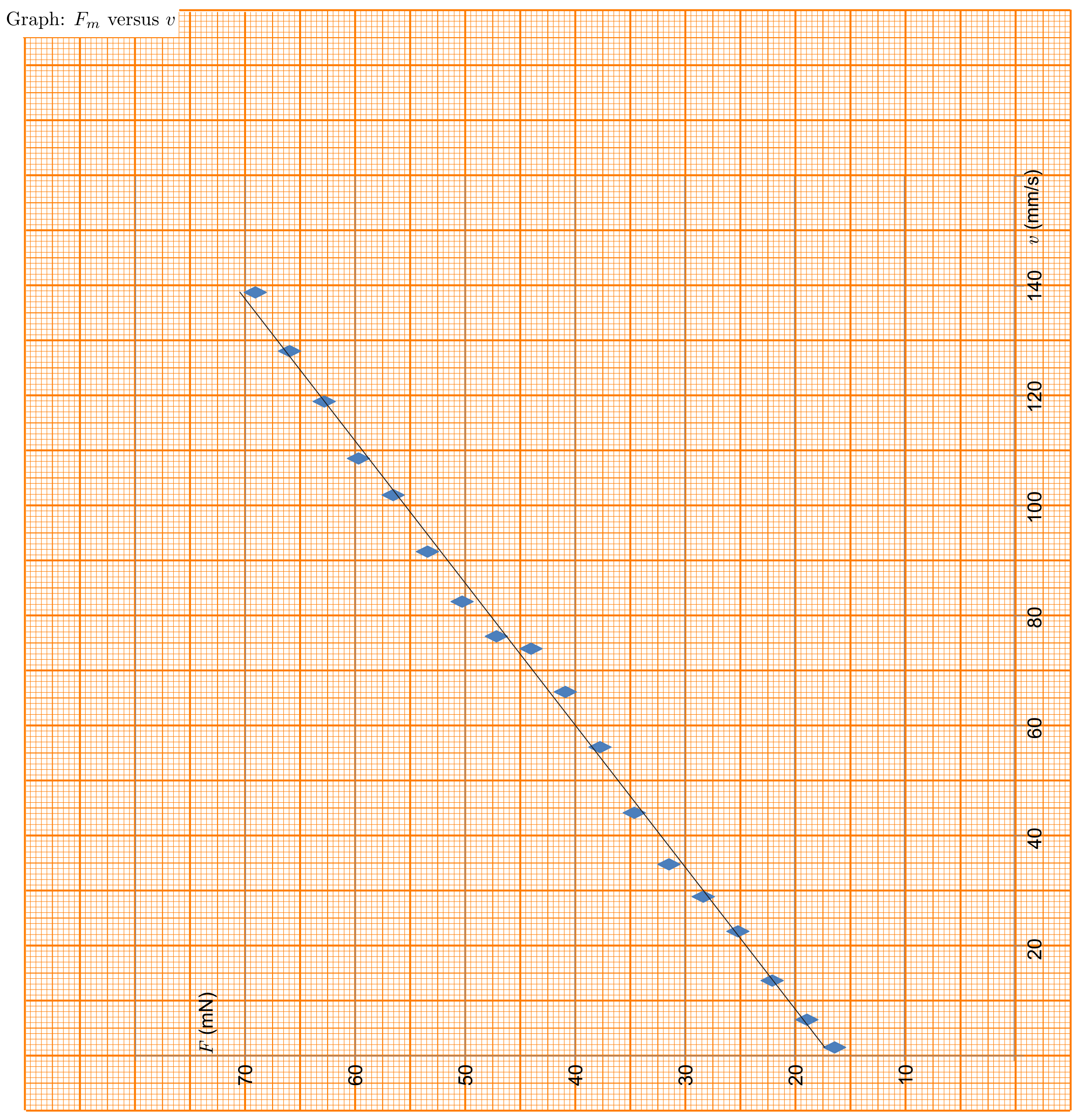
Based on these data, we build a graph, see next page. As one can see, the data lie on a line, which is described by the following law:
where and . Grading: At least 5 correct data points in table for (0.6 pts)
(force calculated correctly, speeds copied from the column. Partial credit: less than 3 data points — no credit; each next correctly copied speed value earns a partial credit; (0.1 pts)
each next correctly calculated force value deserves a partial credit. (0.1 pts)
If speed values are copied from the column of or , 0.1 pts if four or more values are copied.
At least 5 correct data points in table for (0.6 pts)
(force calculated correctly, speeds copied from the column. Partial credit: less than 3 data points — no credit; each next correctly copied speed value earns a partial credit; (0.1 pts)
each next correctly calculated force value deserves a partial credit. (0.1 pts)
If speed values are copied from a wrong column — no credit.
Graph: axis marked and labelled correctly. (0.1 pts)
Scale on graph selected reasonably (the area of the smallest rectangle wich covers all the data is at least one third of the total graphical paper area. (0.1 pts)
At least 5 correctly marked data points on graph for — full credit. (0.3 pts)
Partial credit: less than 3 data points — no credit; each next correctly marked data point earns a partial credit; (0.1 pts)
At least 5 correctly marked data points on graph for — full credit. (0.3 pts)
Partial credit: less than 3 data points — no credit; each next correctly marked data point earns a partial credit; (0.1 pts)
Correctly deduced functional dependence
; (0.1 pts)
; (0.1 pts)
. (0.1 pts)
Part D. Mass of liquid (0.7 points)
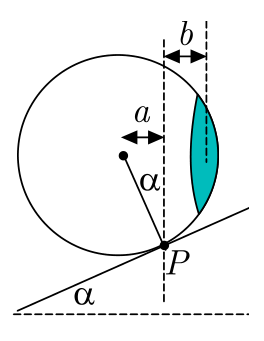
At the critical angle , all the liquid will roll up and provide strongest resistance against rolling when the line connecting the middle point of the liquid and the centre of the cylinder form a vertical line, see figure. At larger angles, this position does not provide enough torque to stop downwards acceleration. Then, the centre of mass of the whole system must lay directly above the point , therefore , where is the mass of liquid. Since and (we neglect the thickness of the layer of liquid), we obtain , hence . Grading: realizing that the ratio is related to the critical angle . (0.3 pts)
Obtaining quality . (0.2 pts)
Correct numerical calculation. (0.2 pts)
Оригинал в Архива: exp.pdf · официални решения: exp_sol.pdf