IAO 1998, Практически тур — Задача 2. Mass of a Galaxy
III International Astronomy Olympiad
Внимание: Бележка към темата
The source prints the unit of G as dyn·cm²·g² and the key prints V_R = c·Δλ₁/λ₀·2 without grouping the final factor. These source expressions are retained as printed; they should not be read as corrected formulas.
Условие
The spiral galaxies which are seen edge-on, are very suitable for determining their masses. A catalogue of such galaxies was created by I. D. Karachencev and his collaborators and mass spectroscopy was performed. The spectrum of one of them, FGC 1908, is shown below. It was obtained on 4.03.1997 using a spectrograph placed in the prime focus of the 6-meter telescope in the SAO. The spectrograph's slit, as the figure shows, was oriented along the galaxy's major axis. The straight lines going across the spectrum are the night sky's emissions. The other emissions belong to the galaxy and their laboratory wave lengths are specified. For calculating of the galaxy's mass in SAO the value of the Hubble's constant was used.
You are proposed to repeat the estimate of the galaxy's mass. We remind that , the Sun's mass is and the gravitation constant is .
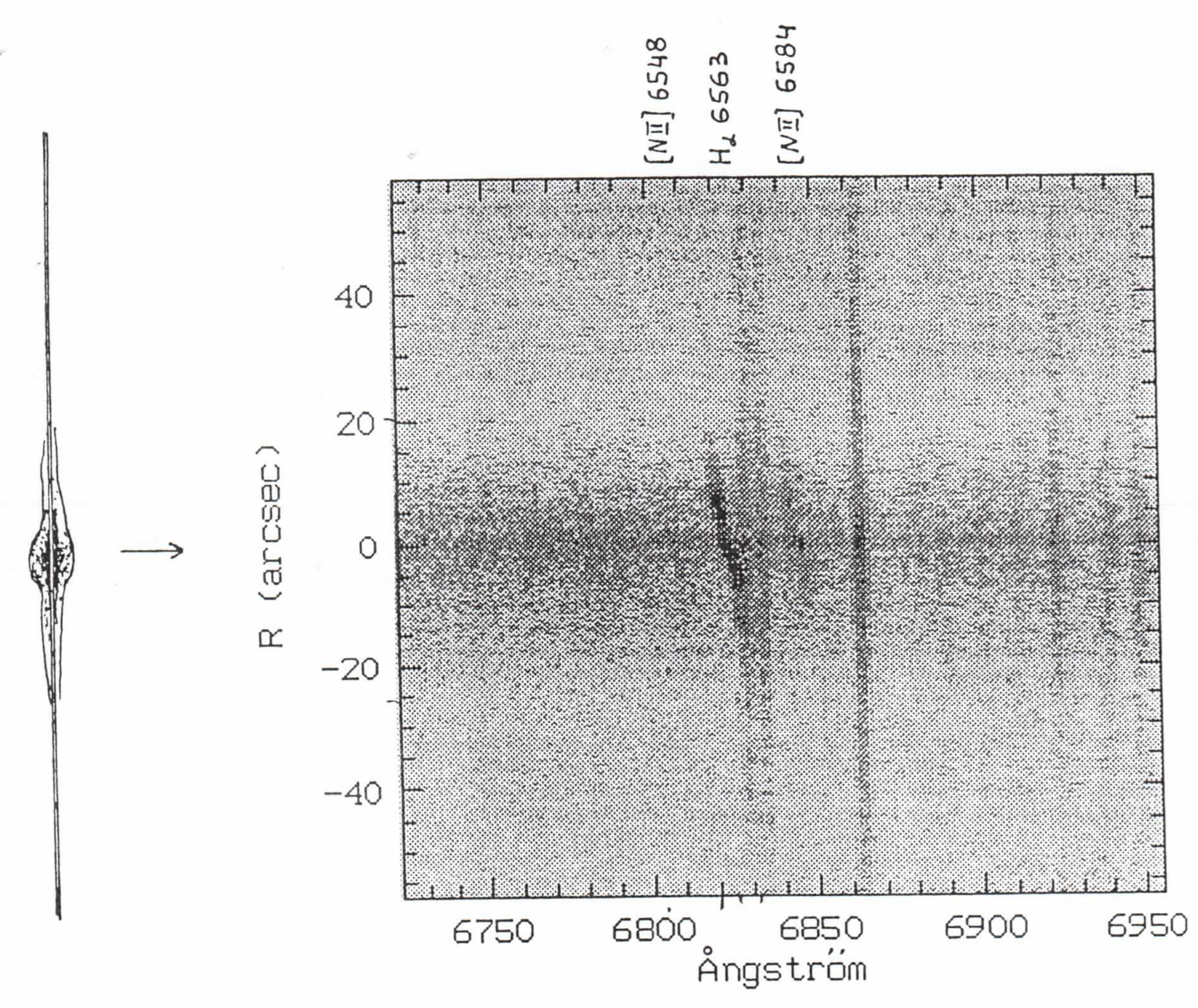
1 Explain why the two-dimensional spectrum of the galaxy looks like this.
2 Estimate the mass of FGC 1908 and compare it with the mass of our own Galaxy.
3 Specify the possible inaccuracies of your estimate.
Решение
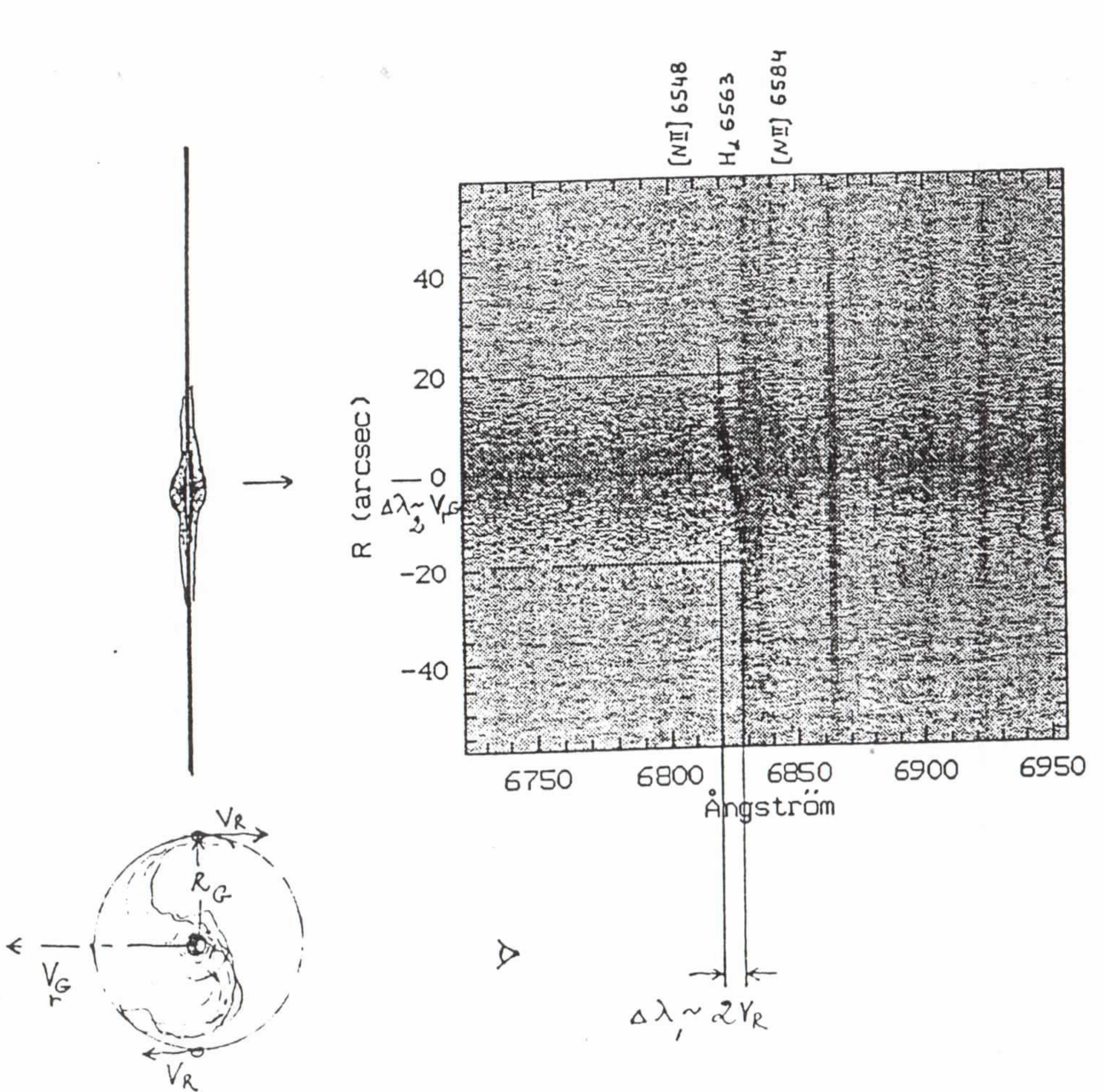
The explaining figures show that for the point on the galaxy periphery we have:
where
and
The line with is selected for measurements as the most extended and therefore it fixes the significant part of the galaxy mass. , i.e. it is less than our Galaxy both by the size and by the mass.
Оригинал в Архива: en1.jpg · официални решения: practsol.jpg · допълнителни данни: en2.jpg · допълнителни данни: practdata1.jpg · допълнителни данни: practdata2.jpg