IAO 2007, Практически тур, Група β — Задача 7. Лъчева скорост.
Практически тур · 29 септември 2007 г.
Note for jury and team leaders
Note for jury and team leaders. The proposed sketches are not full; the team leaders have to give more detailed explanations for students. But the correct solutions in the students’ papers (enough for 10pts) may be shorter.
Source annotations
The supernova key prints H=71km/s and Vr≈180000km, with incomplete units, and its second line gives Vr=180000=0.6c. These printed expressions are retained.
Източници на данните и решенията
Българските ръкописни листове съдържат условията на задачи6 и7 и препращат към графики и таблица. Съответните данни са приложени от английския лист за същата групаβ. Официалните решения са на английски и са запазени на оригиналния им език. Зачеркнатите думи не са възстановявани.
Literal source distance unit
The supplied beta practical key prints r=800kpc in step6, then uses 100pc and 700pc in steps8–9. These inconsistent printed units are retained without scientific correction.
Условие
Представете си цефеида, която се намира около границата на съзвездията Sgr и Sct. Средната стойност на видимата ѝ звездна величина е . В продължение на 16 последователни нощи във втората половина на септември са проведени спектроскопични наблюдения на тази цефеида в линията Hα (лабораторна дължина на вълната Å). Дневникът на наблюденията е даден в таблицата. Начертайте такава графика, като се основавате на данните от Таблицата, която да ви позволи да определите някои важни характеристики на тази цефеида и да отговорите на въпроса: могла ли е тази цефеида да се наблюдава на небето от първите хора на Земята (преди около 2 милиона години)?
(Отговорът трябва да се напише на английски: “Yes” или “No”.) Каква е била нейната видима звездна величина по онова време?
Допълнителна информация: Използвайте зависимостта, представена на приложената по-долу графика (тази зависимост се използва за цефеидите – пулсиращи звезди).
Препоръки: Междузвездното поглъщане, въртенето на Земята около оста ѝ и възможното изменение на средната стойност на светимостта на цефеидата за 2 млн години могат да се пренебрегнат.
| Moment of observations (in part of days) | Observed wavelength, Å |
|---|---|
| 0.9 | 6565,1 |
| 1.8 | 6565,1 |
| 2.9 | 6564,6 |
| 3.9 | 6564,4 |
| 4.9 | 6564,9 |
| 5.8 | 6565,1 |
| 6.8 | 6564,8 |
| 7.8 | 6564,5 |
| 8.8 | 6564,5 |
| 8.9 | 6564,6 |
| 9.8 | 6565,0 |
| 10.8 | 6565,0 |
| 11.9 | 6564,6 |
| 12.8 | 6564,4 |
| 13.8 | 6564,4 |
| 14.8 | 6564,7 |
| 15.9 | 6565,1 |
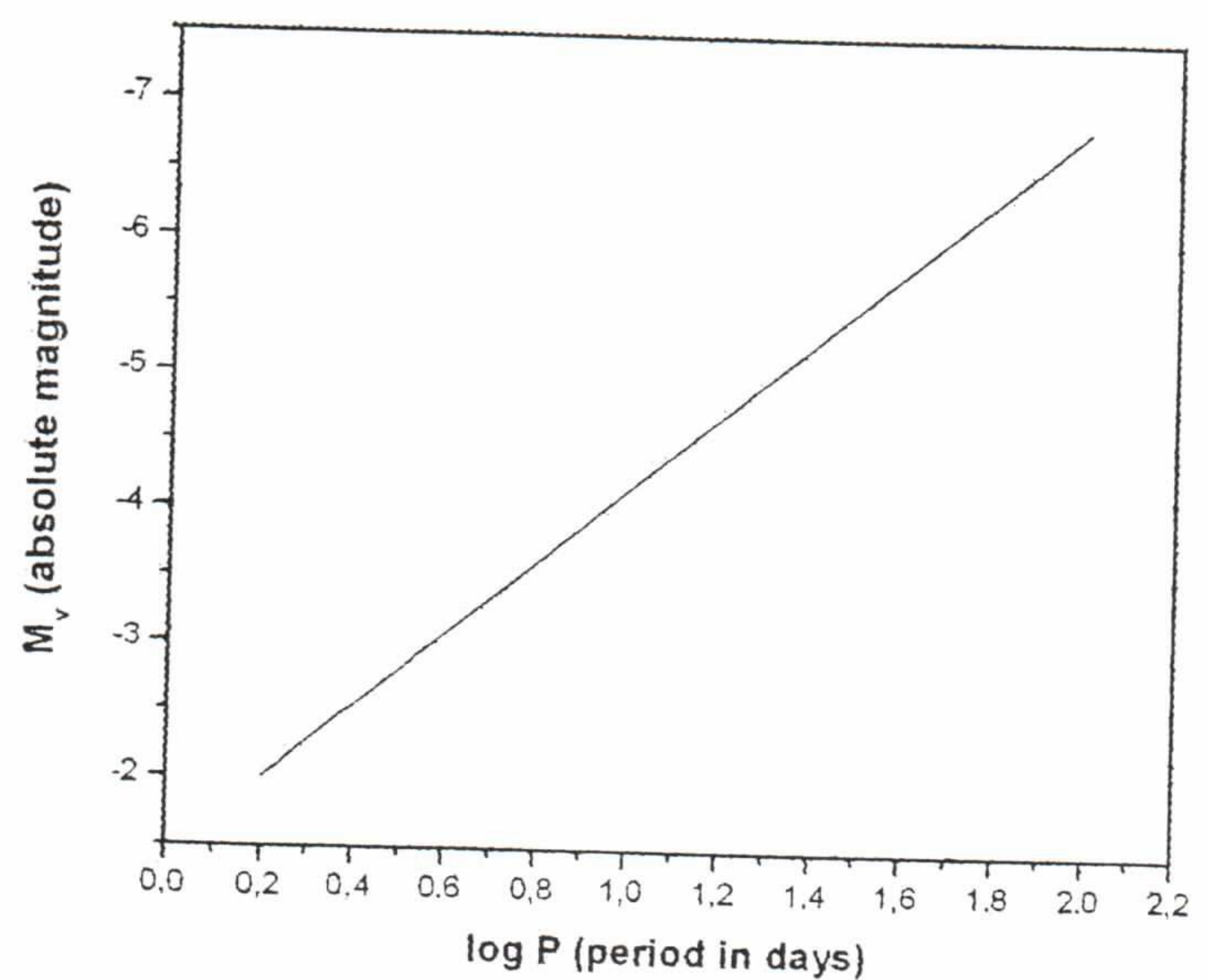
Решение
- Use the data from table to transform redshift H alpha wavelength to the radial velocities of Cepheid relatively to the Earth (rotation of the Earth can be neglected). Remember that laboratory wavelength of Hα is 6562.8 Å.
- Take into account that:
- Our target Cepheid is situated very close to the ecliptic (border of constellations Sct and Sgr);
- Observation were made in September near equinox.
Therefore obtained include the term km/s (where is orbital speed of the Earth)
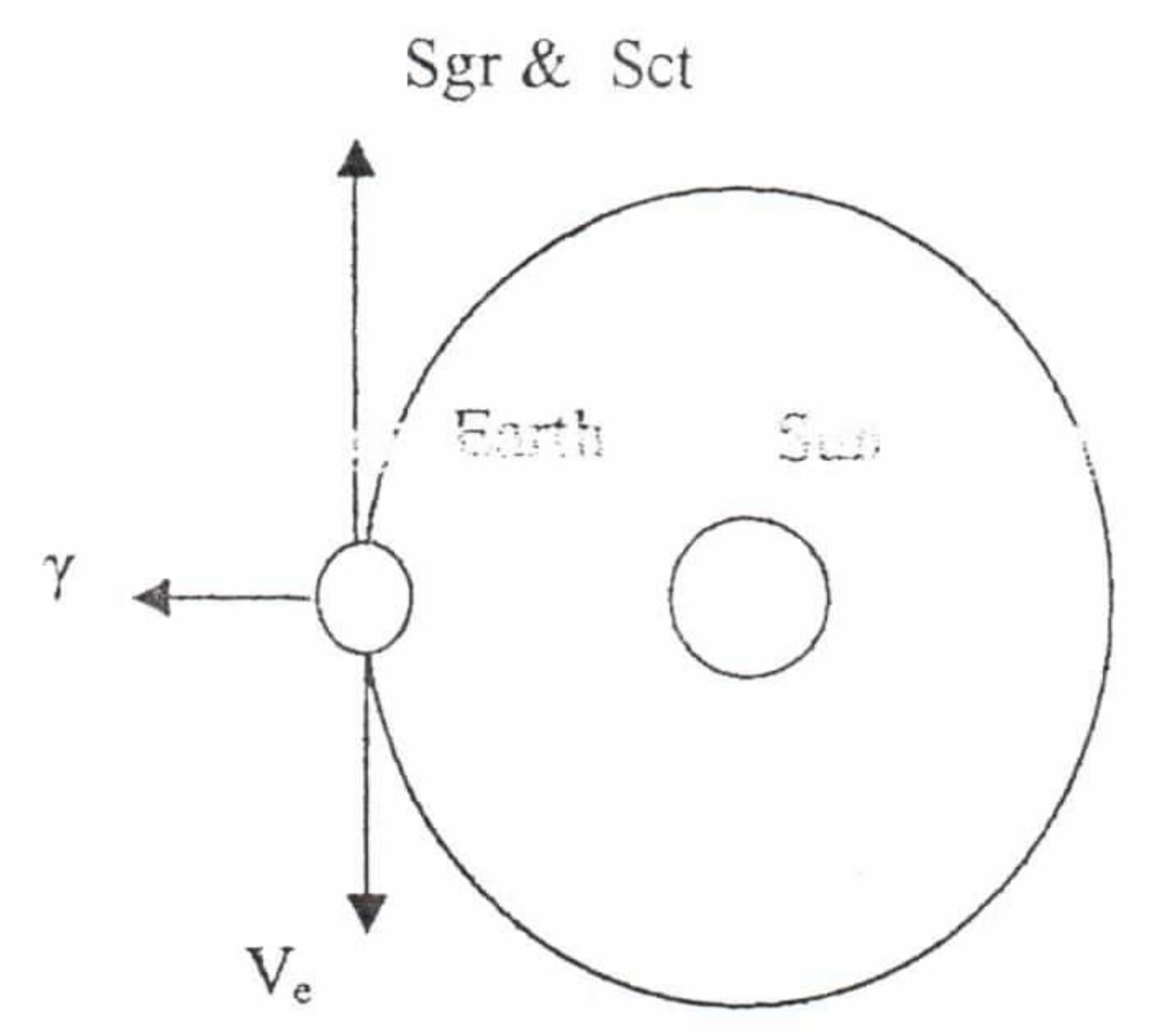
- Plot the data on heliocentric radial velocity versus time, taking into account that is the roughly the same for 16 days of observations.
- Determine approximately pulsational period of Cepheid from the plot ( d).
- Use the given plot to determine the mean absolute magnitude of Cepheid ().
- Determine the heliocentric distance of Cepheid using the known formula (interstellar absorption is ignored). With a given apparent magnitude one gets kpc.
- Use the plot versus time to find approximate heliocentric radial velocity of the center of mass of pulsating star (i.e. velocity of its space motion relatively to the Sun)
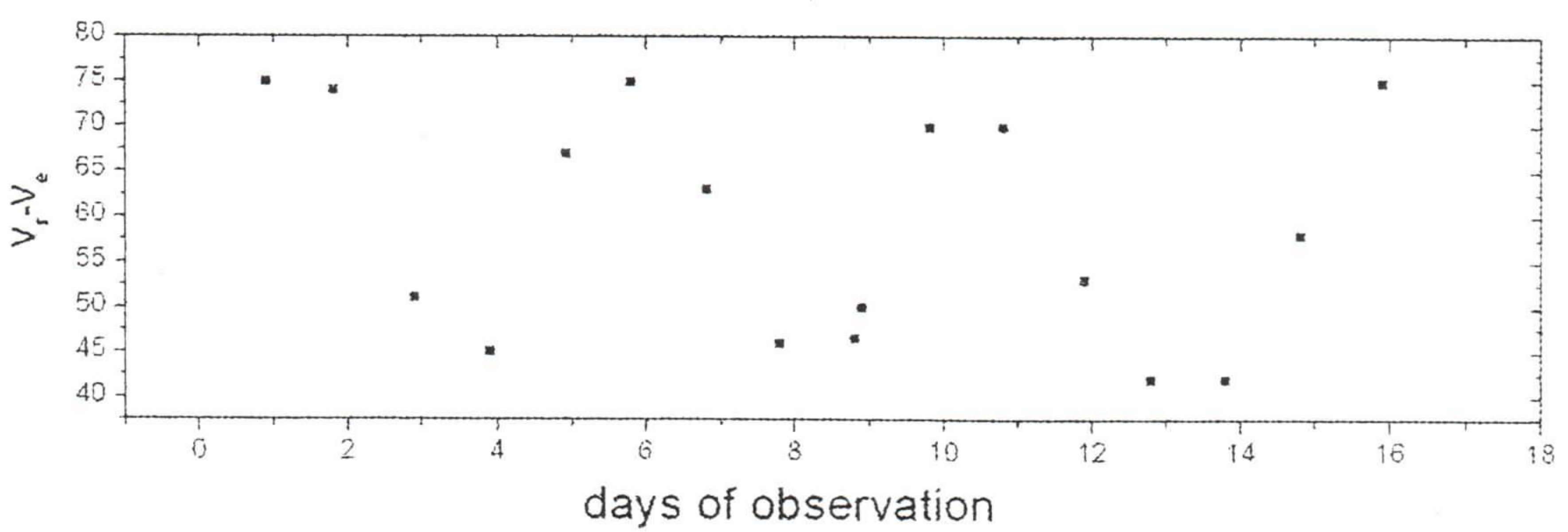
We roughly estimate the mean heliocentric velocity to be = 60 km/s. We conclude that our Cepheid recedes from the Sun
- During 2 million years ( y) the star passed with such a velocity the distance:
Here is the number of seconds in one year.
- 2 million years ago our star was 100 pc closer to the sun than now, thus, its distance was at that time 700 pc. With such a distance its apparent magnitude was:
Here we neglected again the interstellar absorption and possible variations of the absolute magnitude of our cepheid during considered time interval. Thus, we conclude that 2 million year ago the star could be seen.
Оригинал в Архива: bulgarian-pr-004.jpg · официални решения: practsol3.jpg · допълнителни данни: bulgarian-pr-005.jpg · допълнителни данни: betapract.jpg · допълнителни данни: practsol3.jpg · допълнителни данни: practsol1.jpg