IAO 2007, Практически тур, Група β — Задача 7. Radial velocity.
Practical round. Problems to solve · 29 септември 2007 г.
Note for jury and team leaders
Note for jury and team leaders. The proposed sketches are not full; the team leaders have to give more detailed explanations for students. But the correct solutions in the students’ papers (enough for 10pts) may be shorter.
Source annotations
The supernova key prints H=71km/s and Vr≈180000km, with incomplete units, and its second line gives Vr=180000=0.6c. These printed expressions are retained.
Literal source distance unit
The supplied beta practical key prints r=800kpc in step6, then uses 100pc and 700pc in steps8–9. These inconsistent printed units are retained without scientific correction.
Условие
Imagine a cepheid whose position is on the border between the constellations of Sgr and Sct. This cepheid has a mean apparent magnitude of . Spectroscopic observations of the Hα line (laboratory wavelength is Å) for this cepheid were carried out during 16 successive nights in the second part of September. The list of observations is given in the table. Make such a plot based on the data listed in this table which enables you to derive several important characteristics of this cepheid and to answer the question: Could this cepheid be seen by the first people on the Earth (about 2 million years ago)? (the answer should be written in English: Yes or No.) What was the apparent magnitude of this star at that time?
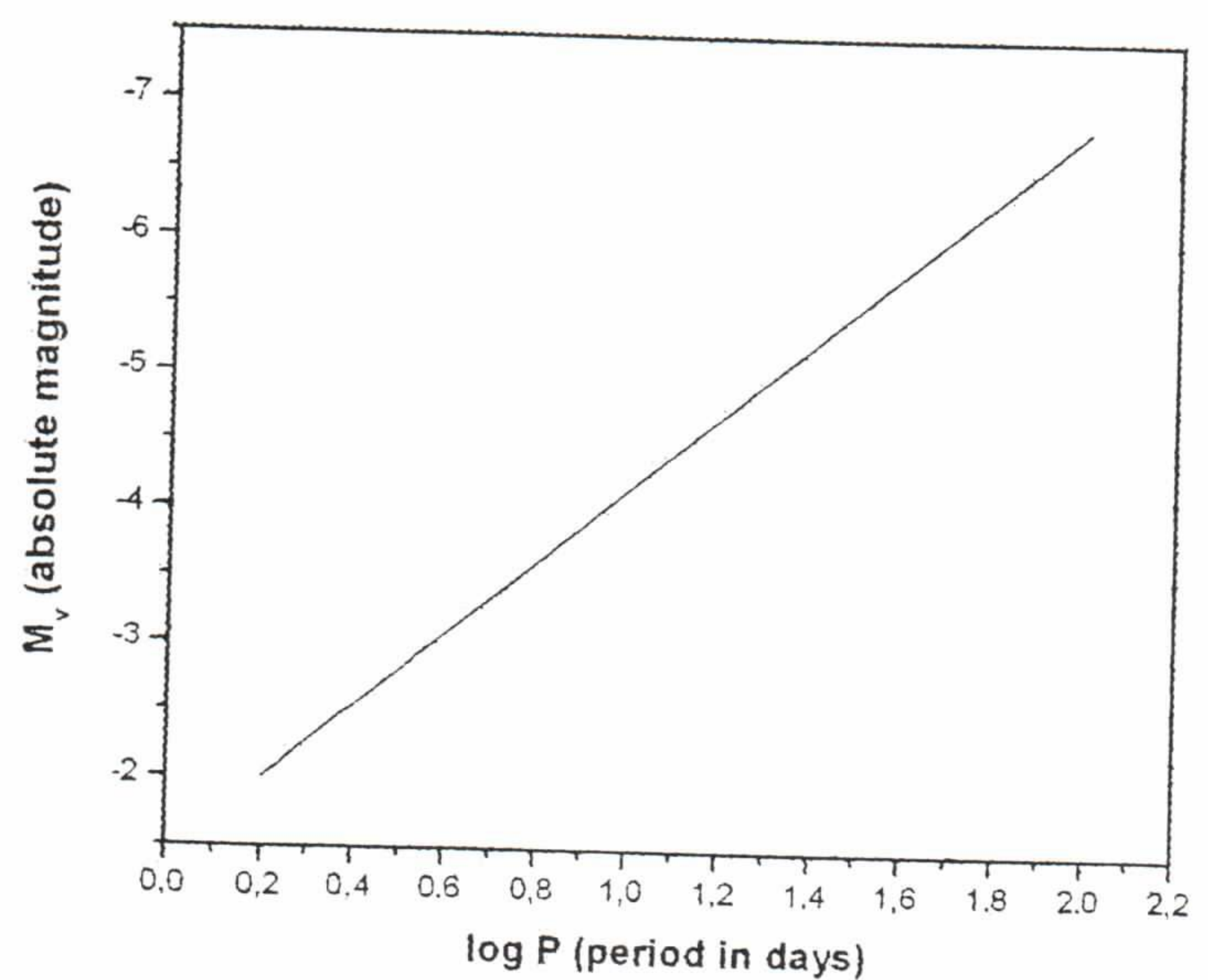
Supplementary information: Use the relation showed in the plot below (this relation is valid for cepheids – pulsating stars).
Recommendations: interstellar absorption, rotation of the Earth around its axis and possible changes of the cepheid mean luminosity during the last 2 million years can be ignored.
| Moment of observations (in part of days) | Observed wavelength, Å |
|---|---|
| 0.9 | 6565,1 |
| 1.8 | 6565,1 |
| 2.9 | 6564,6 |
| 3.9 | 6564,4 |
| 4.9 | 6564,9 |
| 5.8 | 6565,1 |
| 6.8 | 6564,8 |
| 7.8 | 6564,5 |
| 8.8 | 6564,5 |
| 8.9 | 6564,6 |
| 9.8 | 6565,0 |
| 10.8 | 6565,0 |
| 11.9 | 6564,6 |
| 12.8 | 6564,4 |
| 13.8 | 6564,4 |
| 14.8 | 6564,7 |
| 15.9 | 6565,1 |
Решение
- Use the data from table to transform redshift H alpha wavelength to the radial velocities of Cepheid relatively to the Earth (rotation of the Earth can be neglected). Remember that laboratory wavelength of Hα is 6562.8 Å.
- Take into account that:
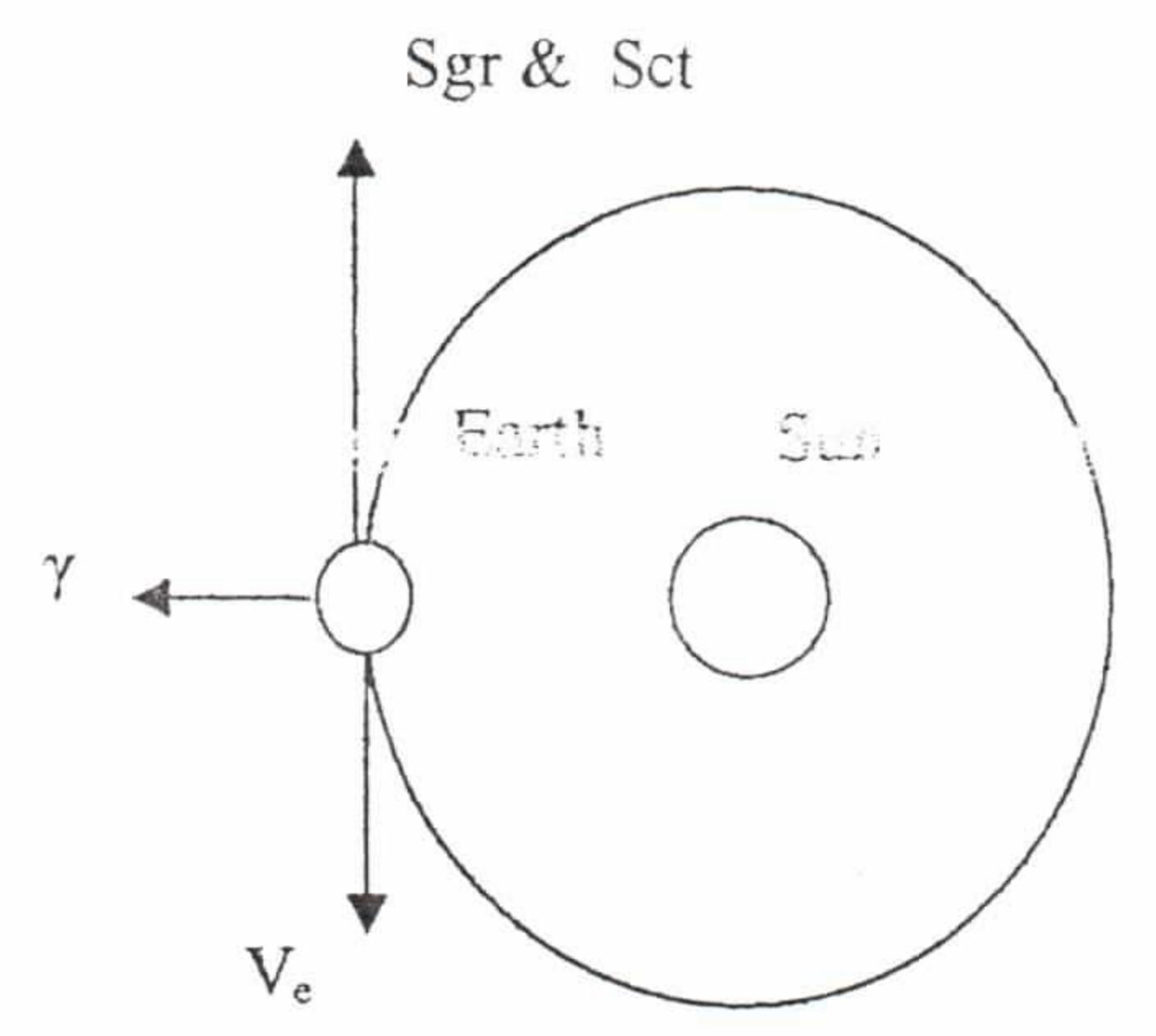
- Our target Cepheid is situated very close to the ecliptic (border of constellations Sct and Sgr);
- Observation were made in September near equinox.
Therefore obtained include the term km/s (where is orbital speed of the Earth)
- Plot the data on heliocentric radial velocity versus time, taking into account that is the roughly the same for 16 days of observations.
- Determine approximately pulsational period of Cepheid from the plot ( d).
- Use the given plot to determine the mean absolute magnitude of Cepheid ().
- Determine the heliocentric distance of Cepheid using the known formula (interstellar absorption is ignored). With a given apparent magnitude one gets kpc.
- Use the plot versus time to find approximate heliocentric radial velocity of the center of mass of pulsating star (i.e. velocity of its space motion relatively to the Sun)
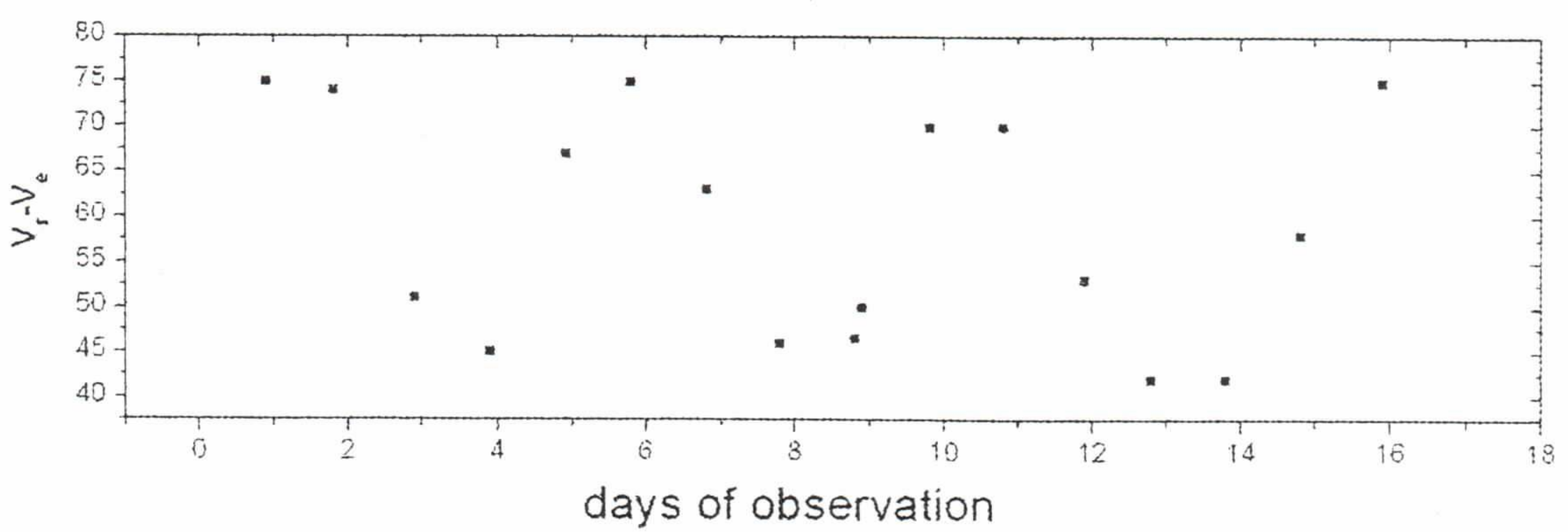
We roughly estimate the mean heliocentric velocity to be = 60 km/s. We conclude that our Cepheid recedes from the Sun
- During 2 million years ( y) the star passed with such a velocity the distance:
Here is the number of seconds in one year.
- 2 million years ago our star was 100 pc closer to the sun than now, thus, its distance was at that time 700 pc. With such a distance its apparent magnitude was:
Here we neglected again the interstellar absorption and possible variations of the absolute magnitude of our cepheid during considered time interval. Thus, we conclude that 2 million year ago the star could be seen.
Оригинал в Архива: betapract.jpg · официални решения: practsol3.jpg · допълнителни данни: practsol3.jpg · допълнителни данни: practsol1.jpg