IAO 2011, Теория, Групи α и β — αβ-4. Снимка на Юпитер
XVI Международная астрономическая олимпиада / XVI International Astronomy Olympiad — Казахстан, Алма-Ата, 22 – 30. IX. 2011 — Round: Theo · 22 септември 2011 г.
Обща информация
Възможно е не всички въпроси да имат верен отговор. Някои въпроси (може би главният въпрос или някой от подвъпросите) могат да нямат смисъл. В този случай, Вие трябва да напишете във Вашия отговор (на английски или руски език) "impossible situation-ситуация невозможна". Разбира се, отговорът трябва да бъде обяснен числено или логически. Данните от таблиците (данни за планети, звезди, константи и т.н.) могат да бъдат използвани за решаването на всяка задача. Отговорите "Да-Yes" или "Нет-No" трябва да бъдат написани на английски или руски език.
Source ownership and groups
The Bulgarian manuscript contains distinct α-1 and β-1 tasks, distinct α/β Planetarium versions, then shared αβ-3–5. Existing IDs p1–p5 are retained; the unrelated β-1 is now p6. The English original supplies the Jupiter photograph and complete reference tables absent from the Bulgarian manuscript. Bulgarian date 18 October 2009 is retained; English question and key say 19 October 2009.
Clipped official sketches
The five-page official key is a preliminary jury sketch. Its page tops are clipped on pages 2–5 in the actual PDF, also visible in fresh PyMuPDF rendering. Missing opening/continuation passages are explicitly marked, not reconstructed. The ray-diagram lower label is partly cut off.
Missing drawings and grading
No detailed grading sheet occurs in the year inventory. The introduction refers to correct student solutions worth 8 points. The requested Mars Bear drawing and promised Jupiter-moon sector/point drawings are absent from the supplied key.
Printed discrepancies
Retained: latitude intermediate −88°28′ versus final −88°23′; solar mass 1.989 × 10⁻³⁰ kg versus reference table 1989000 × 10²⁴ kg; Planetarium inequality R ≪ F; Mars sketch says sunset and discusses eccentricity although the question allows a circular orbit. Jupiter sketch uses “difference in declinations”, reports 1.5% accuracy and gives centre-distance rather than the requested surface distance. These are source statements, not newly calculated answers.
Условие
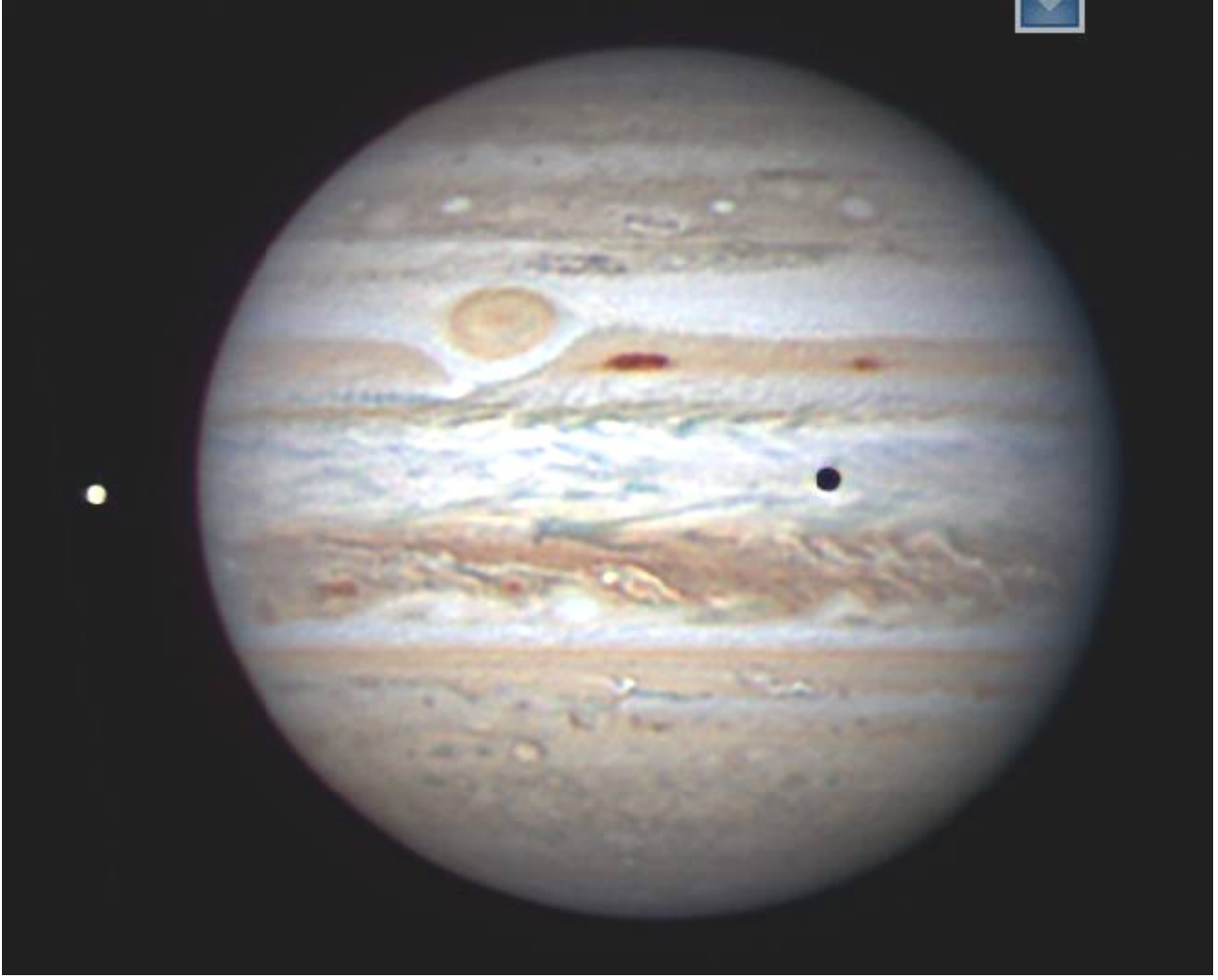
На снимката на Юпитер, която е била направена на 18-ти октомври 2009г. могат да се видят един от Галилеевите спътници и неговата сянка върху планетата. Юпитер се е намирал приблизително в средата на съзвездието Козирог, когато снимката е била направена.
Намерете разстоянието от спътника до повърхността на планетата.
Какво е името на този спътник?
Решението Ви трябва да бъде илюстрирано със схема (схеми). Името на спътника трябва (в решението и на схемата) да бъде написано (или дублирано) на английски език.
Отговори
- Europa; the sketch gives centre-distance L/R=9.64, without the final subtraction requested for surface distance.
Решение
Внимание: Непълно решение
The opening of the source text is cut off, a ray-diagram label is partly clipped, and the sketch identifies Europa and gives centre-distance ratio L/R=9.64 but does not explicitly subtract Jupiter radius for the requested surface distance.
Theoretical round. Sketches for solutions. For preliminary work of Jury ONLY.
Note for jury and team leaders. The proposed sketches are not full; the team leaders have to give more detailed explanations for students. But the correct solutions in the students’ papers (enough for 8 pts) may be shorter.
Photo geometry and identification
Source gap: the opening of this solution is missing at the top edge of scanned page 4. The visible text starts mid-sentence:
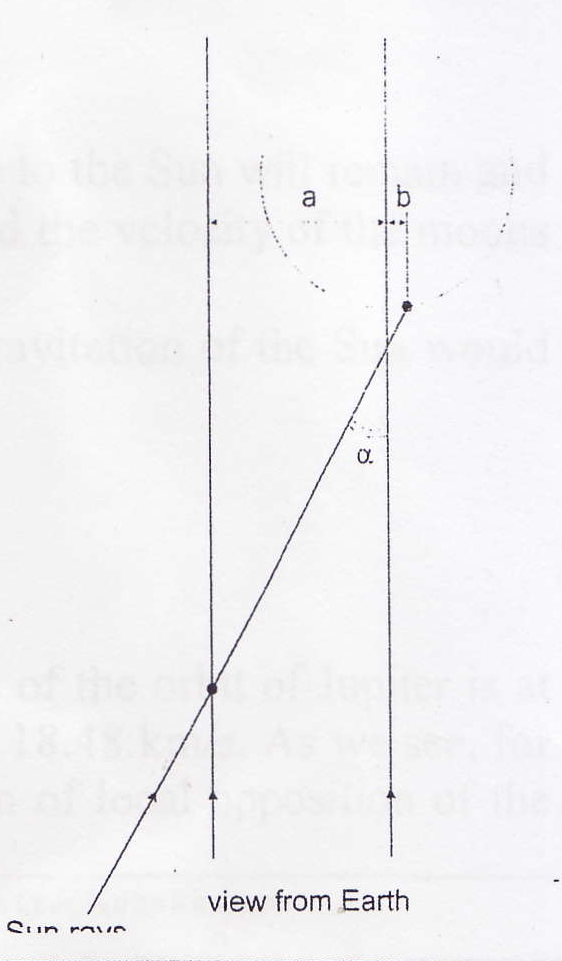
… moon (to the left) and to the shadow of the moon (to the right) the distance from the center of the moon to the center of Jupiter can be calculated using formulas of rectangular triangle:
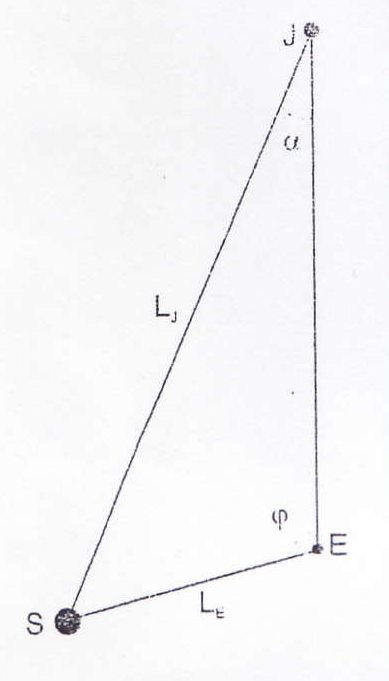
Where is the angle between the direction to the Sun (The Sun beams come a little from the left) and the direction to the Earth (from where the picture is made). We can estimate this angle in two ways.
Or we remember that the Capricorn is a zodiac constellation, and the center of this constellation (not zodiac sign, but zodiac constellation!) is passed by the Sun approximately in the end of January — the beginning of February. The angle between the Sun positions on October, 19th and, assume, on February, 3rd, is equal 3.6 months or .
Or to start with that fact that the picture is made on October, 19th (a direct ascension of the Sun 26 days after an equinox we will estimate as ), Jupiter was in the middle of Capricorn constellation (not zodiac sign, but constellation!) (right ascension of this point we will estimate to ), and both the Sun and Jupiter were close to the ecliptic, declination of both points nearby –. This data allow us to estimate the angle between Sun and Jupiter at the celestial sphere as about the difference in declinations, that is, or .
From the second drawing, knowing this angle , and distances to the Sun from Earth and from Jupiter , it is possible to calculate the angle corner necessary to us:
By measuring the values R, a and b (accordingly 48.5 mm, 59 mm and 18 mm on the author printed picture, on other scaled printed pictures other values may be obtained, but their absolute values are not important, important is only ratios that do not depend on scale) in the photo, and using the formula for a rectangular triangle, we can receive a value of equal to 9.64.
From the given tables it is possible to find that for Io this ratio equals to 5.90, for Europa — 9.39, for Ganimede — 14.97, for Callisto — 26.33. It is evident, that our calculations are made with some accuracy, and the proximity of values 9.64 and 9.39 (1.5% of accuracy) says that we see the moon Europa in the picture.
Transcription note: “difference in declinations” and “1.5%” follow the supplied sketch. The sketch reports distance from Jupiter's centre, while the question asks distance from its surface; a final subtraction of the radius is not explicitly supplied. The ray-diagram label at the bottom of scanned page 3 is partly cut off.
Parameters of orbits. Physical characteristics of Sun, some planets, Moon and Galilean moons of Jupiter
Элементы орбит. Физические характеристики Солнца, некоторых планет, Луны и Галилеевых спутников Юпитера
Parameters of orbits. Physical characteristics of Sun, some planets, Moon and Galilean moons of Jupiter
| Небесное тело, планета / Body, planet | Среднее расстояние от центрального тела, в астр. ед. / Average distance to central body, in astr. units | Среднее расстояние от центрального тела, в млн. км / Average distance to central body, in mln. km | Сидерический (или аналогичный) период обращения, в тропич. годах / Sidereal (or analogous) period, in troph. years | Сидерический (или аналогичный) период обращения, в средних сутках / Sidereal (or analogous) period, in days | Эксцентриситет, e / Eccentricity, e | Экваториальн. диаметр, км / Equat. diameter, km | Масса, кг / Mass, kg | Средняя плотность, г/см³ / Av. density, g/cm³ | Ускор. своб. пад. у пов., м/с² / Grav. acceler. at surf., m/s² | Наклон оси / Axial tilt | Альбедо / Albedo |
|---|---|---|---|---|---|---|---|---|---|---|---|
| Солнце Sun | 1392000 | 1989000 | 1,409 | ||||||||
| Меркурий Mercury | 0,387 | 57,9 | 0,241 | 87,97 | 0,206 | 4 879 | 0,3302 | 5,43 | 3,70 | 0,01° | 0,06 |
| Венера Venus | 0,723 | 108,2 | 0,615 | 224,70 | 0,007 | 12 104 | 4,8690 | 5,24 | 8,87 | 177,36 | 0,78 |
| Земля Earth | 1,000 | 149,6 | 1,000 | 365,26 | 0,017 | 12 756 | 5,9742 | 5,515 | 9,81 | 23,44 | 0,36 |
| Луна Moon | 0,00257 | 0,38440 | 0,0748 | 27,3217 | 0,055 | 3 475 | 0,0735 | 3,34 | 1,62 | 6,7 | 0,07 |
| Марс Mars | 1,524 | 227,9 | 1,880 | 686,98 | 0,093 | 6 794 | 0,6419 | 3,94 | 3,71 | 25,19 | 0,15 |
| Юпитер Jupiter | 5,204 | 778,6 | 11,862 | 4 332,59 | 0,048 | 142 984 | 1899,8 | 1,33 | 24,86 | 3,13 | 0,66 |
| Сатурн Saturn | 9,584 | 1433,7 | 29,458 | 10 759,20 | 0,054 | 120 536 | 568,50 | 0,70 | 10,41 | 26,73 | 0,68 |
| Спутник / Moon | Среднее расстояние от центра планеты, в астр. ед. / Average distance to planet center, in astr. units | Среднее расстояние от центра планеты, в тыс. км / Average distance to planet center, in thous. km | Сидерич. период обращения в средних сутках / Sidereal period in days | Наклонение орбиты (°) / Orbit inclination (°) | Эксцентриситет, e / Eccentricity, e | Диаметр, км / Diameter, km | Масса, кг / Mass, kg | Средняя плотность, г/см³ / Av. density, g/cm³ | Ускор. своб. пад. у пов., м/с² / Grav. acceler. at surf., m/s² | Макс. блеск, вид. с Земли *) / Max. magn. From Earth *) | Геом Альбедо / Geom Albedo |
|---|---|---|---|---|---|---|---|---|---|---|---|
| Ио Io | 0,00282 | 421,70 | 1,769137 | 0,050° | 0,0041 | 3 643 | 89,31 | 3,53 | 1,80 | 0,63 | |
| Европа Europa | 0,00449 | 671,03 | 3,551181 | 0,471° | 0,0094 | 3 122 | 48,00 | 3,01 | 1,32 | 0,67 | |
| Ганимед Ganymede | 0,00716 | 1070,41 | 7,154553 | 0,204° | 0,0011 | 5 262 | 148,19 | 1,94 | 1,43 | 0,43 | |
| Каллисто Callisto | 0,01259 | 1882,71 | 16,689018 | 0,205° | 0,0074 | 4 821 | 107,59 | 1,83 | 1,23 | 0,20 |
*) В среднем противостоянии. *) In mean opposition.
Some constants and formulae
Некоторые константы и формулы
Some constants and formulae
| Константа | Значение / Value | Constant |
|---|---|---|
| Скорость света в вакууме, c (м/с) | 299 792 458 | Speed of light in vacuum, c (m/s) |
| Гравитационная постоянная, G (Н·м²/кг²) | Constant of gravitation, G (N·m²/kg²) | |
| Солнечная постоянная, A (Вт/м²) | 1367 | Solar constant, A (W/m²) |
| Параметр Хаббла, H₀ (км/с/МПк), среднее значение | 71 | mean value, Hubble parameter, H₀ (km/s/Mpc) |
| Параметр Хаббла, H₀ (км/с/МПк), диапазон значений | 50-100 | diapason of values, Hubble parameter, H₀ (km/s/Mpc) |
| Постоянная Планка, h (Дж·с) | Plank constant, h (J·s) | |
| Заряд электрона, e (Кл) | Charge of electron, e (C) | |
| Масса электрона, mₑ (кг) | Mass of electron, mₑ (kg) | |
| Соотношение масс протона и электрона | 1836.15 | Proton-to-electron ratio |
| Постоянная Фарадея, F (Кл/моль) | 96 485 | Faraday constant, F (C/mol) |
| Магнитная постоянная, μ₀ (Гн/м) | Magnetic constant, μ₀ (H/m) | |
| Универсальная газовая постоянная, R (Дж/моль/K) | 8.314 | Universal gas constant, R (J/mol/K) |
| Постоянная Больцмана, k (Дж/K) | Boltzmann constant, k (J/K) | |
| Стандартная атмосфера (Па) | 101 325 | Standard atmosphere (Pa) |
| Постоянная Стефана-Больцмана, σ (Вт/м²/K⁴) | Stefan-Boltzmann constant, σ (W/m²/K⁴) | |
| Константа смещения Вина, b (м·K) | 0.002897 | Wien’s displacement constant, b (m·K) |
| Лабораторная длина волны Hα (Å) | 6562.81 | Laboratory wavelength of Hα (Å) |
| Длина тропического года, T (сут) | 365.242199 | Tropical year length, T (days) |
| Показатель преломления воды при 20°C, n | 1.334 | Refractive index of water for 20°C, n |
| Момент инерции шара | Moment of inertia of a solid ball | |
| Площадь сферы | Area of sphere | |
| π | 3.14159265 | π |
| e | 2.71828183 | e |
| Золотое сечение, φ | 1.61803399 | Golden ratio, φ |
Оригинал в Архива: bgtheo.pdf · официални решения: theosol.pdf · допълнителни данни: alphatheo.pdf · допълнителни данни: betatheo.pdf · допълнителни данни: data_1.png · допълнителни данни: data_2.png