IAO 2012, Практически тур, Група α — Задача 8. Moon
IAO2012 — Practical round (α) · 10 т.
Practical round. Problems to solve
XVII International Astronomy Olympiad. Gwangju, Korea,16–24 X 2012. Group α.
Note. If you find somewhere in the problems an impossible situation, write in English «impossible situation».
Бележки от източника
The official Fireball solution explicitly acknowledges an incorrectly plotted observing point II. It gives A/B latitudes36.47°/36.10° in7.2, then36.49°/36.11° in7.4 and its final table. These printed values are retained.
Missing plotting form
The original blank Moon eccentric-orbit plotting sheet (a) referred to in8.3/8.5 is absent from the complete same-year source inventory; the available paper.png is the Fireball geographic grid.
Printed solution details
The official Moon solution prints an arcsecond mark after384400 and gives a lunar diameter3476.4km whereas the shared reference table gives3475km. Its culmination-difference table is retained as printed, including values that differ from direct subtraction of adjacent times. These are not silently recalculated.
Shared source pack
The six official practical solution images and grading sheet cover both group editions; this edition includes only its matching problem8. Four theory-labelled reference sheets were inspected. The orbital-properties table supports Moon, and the Hertzsprung-Russell diagram is explicitly mentioned by the Clusters solution. The constants and individual-star tables supply reference context, not extra practical tasks. The geographic grid belongs to Fireball.
Условие
The Korean Astronomy and Space Science Institute (KASI) publishes the Korean Astronomical Almanac every year. You have been provided with an astronomical table extracted from the Korean Astronomical Almanac of 2012 showing the Korean local time of Moon culmination. (See separate sheet, and you may fill the empty cells by necessary content.)
| Date | Culmination of Moon | Date | Culmination of Moon | Date | Culmination of Moon | |||
|---|---|---|---|---|---|---|---|---|
| Mar 2 | April 1 | May 1 | ||||||
Also you are provided with a scaled marked graph paper to plot graphs.
8.1 Find the date in April 2012 when the Moon is closest to the Earth.
8.2 Find the date in March 2012 when the Moon is remotest from the Earth.
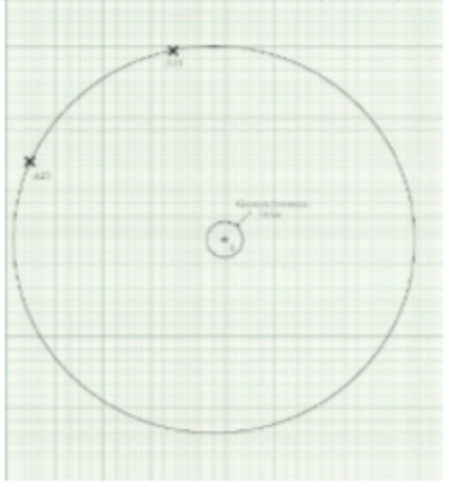
8.3 The scaled marked graph paper (a) shows the eccentric orbit of the Moon, the Earth being located at the center. Mark the positions of the Moon by the symbol × on April 19 and April 23 (with labels A19 and A23).
8.4 Calculate the ratio of the apparent angular sizes of the Moon () and the Sun () on July 1.
8.5 Draw on the scaled marked graph paper the geostationary orbit around the Earth in the given scale.
Практический тур. Таблица к задаче 8 / Practical round. Table for Problem 8
| Дата / Date | Кульминация Луны / Culmination of Moon | Дата / Date | Кульминация Луны / Culmination of Moon | Дата / Date | Кульминация Луны / Culmination of Moon | |||
|---|---|---|---|---|---|---|---|---|
| Mar 2 | 19 40 | April 1 | 20 02 | May 1 | 20 20 | |||
| Mar 3 | 20 31 | April 2 | 20 52 | May 2 | 21 10 | |||
| Mar 4 | 21 22 | April 3 | 21 42 | May 3 | 22 02 | |||
| Mar 5 | 22 14 | April 4 | 22 33 | May 4 | 22 57 | |||
| Mar 6 | 23 05 | April 5 | 23 25 | May 5 | 23 56 | |||
| Mar 7 | 23 56 | April 6 | - | May 6 | - | |||
| Mar 8 | - | April 7 | 0 19 | May 7 | 0 57 | |||
| Mar 9 | 0 48 | April 8 | 1 16 | May 8 | 2 01 | |||
| Mar 10 | 1 41 | April 9 | 2 16 | May 9 | 3 03 | |||
| Mar 11 | 2 36 | April 10 | 3 17 | May 10 | 4 04 | |||
| Mar 12 | 3 32 | April 11 | 4 19 | May 11 | 5 00 | |||
| Mar 13 | 4 31 | April 12 | 5 19 | May 12 | 5 52 | |||
| Mar 14 | 5 30 | April 13 | 6 15 | May 13 | 6 40 | |||
| Mar 15 | 6 29 | April 14 | 7 08 | May 14 | 7 26 | |||
| Mar 16 | 7 26 | April 15 | 7 57 | May 15 | 8 09 | |||
| Mar 17 | 8 20 | April 16 | 8 43 | May 16 | 8 52 | |||
| Mar 18 | 9 11 | April 17 | 9 28 | May 17 | 9 35 | |||
| Mar 19 | 9 59 | April 18 | 10 10 | May 18 | 10 18 | |||
| Mar 20 | 10 45 | April 19 | 10 53 | May 19 | 11 02 | |||
| Mar 21 | 11 29 | April 20 | 11 36 | May 20 | 11 48 | |||
| Mar 22 | 12 12 | April 21 | 12 19 | May 21 | 12 36 | |||
| Mar 23 | 12 55 | April 22 | 13 04 | May 22 | 13 24 | |||
| Mar 24 | 13 38 | April 23 | 13 51 | May 23 | 14 14 | |||
| Mar 25 | 14 22 | April 24 | 14 39 | May 24 | 15 03 | |||
| Mar 26 | 15 08 | April 25 | 15 27 | May 25 | 15 52 | |||
| Mar 27 | 15 54 | April 26 | 16 17 | May 26 | 16 40 | |||
| Mar 28 | 16 43 | April 27 | 17 06 | May 27 | 17 27 | |||
| Mar 29 | 17 32 | April 28 | 17 55 | May 28 | 18 14 | |||
| Mar 30 | 18 22 | April 29 | 18 43 | May 29 | 19 02 | |||
| Mar 31 | 19 12 | April 30 | 19 31 | May 30 | 19 51 |
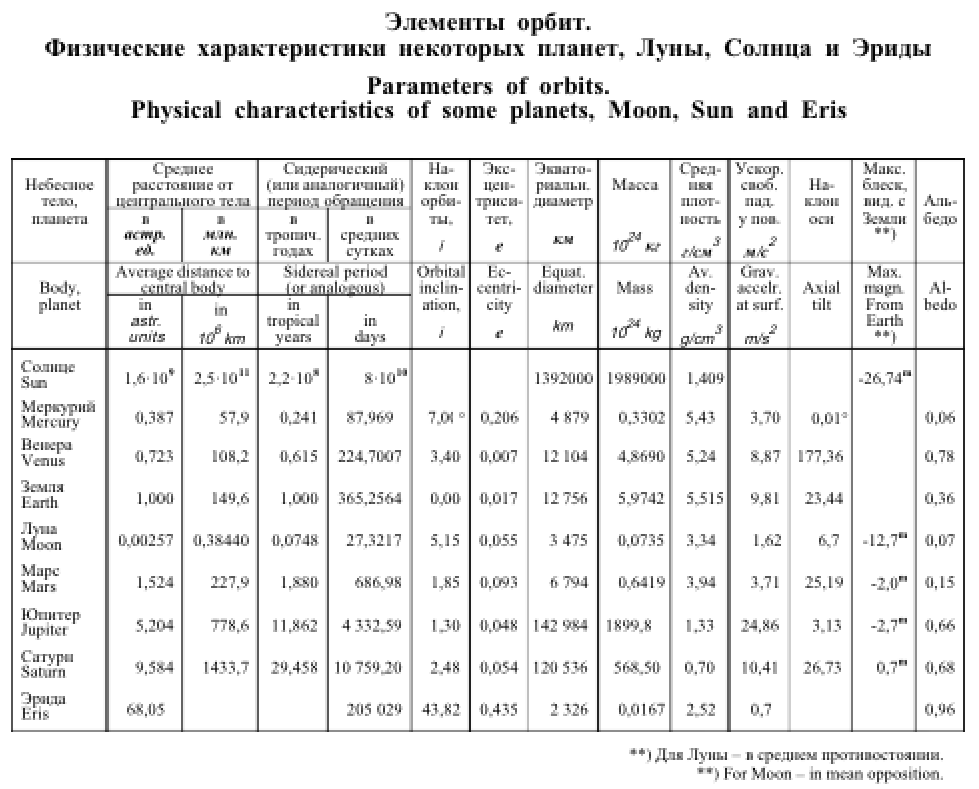
Parameters of orbits. Physical characteristics of some planets, Moon, Sun and Eris
Решение
α-8. Moon
| Date | Culmination of Moon | (min) | Date | Culmination of Moon | (min) | Date | Culmination of Moon | (min) |
|---|---|---|---|---|---|---|---|---|
| Mar 2 | 19 40 | 51 | April 1 | 20 02 | 50 | May 1 | 20 20 | 50 |
| Mar 3 | 20 31 | 51 | April 2 | 20 52 | 50 | May 2 | 21 10 | 52 |
| Mar 4 | 21 22 | 52 | April 3 | 21 42 | 51 | May 3 | 22 02 | 55 |
| Mar 5 | 22 14 | 51 | April 4 | 22 33 | 52 | May 4 | 22 57 | 59 |
| Mar 6 | 23 05 | 51 | April 5 | 23 25 | 54 | May 5 | 23 56 | 61 |
| Mar 7 | 23 56 | 52 | April 6 | - | May 6 | - | ||
| Mar 8 | - | April 7 | 0 19 | 57 | May 7 | 0 57 | 65 | |
| Mar 9 | 0 48 | 53 | April 8 | 1 16 | 57 | May 8 | 2 01 | 62 |
| Mar 10 | 1 41 | 55 | April 9 | 2 16 | 60 | May 9 | 3 03 | 61 |
| Mar 11 | 2 36 | 56 | April 10 | 3 17 | 61 | May 10 | 4 04 | 56 |
| Mar 12 | 3 32 | 59 | April 11 | 4 19 | 62 | May 11 | 5 00 | 52 |
| Mar 13 | 4 31 | 59 | April 12 | 5 19 | 60 | May 12 | 5 52 | 48 |
| Mar 14 | 5 30 | 59 | April 13 | 6 15 | 56 | May 13 | 6 40 | 46 |
| Mar 15 | 6 29 | 57 | April 14 | 7 08 | 53 | May 14 | 7 26 | 43 |
| Mar 16 | 7 26 | 54 | April 15 | 7 57 | 49 | May 15 | 8 09 | 43 |
| Mar 17 | 8 20 | 51 | April 16 | 8 43 | 46 | May 16 | 8 52 | 43 |
| Mar 18 | 9 11 | 48 | April 17 | 9 28 | 45 | May 17 | 9 35 | 43 |
| Mar 19 | 9 59 | 46 | April 18 | 10 10 | 43 | May 18 | 10 18 | 42 |
| Mar 20 | 10 45 | 44 | April 19 | 10 53 | 46 | May 19 | 11 02 | 46 |
| Mar 21 | 11 29 | 43 | April 20 | 11 36 | 43 | May 20 | 11 48 | 48 |
| Mar 22 | 12 12 | 43 | April 21 | 12 19 | 45 | May 21 | 12 36 | 48 |
| Mar 23 | 12 55 | 43 | April 22 | 13 04 | 47 | May 22 | 13 24 | 50 |
| Mar 24 | 13 38 | 44 | April 23 | 13 51 | 48 | May 23 | 14 14 | 50 |
| Mar 25 | 14 22 | 46 | April 24 | 14 39 | 48 | May 24 | 15 03 | 49 |
| Mar 26 | 15 08 | 46 | April 25 | 15 27 | 50 | May 25 | 15 52 | 48 |
| Mar 27 | 15 54 | 49 | April 26 | 16 17 | 50 | May 26 | 16 40 | 47 |
| Mar 28 | 16 43 | 49 | April 27 | 17 06 | 49 | May 27 | 17 27 | 47 |
| Mar 29 | 17 32 | 50 | April 28 | 17 55 | 48 | May 28 | 18 14 | 48 |
| Mar 30 | 18 22 | 50 | April 29 | 18 43 | 48 | May 29 | 19 02 | 49 |
| Mar 31 | 19 12 | 50 | April 30 | 19 31 | 49 | May 30 | 19 51 |
8.1
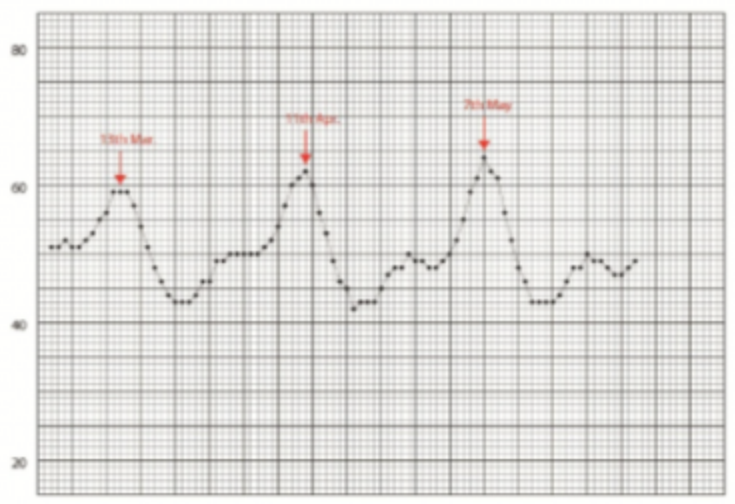
In the table above, we compute the difference in culmination times of two neighboring days. On average it is about 48 minutes, but differs every day due to the elliptical nature of the lunar orbit. Figure 1 shows the variation of culmination time for the three months. When the moon is at the perigee, the difference in culmination is the largest. Therefore, the moon is at the perigee on Mar 13, April 11, May 7. Therefore, the answer is 11.
8.2
14 days after Mar 13 (or 14 days before April 11) the moon is located on the opposite side of the perigee. Therefore, the answer is Mar 27.
8.3
There are 8 days between April 11 and April 19, which correspond to 8/27.3 of the lunar orbital period. The angle from the perigee is 105.5 degrees. There are 12 days corresponding to degrees. The locations are indicated in Fig. 2. (See just below.)
8.4
July 1 is 54 days after May 7th, where the Moon is at perigee. The Sun is near aphelion, whereas the Moon is near perigee. Therefore the sun’s apparent angular diameter is . The real diameter of the moon is km. The distance is km. Hence the apparent angular size is . Therefore, the moon appears 1.05 larger than the Sun.
8.5
The approximate size of the geostationary orbit may be found using the Kepler’s III law, with the additional fact that geostationary orbit has 27.3 times shorter period. The ratio or the orbital sizes is , or approximately 9. The answer is shown in Fig. 2.
Practical round. Basic grading criteria
| Part | Criteria |
|---|---|
| 8.1 | April (11 ± 1) – 2 pts, ± 2 days – 1 pt. |
| 8.2 | Mrch (27 ± 1) – 2 pts, ± 2 days – 1 pt. |
| 8.3 | Similar to the Figure in the answer sheet – 2 pts, ± 10 degrees – 1 pt. |
| 8.4 | Correct ratio ± 0.01 – 2 pts, ± 0.04 – 1 pts. |
| 8.5 | Similar to the figure in the solutions – 2 pts, radius less than 1 cm – 1 pts. |
Теми и трудност
Трудност: неоценена.
Време и календари · Небесна механика · Светлина и астрономически измервания · Периоди и цикли · Орбитални елементи · Ъглов размер
Предпоставки: Разширена олимпиадна подготовка
Оригинал в Архива: alphapract.pdf · официални решения: practsol1.png · допълнителни данни: practsol2.png · допълнителни данни: practsol3.png · допълнителни данни: practsol4.png · допълнителни данни: practsol5.png · допълнителни данни: practsol6.png · допълнителни данни: pract_cr.png · допълнителни данни: paper.png · допълнителни данни: data_1.png · допълнителни данни: data_2.png · допълнителни данни: data_3.png · допълнителни данни: data_4.png