IAO 2012, Практически тур — Задача 8 (група α). Луна
XVII Международна астрономическа олимпиада — практически кръг, българско издание · 16 октомври 2012 г. · 10 т.
Забележка (група α, β)
Забележка: Ако откриете някъде в задачите невъзможна ситуация, напишете на английски „impossible situation“.
Забележка (група α)
Забележка: Ако намерите някъде в задачите невъзможна ситуация, напишете на английски „impossible situation“
Забележка (група β)
Забележка. Ако откриете някъде в задачите невъзможна ситуация, напишете на английски „impossible situation“
Fireball: printed solution values
The official key acknowledges that point II is plotted incorrectly. Section 7.2 gives A/B latitudes 36.47°/36.10°, while section 7.4 and the final table give 36.49°/36.11°. Both are retained.
Moon: missing plotting sheet and printed discrepancies
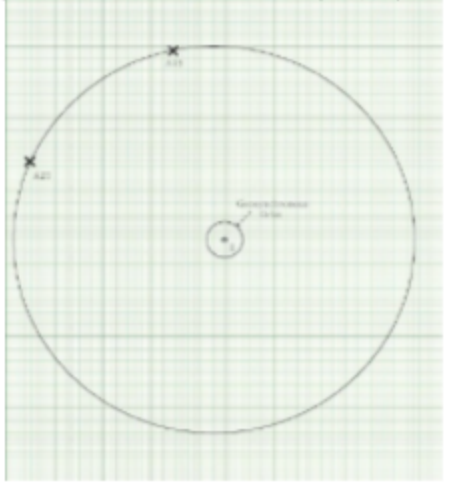
The blank eccentric-orbit plotting sheet (a) is absent from the full year inventory. The supplied geographic grid belongs to Fireball. The official completed orbit diagram is retained in the solution. The key prints an arcsecond mark after the distance 384400, uses Moon diameter 3476.4 km (3476 in its calculation), while the reference sheet lists 3475 km; values are retained. Its culmination difference table is reproduced as printed, including entries that do not equal the adjacent clock-time difference.
Clusters: missing plotting sheets and printed discrepancies
Blank graph papers (A) and (B) are absent from the full year inventory. Complete data and completed official plots are retained. The colour-colour heading prints NGC6282; the 8.4 explanation prints NGC2686; the actual problem is NGC2682. The Hyades absolute-magnitude equation and 0.75 answer are retained without recalculation.
Source ownership
Bulgarian questions and all three original IDs are retained. English source PDFs confirm shared αβ-7, α-8 Moon and β-8 Clusters. All six key images and full practical rubric apply to this combined Bulgarian edition. Four theory-labelled reference sheets were inspected: orbital data support Moon and the H-R diagram is explicitly cited by Clusters; constants and individual-star data remain separately attributed reference context, not additional practical tasks. No Bulgarian key was found.
Условие
Корейският институт по астрономия и космически науки (KASI) издава Корейски астрономически алманах всяка година. Таблицата, в която се дава времето на кулминацията на Луната по корейско време, е взета от Алманаха за 2012 г. (Вижте отделния лист; свободните клетки можете да попълните с необходимото съдържание.)
| Дата | Кулминация на Луната | Дата | Кулминация на Луната | Дата | Кулминация на Луната | ||
|---|---|---|---|---|---|---|---|
| 2 март | 1 април | 1 май |
Също така ви се дава милиметрова хартия за построяване на графики.
8.1. Определете датата от април 2012 г., когато Луната е била най-близо до Земята. [2 т.]
8.2. Определете датата от март 2012 г., когато Луната е била най-далеч от Земята. [2 т.]
8.3. На листа милиметрова хартия (а) е дадена ексцентричната орбита на Луната; в центъра се намира Земята. Отбележете с кръстче (×) положенията на Луната на 19 април и 23 април (означете ги с A19 и A23. [2 т.]
8.4. Пресметнете отношението на видимите ъглови размери на Луната () и Слънцето () на 1 юли. [2 т.]
8.5. На листа милиметрова хартия начертайте в дадения мащаб геостационарна орбита около Земята. [2 т.]
Практический тур. Таблица к задаче 8 / Practical round. Table for Problem 8
| Дата / Date | Кульминация Луны / Culmination of Moon | Дата / Date | Кульминация Луны / Culmination of Moon | Дата / Date | Кульминация Луны / Culmination of Moon | |||
|---|---|---|---|---|---|---|---|---|
| Mar 2 | 19 40 | April 1 | 20 02 | May 1 | 20 20 | |||
| Mar 3 | 20 31 | April 2 | 20 52 | May 2 | 21 10 | |||
| Mar 4 | 21 22 | April 3 | 21 42 | May 3 | 22 02 | |||
| Mar 5 | 22 14 | April 4 | 22 33 | May 4 | 22 57 | |||
| Mar 6 | 23 05 | April 5 | 23 25 | May 5 | 23 56 | |||
| Mar 7 | 23 56 | April 6 | - | May 6 | - | |||
| Mar 8 | - | April 7 | 0 19 | May 7 | 0 57 | |||
| Mar 9 | 0 48 | April 8 | 1 16 | May 8 | 2 01 | |||
| Mar 10 | 1 41 | April 9 | 2 16 | May 9 | 3 03 | |||
| Mar 11 | 2 36 | April 10 | 3 17 | May 10 | 4 04 | |||
| Mar 12 | 3 32 | April 11 | 4 19 | May 11 | 5 00 | |||
| Mar 13 | 4 31 | April 12 | 5 19 | May 12 | 5 52 | |||
| Mar 14 | 5 30 | April 13 | 6 15 | May 13 | 6 40 | |||
| Mar 15 | 6 29 | April 14 | 7 08 | May 14 | 7 26 | |||
| Mar 16 | 7 26 | April 15 | 7 57 | May 15 | 8 09 | |||
| Mar 17 | 8 20 | April 16 | 8 43 | May 16 | 8 52 | |||
| Mar 18 | 9 11 | April 17 | 9 28 | May 17 | 9 35 | |||
| Mar 19 | 9 59 | April 18 | 10 10 | May 18 | 10 18 | |||
| Mar 20 | 10 45 | April 19 | 10 53 | May 19 | 11 02 | |||
| Mar 21 | 11 29 | April 20 | 11 36 | May 20 | 11 48 | |||
| Mar 22 | 12 12 | April 21 | 12 19 | May 21 | 12 36 | |||
| Mar 23 | 12 55 | April 22 | 13 04 | May 22 | 13 24 | |||
| Mar 24 | 13 38 | April 23 | 13 51 | May 23 | 14 14 | |||
| Mar 25 | 14 22 | April 24 | 14 39 | May 24 | 15 03 | |||
| Mar 26 | 15 08 | April 25 | 15 27 | May 25 | 15 52 | |||
| Mar 27 | 15 54 | April 26 | 16 17 | May 26 | 16 40 | |||
| Mar 28 | 16 43 | April 27 | 17 06 | May 27 | 17 27 | |||
| Mar 29 | 17 32 | April 28 | 17 55 | May 28 | 18 14 | |||
| Mar 30 | 18 22 | April 29 | 18 43 | May 29 | 19 02 | |||
| Mar 31 | 19 12 | April 30 | 19 31 | May 30 | 19 51 |
Parameters of orbits. Physical characteristics of some planets, Moon, Sun and Eris
| Body | Average distance (au) | Average distance ( km) | Sidereal period (tropical years) | Period (mean days) | Inclination (°) | Eccentricity | Equatorial diameter (km) | Mass ( kg) | Density (g/cm³) | Gravity (m/s²) | Axial tilt (°) | Maximum magnitude | Albedo |
|---|---|---|---|---|---|---|---|---|---|---|---|---|---|
| Sun | 1392000 | 1989000 | 1.409 | −26.74 | |||||||||
| Mercury | 0.387 | 57.9 | 0.241 | 87.969 | 7.01 | 0.206 | 4879 | 0.3302 | 5.43 | 3.70 | 0.01 | 0.06 | |
| Venus | 0.723 | 108.2 | 0.615 | 224.7007 | 3.40 | 0.007 | 12104 | 4.8690 | 5.24 | 8.87 | 177.36 | 0.78 | |
| Earth | 1.000 | 149.6 | 1.000 | 365.2564 | 0.00 | 0.017 | 12756 | 5.9742 | 5.515 | 9.81 | 23.44 | 0.36 | |
| Moon | 0.00257 | 0.38440 | 0.0748 | 27.3217 | 5.15 | 0.055 | 3475 | 0.0735 | 3.34 | 1.62 | 6.7 | −12.7 | 0.07 |
| Mars | 1.524 | 227.9 | 1.880 | 686.98 | 1.85 | 0.093 | 6794 | 0.6419 | 3.94 | 3.71 | 25.19 | −2.0 | 0.15 |
| Jupiter | 5.204 | 778.6 | 11.862 | 4332.59 | 1.30 | 0.048 | 142984 | 1899.8 | 1.33 | 24.86 | 3.13 | −2.7 | 0.66 |
| Saturn | 9.584 | 1433.7 | 29.458 | 10759.20 | 2.48 | 0.054 | 120536 | 568.50 | 0.70 | 10.41 | 26.73 | 0.7 | 0.68 |
| Eris | 68.05 | 205029 | 43.82 | 0.435 | 2326 | 0.0167 | 2.52 | 0.7 | 0.96 |
Maximum magnitude from Earth; for Moon — in mean opposition. Original blank cells retained.
Отговори
- April 11; March 27; angles 105.5° and 158.2° from perigee; apparent-size ratio ≈ 1.05; orbital-radius ratio ≈ 9.
Решение
Официални скици на решенията и основни критерии за оценяване, на оригиналния английски език.
α-8. Moon
| Date | Culmination of Moon | (min) | Date | Culmination of Moon | (min) | Date | Culmination of Moon | (min) |
|---|---|---|---|---|---|---|---|---|
| Mar 2 | 19 40 | 51 | April 1 | 20 02 | 50 | May 1 | 20 20 | 50 |
| Mar 3 | 20 31 | 51 | April 2 | 20 52 | 50 | May 2 | 21 10 | 52 |
| Mar 4 | 21 22 | 52 | April 3 | 21 42 | 51 | May 3 | 22 02 | 55 |
| Mar 5 | 22 14 | 51 | April 4 | 22 33 | 52 | May 4 | 22 57 | 59 |
| Mar 6 | 23 05 | 51 | April 5 | 23 25 | 54 | May 5 | 23 56 | 61 |
| Mar 7 | 23 56 | 52 | April 6 | - | May 6 | - | ||
| Mar 8 | - | April 7 | 0 19 | 57 | May 7 | 0 57 | 65 | |
| Mar 9 | 0 48 | 53 | April 8 | 1 16 | 57 | May 8 | 2 01 | 62 |
| Mar 10 | 1 41 | 55 | April 9 | 2 16 | 60 | May 9 | 3 03 | 61 |
| Mar 11 | 2 36 | 56 | April 10 | 3 17 | 61 | May 10 | 4 04 | 56 |
| Mar 12 | 3 32 | 59 | April 11 | 4 19 | 62 | May 11 | 5 00 | 52 |
| Mar 13 | 4 31 | 59 | April 12 | 5 19 | 60 | May 12 | 5 52 | 48 |
| Mar 14 | 5 30 | 59 | April 13 | 6 15 | 56 | May 13 | 6 40 | 46 |
| Mar 15 | 6 29 | 57 | April 14 | 7 08 | 53 | May 14 | 7 26 | 43 |
| Mar 16 | 7 26 | 54 | April 15 | 7 57 | 49 | May 15 | 8 09 | 43 |
| Mar 17 | 8 20 | 51 | April 16 | 8 43 | 46 | May 16 | 8 52 | 43 |
| Mar 18 | 9 11 | 48 | April 17 | 9 28 | 45 | May 17 | 9 35 | 43 |
| Mar 19 | 9 59 | 46 | April 18 | 10 10 | 43 | May 18 | 10 18 | 42 |
| Mar 20 | 10 45 | 44 | April 19 | 10 53 | 46 | May 19 | 11 02 | 46 |
| Mar 21 | 11 29 | 43 | April 20 | 11 36 | 43 | May 20 | 11 48 | 48 |
| Mar 22 | 12 12 | 43 | April 21 | 12 19 | 45 | May 21 | 12 36 | 48 |
| Mar 23 | 12 55 | 43 | April 22 | 13 04 | 47 | May 22 | 13 24 | 50 |
| Mar 24 | 13 38 | 44 | April 23 | 13 51 | 48 | May 23 | 14 14 | 50 |
| Mar 25 | 14 22 | 46 | April 24 | 14 39 | 48 | May 24 | 15 03 | 49 |
| Mar 26 | 15 08 | 46 | April 25 | 15 27 | 50 | May 25 | 15 52 | 48 |
| Mar 27 | 15 54 | 49 | April 26 | 16 17 | 50 | May 26 | 16 40 | 47 |
| Mar 28 | 16 43 | 49 | April 27 | 17 06 | 49 | May 27 | 17 27 | 47 |
| Mar 29 | 17 32 | 50 | April 28 | 17 55 | 48 | May 28 | 18 14 | 48 |
| Mar 30 | 18 22 | 50 | April 29 | 18 43 | 48 | May 29 | 19 02 | 49 |
| Mar 31 | 19 12 | 50 | April 30 | 19 31 | 49 | May 30 | 19 51 |
8.1
In the table above, we compute the difference in culmination times of two neighboring days. On average it is about 48 minutes, but differs every day due to the elliptical nature of the lunar orbit. Figure 1 shows the variation of culmination time for the three months. When the moon is at the perigee, the difference in culmination is the largest. Therefore, the moon is at the perigee on Mar 13, April 11, May 7. Therefore, the answer is 11.
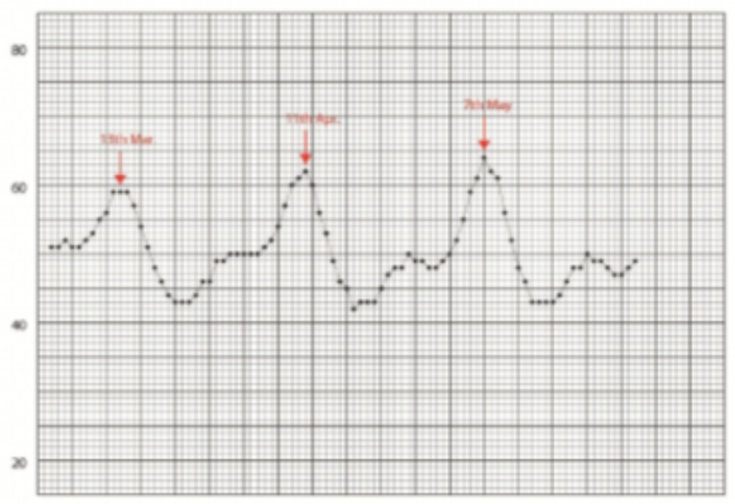
Fig. 1. Culmination time difference in minutes. On the dates marked by the red arrows the moon is at perigee.
8.2
14 days after Mar 13 (or 14 days before April 11) the moon is located on the opposite side of the perigee. Therefore, the answer is Mar 27.
8.3
There are 8 days between April 11 and April 19, which correspond to 8/27.3 of the lunar orbital period. The angle from the perigee is 105.5 degrees. There are 12 days corresponding to degrees. The locations are indicated in Fig. 2. (See just below.)
8.4
July 1 is 54 days after May 7th, where the Moon is at perigee. The Sun is near aphelion, whereas the Moon is near perigee. Therefore the sun’s apparent angular diameter is . The real diameter of the moon is km. The distance is km. Hence the apparent angular size is . Therefore, the moon appears 1.05 larger than the Sun.
8.5
The approximate size of the geostationary orbit may be found using the Kepler’s III law, with the additional fact that geostationary orbit has 27.3 times shorter period. The ratio or the orbital sizes is , or approximately 9. The answer is shown in Fig. 2.
Practical round. Basic grading criteria
| Part | Criteria |
|---|---|
| 8.1 | April (11 ± 1) – 2 pts, ± 2 days – 1 pt. |
| 8.2 | Mrch (27 ± 1) – 2 pts, ± 2 days – 1 pt. |
| 8.3 | Similar to the Figure in the answer sheet – 2 pts, ± 10 degrees – 1 pt. |
| 8.4 | Correct ratio ± 0.01 – 2 pts, ± 0.04 – 1 pts. |
| 8.5 | Similar to the figure in the solutions – 2 pts, radius less than 1 cm – 1 pts. |
Оригинал в Архива: bgpract.pdf · официални решения: practsol1.png · допълнителни данни: practsol2.png · допълнителни данни: practsol3.png · допълнителни данни: practsol4.png · допълнителни данни: practsol5.png · допълнителни данни: practsol6.png · допълнителни данни: pract_cr.png · допълнителни данни: paper.png · допълнителни данни: alphapract.pdf · допълнителни данни: betapract.pdf · допълнителни данни: data_1.png · допълнителни данни: data_2.png · допълнителни данни: data_3.png · допълнителни данни: data_4.png