IOAA 2008, Наблюдения — Задача 1. PART I: Naked Eye
The 2nd International Olympiad on Astronomy and Astrophysics, Bandung, Indonesia. Thursday, August 21, 2008. Practical Competition: Observations · 21 август 2008 г. · 150 т.
Внимание: Бележка към темата
The official CCD examples leave the limiting-magnitude answer lines blank. Printed scoring and coordinate discrepancies are retained; the M23 identification table is recovered from the original Word table beneath an overlapping naked-eye chart.
Условие
Instructions:
- All participants will receive a naked-eye observation problem set, a writing board, a pen, a ruler and a flash light at the examination room.
- Part I consists of three steps: distribution of problem sheets in examination room, naked eye observation on the observing ground (7 minutes), and returning to the examination room to answer questions (8 minutes). Bell ring will indicate the beginning and the end of each step.
- All participants will be guided by assistants to go to the observing ground until return to the examination room. Assistants will collect the answer sheets from your table, after the 8 minute time is up.
- Never forget to fill in the boxes at the top of each answer sheet with your country and your student codes. Otherwise, it will be ignored.
PROBLEM
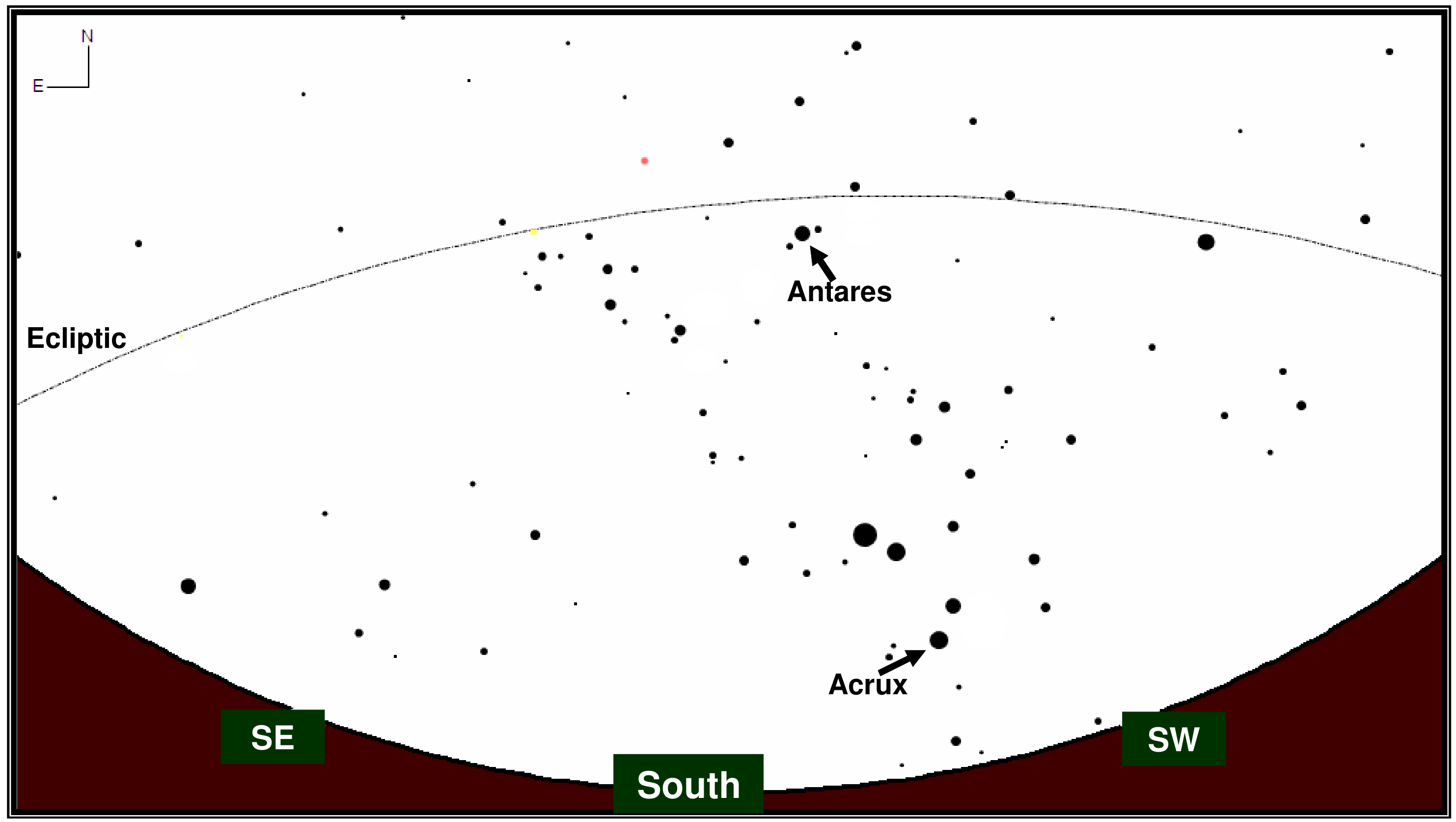
Figure 1 shows a part of the southern sky chart for August 21, 2008 at 07.00 p.m. local time. Unfortunately, a number of bright stars in Capricorn and Scorpio constellations are missing. Now, you have to find those missing bright stars in both constellations by looking at the sky directly. To help you remember, the common names of many bright stars are listed in Table 1. Draw small circles on the locations of the missing bright stars in the Capricorn and Scorpio constellations (Point: 60) and identify them by putting the numbers on the sky chart, as many as possible based on the Table 1 (Point: 60). Afterwards, draw on the sky chart, the border of Scorpio constellation (Point: 15) and Capricorn constellation (Point: 15).
Table 1: The number and common name of bright stars
| Number | Common Names | Number | Common Names |
|---|---|---|---|
| 1 | Rukbat (α Sgr) | 18 | Albali (ε Aqr) |
| 2 | Graffias (β Sco) | 19 | Altair (α Aql) |
| 3 | Nunki (σ Sgr) | 20 | Shaula (λ Sco) |
| 4 | Deneb (α Cyg) | 21 | Vrischika (π Sco) |
| 5 | Zaniah (η Vir) | 22 | Arich (γ Vir) |
| 6 | Tarazed (γ Aql) | 23 | Deneb Algedi (δ Cap) |
| 7 | Dabih (β Cap) | 24 | Heze (ζ Vir) |
| 8 | Girtab (κ Sco) | 25 | Nusakan (β CrB) |
| 9 | Spica (α Vir) | 26 | Wei (ε Sco) |
| 10 | Sabik (η Oph) | 27 | Syrma (ι Vir) |
| 11 | Dschubba (δ Sco) | 28 | Nashira (γ Cap) |
| 12 | Kaus Australis (ε Sgr) | 29 | Lesath (υ Sco) |
| 13 | Algiedi (α Cap) | 30 | Zavijava (β Vir) |
| 14 | Sadr (γ Cyg) | 31 | Arcturus (α Boo) |
| 15 | Vindemiatrix (ε Vir) | 32 | Megrez (δ UMa) |
| 16 | Antares (α Sco) | 33 | Chara (β CVn) |
| 17 | Yen (ζ Cap) | 34 | Sargas (θ Sco) |
Решение
Marking scheme
- Correct drawing for Scorpio constellation border: +15 (max)
- Correct drawing for Capricorn constellation border: +15 (max)
- Correct location of 3 bright stars in Scorpio: +10 (max. = 40)
- Correct location of 2 bright stars in Capricorn: +10 (max. = 20)
- Additional correct answer for bright star locations in both constellation, each location: +5
- Correct answer for 3 bright stars in Scorpio: +10 (max. = 40)
- Correct answer for 2 bright stars in Capricorn: +10 (max. = 20)
- Additional correct answer for bright star names in both constellation; each name: +5
MAXIMUM MARK = 150
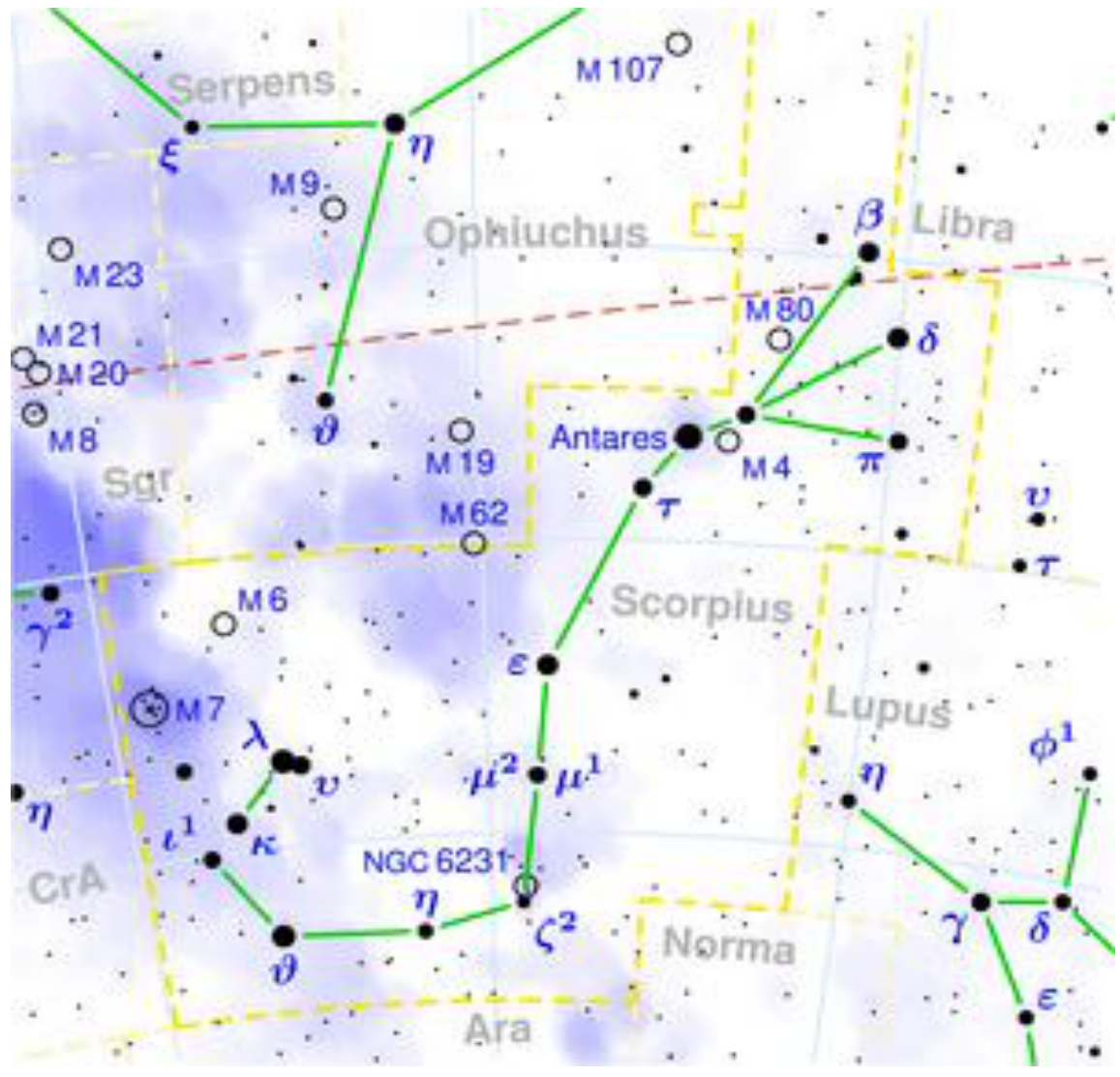
Answer: 1
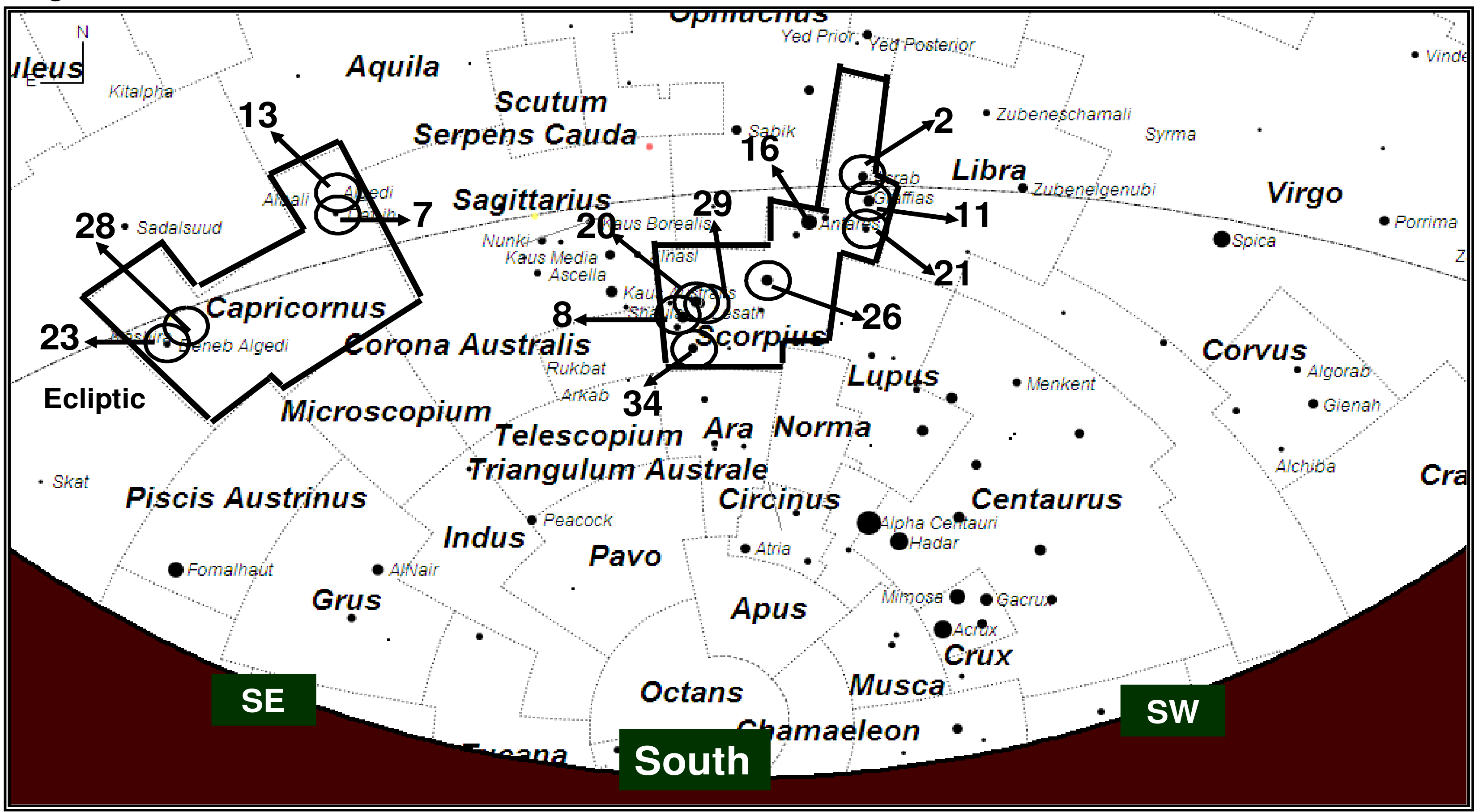
There are 9 bright stars in Scorpio constellation in the Table 1
| Number | Common Names | Bayer designation |
|---|---|---|
| 2 | Acrab Graffias | β Sco. |
| 8 | Girtab | κ Sco |
| 11 | Dschubba | δ Sco. |
| 16 | Antares (given) | α Sco. |
| 20 | Shaula | λ Sco |
| 21 | Vrischika | π Sco |
| 26 | Wei | ε Sco |
| 29 | Lesath | υ Sco |
| 34 | Sargas | θ Sco |
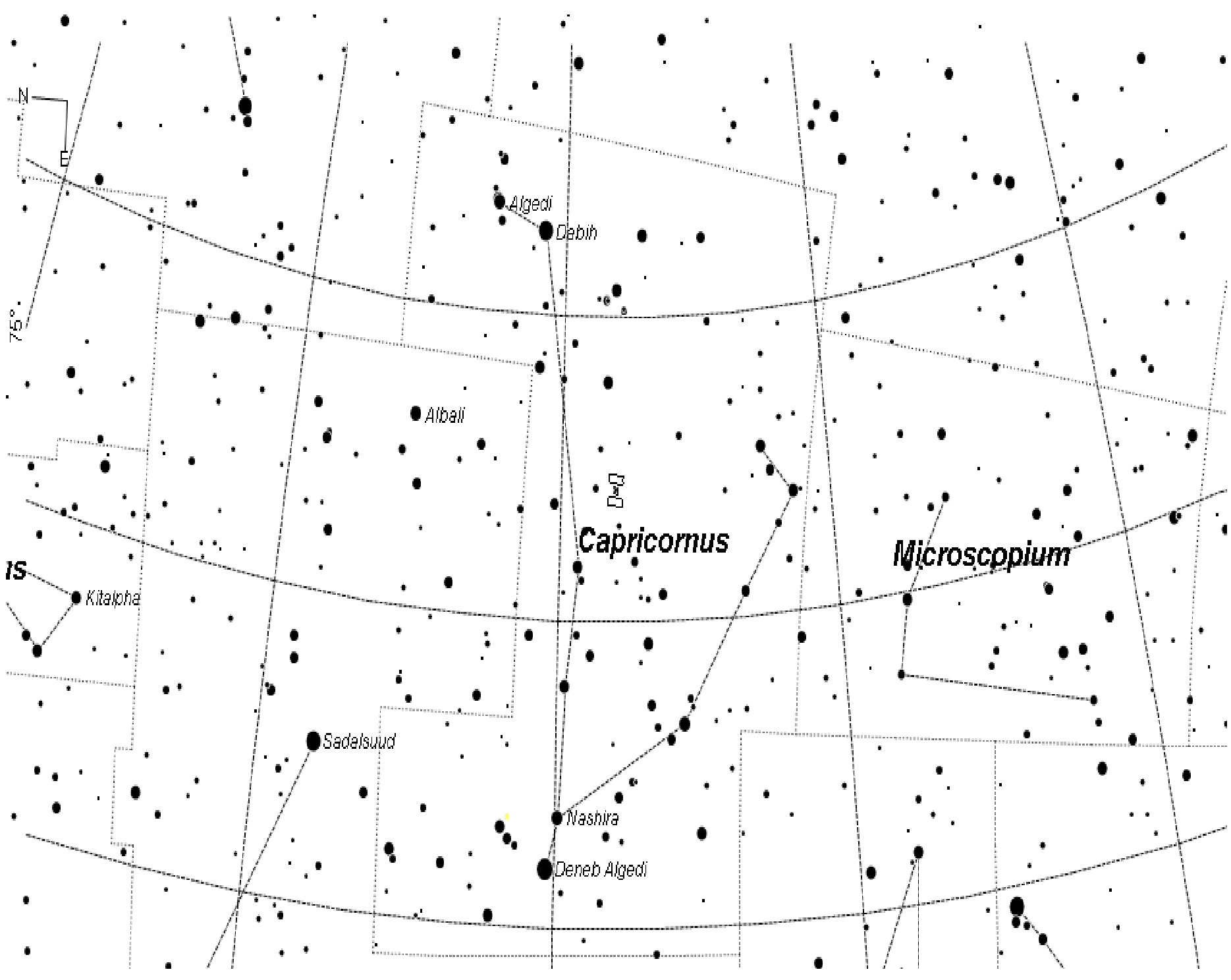
Answer: 2
There are 4 bright stars in Capricorn constellation in the Table 1
| Number | Common Names | Bayer Designation |
|---|---|---|
| 7 | Dabih | β Cap. |
| 13 | Algiedi | α Cap. |
| 23 | Deneb Algedi | δ Cap. |
| 28 | Nashira | γ Cap. |
Solution of PART I: Naked Eye
Sky chart at 19.00 on 21 August 2008
Оригинал в Архива: 2008_Observation.pdf · официални решения: nakedeye_sol.doc · допълнителни данни: ccd_sol.doc