IOAA 2015, Теория, дълги задачи, български — Задача 2
IOAA 2015 — ДЪЛГИ ЗАДАЧИ
Внимание: Бележка към темата
Официалните решения и критерии са запазени на английски. В българската задача 3 няма въпрос за разстоянието: части d/e съответстват на e/f от английския финал. В задача 1(c) българският текст определя височината на точката от орбитата, а английският финал — на горната допирателна към спътника; решението следва английската формулировка. По-ранните варианти са показани отделно и не заместват финалните условия.
Instruction — Theoretical Round
Write your answer on the answer-sheet only. You can use more than one sheet for one problem. Please ask the organizer for the additional answer-sheets.
Different problems should be done on different sheets.
You can use your own calculator without program and graphic facility.
You can ask the organizer for rough paper.
Astronomical and Physical Constants — 20150729
| Constant | Value |
|---|---|
| Astronomical unit (AU) | |
| Light year (ly) | |
| Parsec (pc) | |
| Jansky (Jy) | |
| 1 Sidereal year | 365.2564 solar days |
| 1 Tropical year | 365.2422 solar days |
| 1 Calendar year | 365.2425 solar days |
| 1 Sidereal day | |
| 1 Solar day | units of sidereal time |
| 1 Å | |
| 1 erg | |
| 1 dyne | |
| Mass of Earth | |
| Mean radius of Earth | |
| Equatorial radius of Earth | |
| Mean velocity of Earth on its orbit | |
| Mass of Moon | |
| Radius of Moon | |
| Mass of Jupiter | |
| Mean Earth – Moon distance | |
| Mass of Sun | |
| Radius of Sun | |
| Effective temperature of the Sun | 5780 K |
| Luminosity of the Sun | |
| Solar constant | |
| Brightness of the Sun in V-band | −26.8 mag. |
| Absolute brightness of the Sun in V-band | 4.75 mag. |
| Absolute bolometric brightness of Sun | 4.72 mag. |
| Angular diameter of the Sun | 30′ |
| Speed of light in vacuum (c) | |
| Gravitational constant (G) | |
| Boltzmann constant (k) | |
| Universal gas constant (R) | |
| Stefan–Boltzmann constant (σ) | |
| Planck constant (h) | |
| Wien's constant (b) | |
| Hubble constant (H₀) |
Astronomical and Physical Constants — continuation
| Constant | Value |
|---|---|
| electron charge (e) | |
| Mass of hydrogen atom | |
| Current inclination of the ecliptic (ε) | 23º 26.3′ |
| Coordinates of the northern ecliptic pole for epoch 2000.0 (αE, δE) | |
| Coordinates of the northern galactic pole for epoch 2000.0 (αG, δG) |
You can try to solve an equation using iteration: .
Basic equations of spherical trigonometry
Rayleigh-Jeans formula (long wavelength approximation of Planck’s Law):
Условие
Две масивни звезди A и B с маси и , се намират на разстояние d една от друга. Те се движат около общия център на масите под действие на гравитационни сили. Приемете, че техните орбити са кръгови и лежат в равнината X-Y, като началото на координатната система е в центъра на масите. (виж Фигура 2).
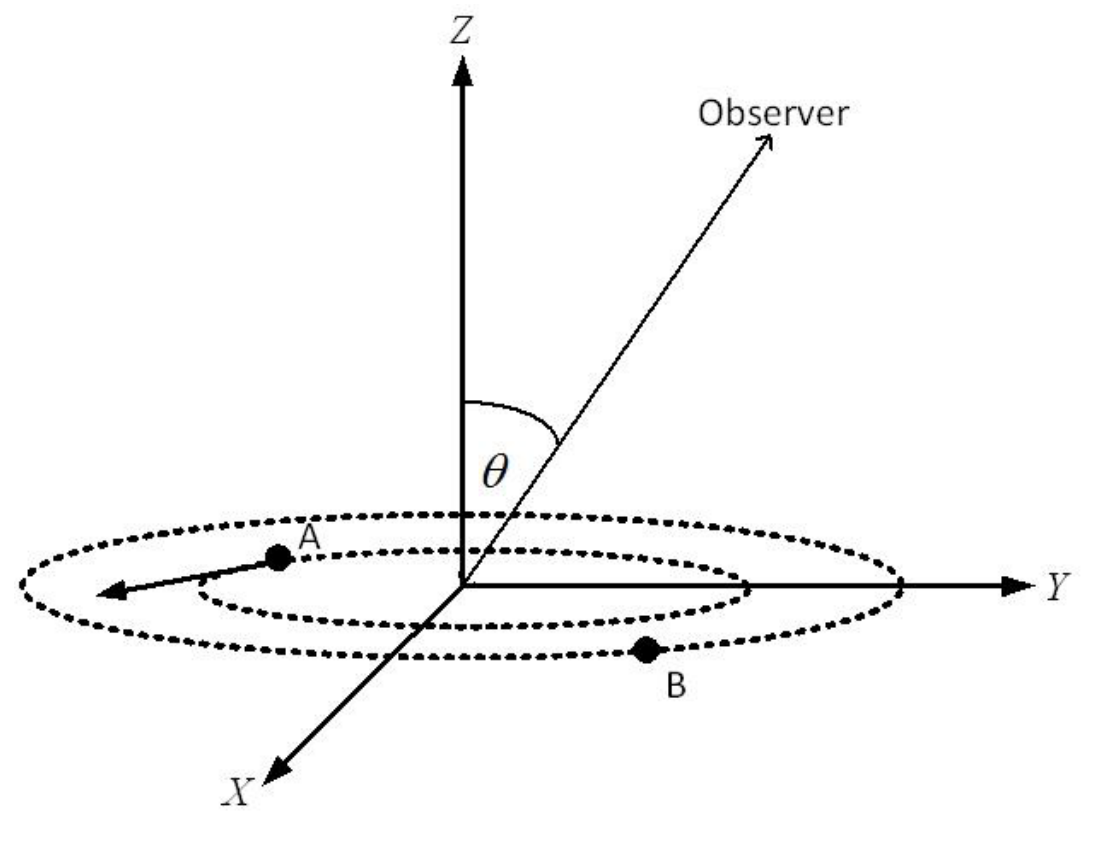
a. Изразете линейната и ъгловата скорост на звездата A.
Един наблюдател се намира в равнината Y-Z (виж Фигура 2) и наблюдава звездите от голямо разстояние под ъгъл спрямо оста Z. Той измерва, че скоростта на компонентата A по лъча на зрение (лъчевата скорост) се променя с времето по следния закон: , където и са положителни.
b. Представете израза като функция на , и ( е гравитационната константа).
Да предположим, че наблюдателят определя масата на звездата A и получава стойност 30, където е масата на Слънцето. Освен това, той наблюдава рентгеново лъчение, излъчено от обекта B и благодарение на това той може да заключи, че тя е или неутронна звезда или черна дупка. Крайното заключение зависи от точната стойност на : 1) ако < 2, то звездата B е неутронна звезда или 2) ако > 2, то звездата B е черна дупка.
c. Според измерванията на наблюдателя . Всъщност, стойността на обикновено е неизвестна. Какво условие трябва да изпълнява този ъгъл, за да бъде обектът B черна дупка?
Решение
Revised marking scheme — a. (30 т.)
The center of gravity of the stars is relatively to the star A given by
and since the orbit of A is a circle, then
So, we get
The angular velocity of A is given by
Revised marking scheme — b. (30 т.)
In Cartesian coordinate system, the velocity of A is
Unit vector of the observer is
so the component of in the line of the observer sight is given by
Since the component of in the line of the observer sight is , then
Finally, we have
Revised marking scheme — c. (40 т.)
From the result in b., namely eq. (**), we get
Since , then . Thus, the probability of B is a black hole is the same as the probability of for . So is less than or greater than .
Earlier image edition — probability question
A measurement has been done by the observer which results . If the value of has the same probability, then calculate the probability of B to be a black hole. (Hint: Use )
Since , then . Thus, the probability of B is a black hole is the same as the probability of for . Since or , then
Earlier image edition — original page 4
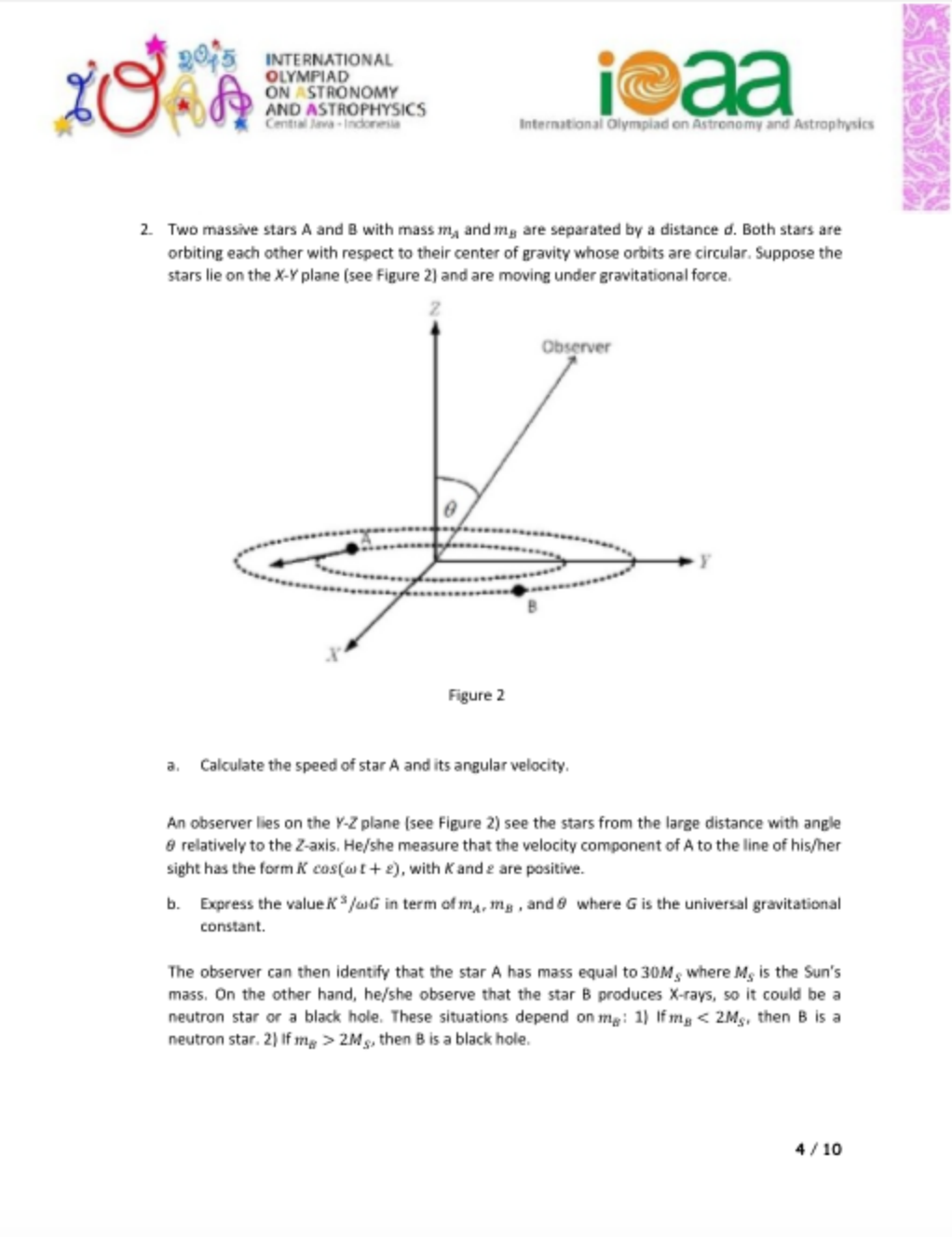
Earlier image edition — original page 5
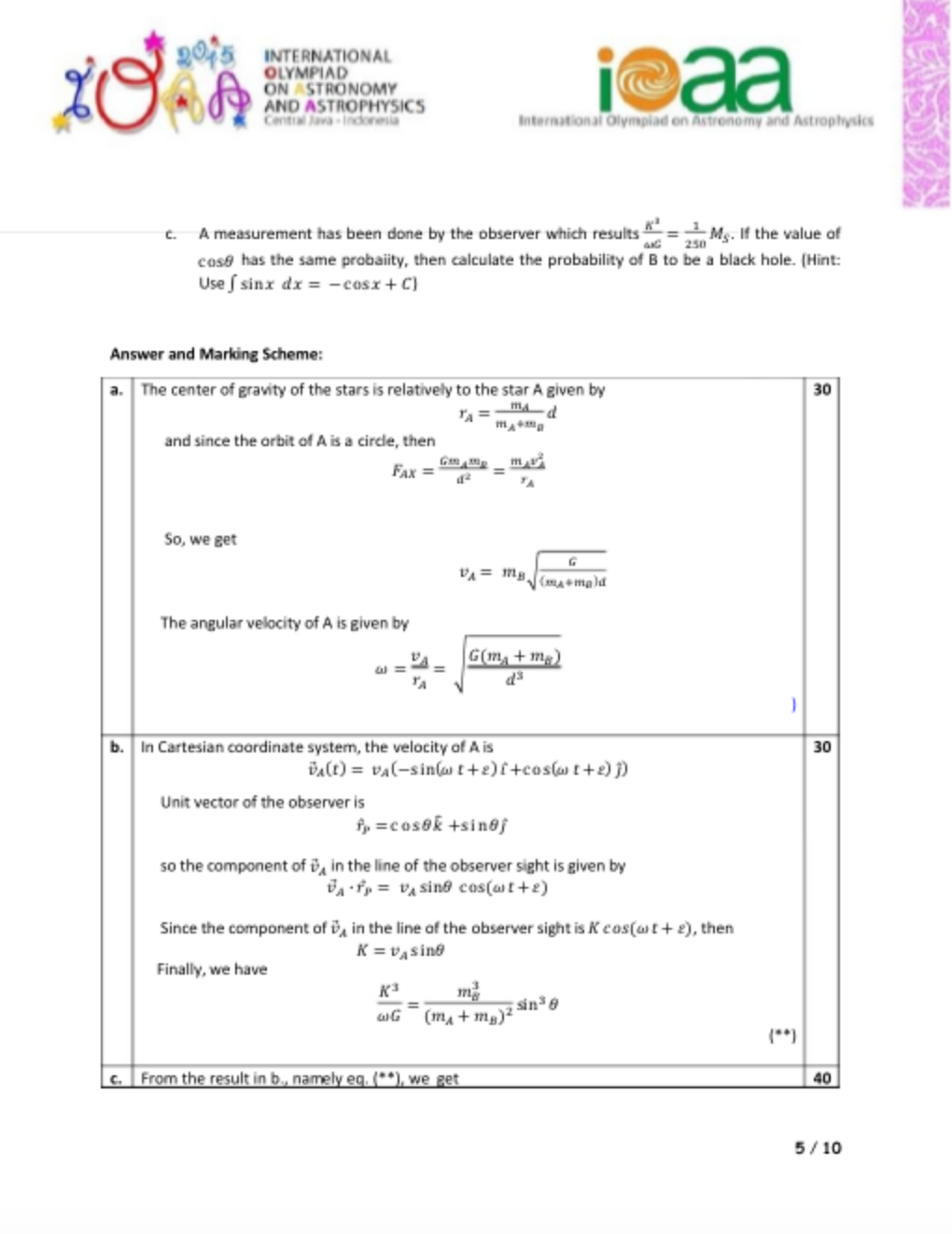
Earlier image edition — original page 6
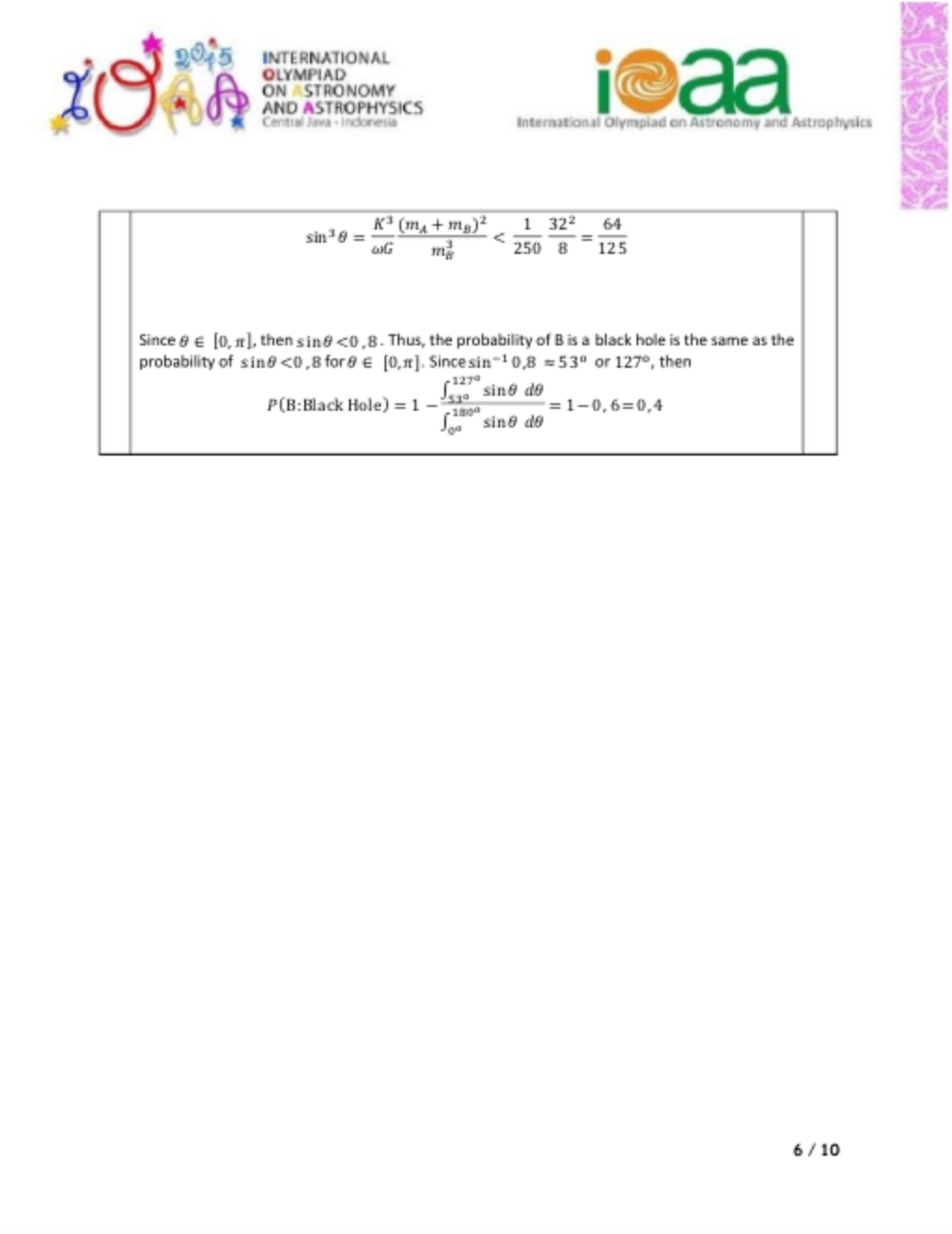
Оригинал в Архива: Long_problem_Final_BG.pdf · официални решения: Long Problem Solution-Marking Scheme [Revised] - 310715 - 13.58.pdf · допълнителни данни: long_sol_1.png · допълнителни данни: long_sol_2.png · допълнителни данни: long_sol_3.png · допълнителни данни: long_sol_4.png · допълнителни данни: long_sol_5.png · допълнителни данни: long_sol_6.png · допълнителни данни: long_sol_7.png · допълнителни данни: long_sol_8.png · допълнителни данни: long_sol_9.png · допълнителни данни: long_sol_10.png · допълнителни данни: 9th IOAA Constants Table 20150729.pdf · допълнителни данни: constants.pdf · допълнителни данни: instructions.docx