IOAA 2015, Теория, дълги задачи, английски — Задача 2
International Olympiad on Astronomy and Astrophysics 2015, Central Java - Indonesia — Long Problems
Внимание: Бележка към темата
The revised official marking scheme is primary. Earlier image-key questions and marking weights differ and are labelled separately. The revised key leaves problem 3(d) blank; the earlier distance derivation adds an assumption absent from the final question. Printed algebraic inconsistencies are retained.
Instruction — Theoretical Round
Write your answer on the answer-sheet only. You can use more than one sheet for one problem. Please ask the organizer for the additional answer-sheets.
Different problems should be done on different sheets.
You can use your own calculator without program and graphic facility.
You can ask the organizer for rough paper.
Astronomical and Physical Constants — 20150729
| Constant | Value |
|---|---|
| Astronomical unit (AU) | |
| Light year (ly) | |
| Parsec (pc) | |
| Jansky (Jy) | |
| 1 Sidereal year | 365.2564 solar days |
| 1 Tropical year | 365.2422 solar days |
| 1 Calendar year | 365.2425 solar days |
| 1 Sidereal day | |
| 1 Solar day | units of sidereal time |
| 1 Å | |
| 1 erg | |
| 1 dyne | |
| Mass of Earth | |
| Mean radius of Earth | |
| Equatorial radius of Earth | |
| Mean velocity of Earth on its orbit | |
| Mass of Moon | |
| Radius of Moon | |
| Mass of Jupiter | |
| Mean Earth – Moon distance | |
| Mass of Sun | |
| Radius of Sun | |
| Effective temperature of the Sun | 5780 K |
| Luminosity of the Sun | |
| Solar constant | |
| Brightness of the Sun in V-band | −26.8 mag. |
| Absolute brightness of the Sun in V-band | 4.75 mag. |
| Absolute bolometric brightness of Sun | 4.72 mag. |
| Angular diameter of the Sun | 30′ |
| Speed of light in vacuum (c) | |
| Gravitational constant (G) | |
| Boltzmann constant (k) | |
| Universal gas constant (R) | |
| Stefan–Boltzmann constant (σ) | |
| Planck constant (h) | |
| Wien's constant (b) | |
| Hubble constant (H₀) |
Astronomical and Physical Constants — continuation
| Constant | Value |
|---|---|
| electron charge (e) | |
| Mass of hydrogen atom | |
| Current inclination of the ecliptic (ε) | 23º 26.3′ |
| Coordinates of the northern ecliptic pole for epoch 2000.0 (αE, δE) | |
| Coordinates of the northern galactic pole for epoch 2000.0 (αG, δG) |
You can try to solve an equation using iteration: .
Basic equations of spherical trigonometry
Rayleigh-Jeans formula (long wavelength approximation of Planck’s Law):
Условие
Two massive stars A and B with masses and are separated by a distance . Both stars orbit around their center of mass under gravitational force. Assume their orbits are circular and lie on the - plane whose origin is at the stars’ center of mass (see Figure 2)
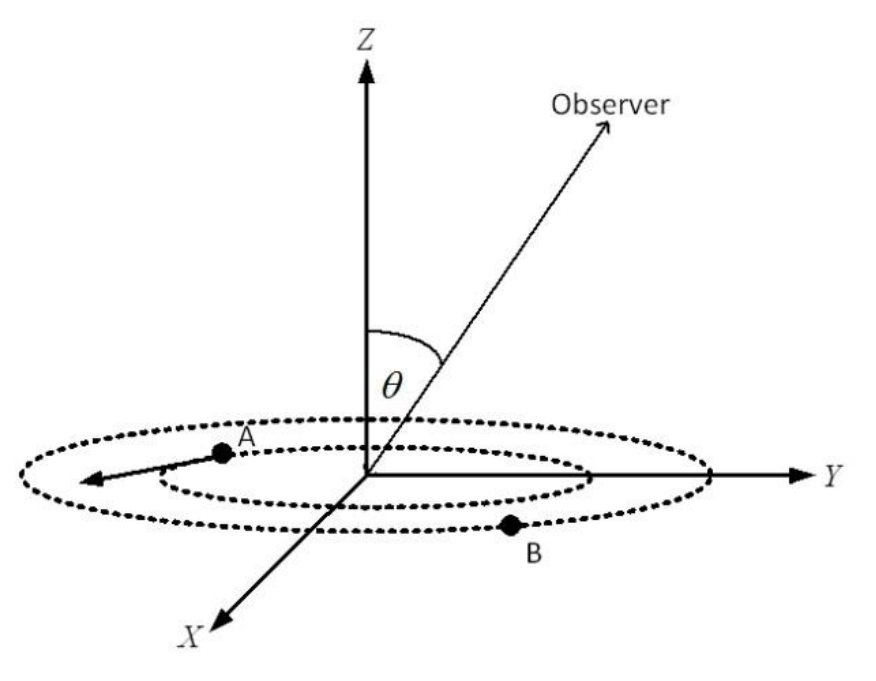
a. Find the expressions for the tangential and angular speeds of star A.
An observer standing on the - plane (see Figure 2) sees the stars from a large distance with an angle relatively to the -axis. He measures that the velocity component of star A to his line of sight has the form , where and are positive.
b. Express in terms of , , and where is the universal gravitational constant.
Assume that the observer then identifies that star A has mass equal to where is the Sun’s mass. In addition, he observes that star B produces X-rays and then realizes that it could be a neutron star or a black hole. This conclusion would depend on , i.e.: i) If , then B is a neutron star; ii) If , then B is a black hole.
c. A measurement by the observer shows that . In practice, the value of is usually not known. What is the condition on for star B to be a black hole?
Решение
Revised marking scheme — a. (30 т.)
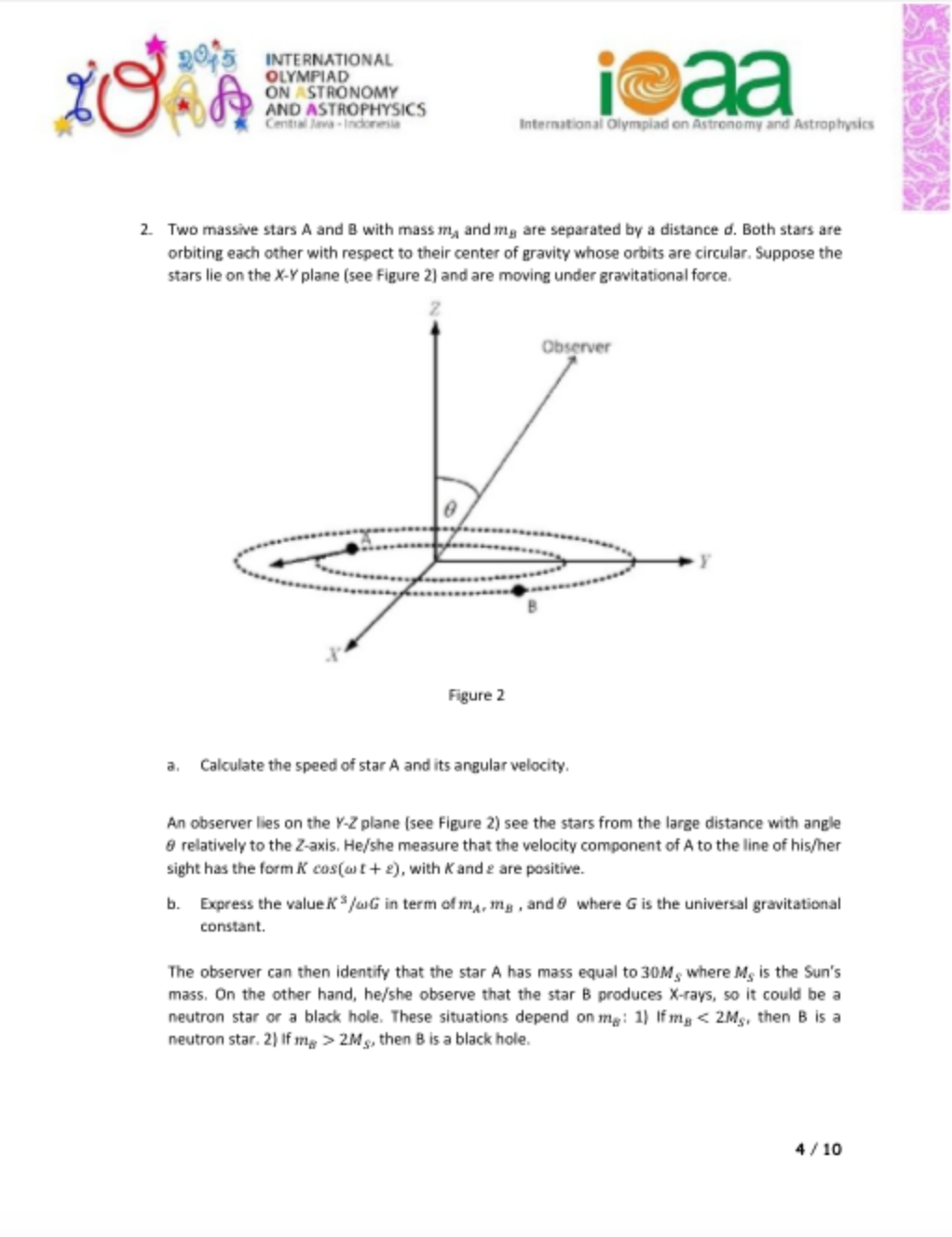
The center of gravity of the stars is relatively to the star A given by
and since the orbit of A is a circle, then
So, we get
The angular velocity of A is given by
Revised marking scheme — b. (30 т.)
In Cartesian coordinate system, the velocity of A is
Unit vector of the observer is
so the component of in the line of the observer sight is given by
Since the component of in the line of the observer sight is , then
Finally, we have
Revised marking scheme — c. (40 т.)
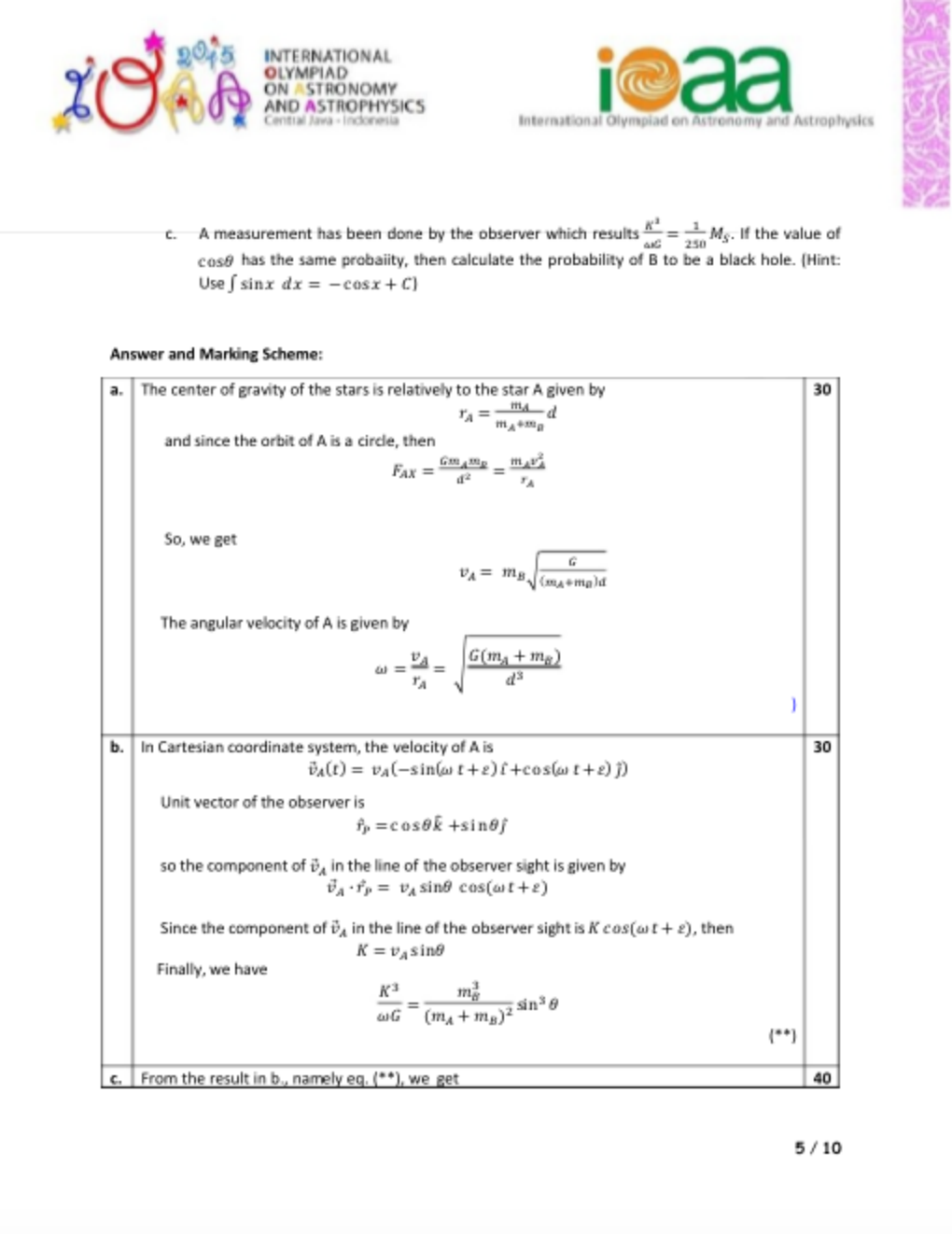
From the result in b., namely eq. (**), we get
Since , then . Thus, the probability of B is a black hole is the same as the probability of for . So is less than or greater than .
Earlier image edition — probability question
A measurement has been done by the observer which results . If the value of has the same probability, then calculate the probability of B to be a black hole. (Hint: Use )
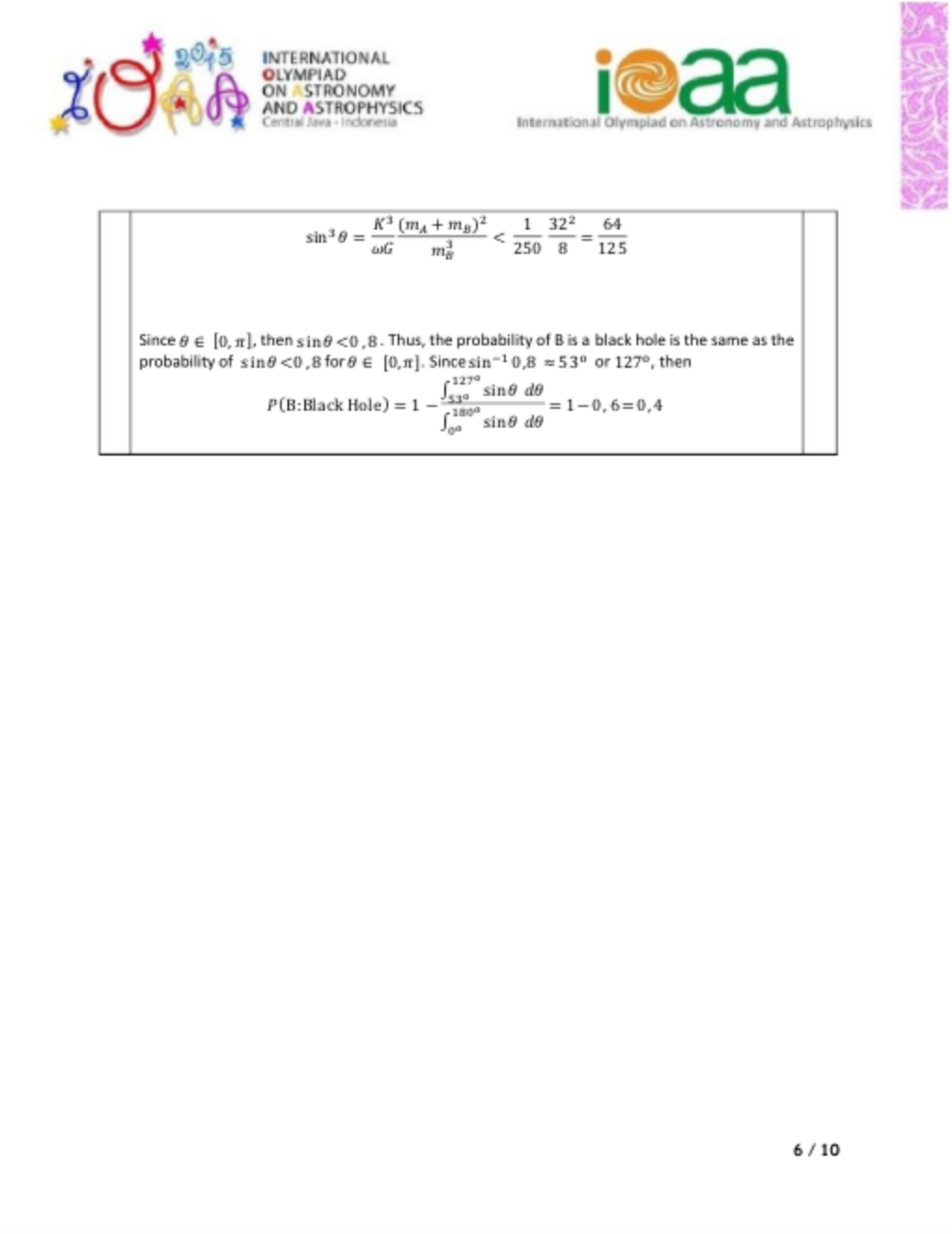
Since , then . Thus, the probability of B is a black hole is the same as the probability of for . Since or , then
Earlier image edition — original page 4
Earlier image edition — original page 5
Earlier image edition — original page 6
Оригинал в Архива: Long_problem_Final_EN.pdf · официални решения: Long Problem Solution-Marking Scheme [Revised] - 310715 - 13.58.pdf · допълнителни данни: long_sol_1.png · допълнителни данни: long_sol_2.png · допълнителни данни: long_sol_3.png · допълнителни данни: long_sol_4.png · допълнителни данни: long_sol_5.png · допълнителни данни: long_sol_6.png · допълнителни данни: long_sol_7.png · допълнителни данни: long_sol_8.png · допълнителни данни: long_sol_9.png · допълнителни данни: long_sol_10.png · допълнителни данни: 9th IOAA Constants Table 20150729.pdf · допълнителни данни: constants.pdf · допълнителни данни: instructions.docx