IOAA 2015, Теория, дълги задачи, английски — Задача 1
International Olympiad on Astronomy and Astrophysics 2015, Central Java - Indonesia — Long Problems
Внимание: Бележка към темата
The revised official marking scheme is primary. Earlier image-key questions and marking weights differ and are labelled separately. The revised key leaves problem 3(d) blank; the earlier distance derivation adds an assumption absent from the final question. Printed algebraic inconsistencies are retained.
Instruction — Theoretical Round
Write your answer on the answer-sheet only. You can use more than one sheet for one problem. Please ask the organizer for the additional answer-sheets.
Different problems should be done on different sheets.
You can use your own calculator without program and graphic facility.
You can ask the organizer for rough paper.
Astronomical and Physical Constants — 20150729
| Constant | Value |
|---|---|
| Astronomical unit (AU) | |
| Light year (ly) | |
| Parsec (pc) | |
| Jansky (Jy) | |
| 1 Sidereal year | 365.2564 solar days |
| 1 Tropical year | 365.2422 solar days |
| 1 Calendar year | 365.2425 solar days |
| 1 Sidereal day | |
| 1 Solar day | units of sidereal time |
| 1 Å | |
| 1 erg | |
| 1 dyne | |
| Mass of Earth | |
| Mean radius of Earth | |
| Equatorial radius of Earth | |
| Mean velocity of Earth on its orbit | |
| Mass of Moon | |
| Radius of Moon | |
| Mass of Jupiter | |
| Mean Earth – Moon distance | |
| Mass of Sun | |
| Radius of Sun | |
| Effective temperature of the Sun | 5780 K |
| Luminosity of the Sun | |
| Solar constant | |
| Brightness of the Sun in V-band | −26.8 mag. |
| Absolute brightness of the Sun in V-band | 4.75 mag. |
| Absolute bolometric brightness of Sun | 4.72 mag. |
| Angular diameter of the Sun | 30′ |
| Speed of light in vacuum (c) | |
| Gravitational constant (G) | |
| Boltzmann constant (k) | |
| Universal gas constant (R) | |
| Stefan–Boltzmann constant (σ) | |
| Planck constant (h) | |
| Wien's constant (b) | |
| Hubble constant (H₀) |
Astronomical and Physical Constants — continuation
| Constant | Value |
|---|---|
| electron charge (e) | |
| Mass of hydrogen atom | |
| Current inclination of the ecliptic (ε) | 23º 26.3′ |
| Coordinates of the northern ecliptic pole for epoch 2000.0 (αE, δE) | |
| Coordinates of the northern galactic pole for epoch 2000.0 (αG, δG) |
You can try to solve an equation using iteration: .
Basic equations of spherical trigonometry
Rayleigh-Jeans formula (long wavelength approximation of Planck’s Law):
Условие
A moon is orbiting a planet such that the plane of its orbit is perpendicular to the surface of the planet where an observer is standing. After some necessary scaling, suppose the orbit satisfies the following equation:
Consider Cartesian coordinates where x is on the horizontal plane and y is on the zenith of the observer. Let be the radius of the moon. Assume that the period of rotation of the planet is much larger than the orbital period of the moon. Ignore the atmospheric refraction.
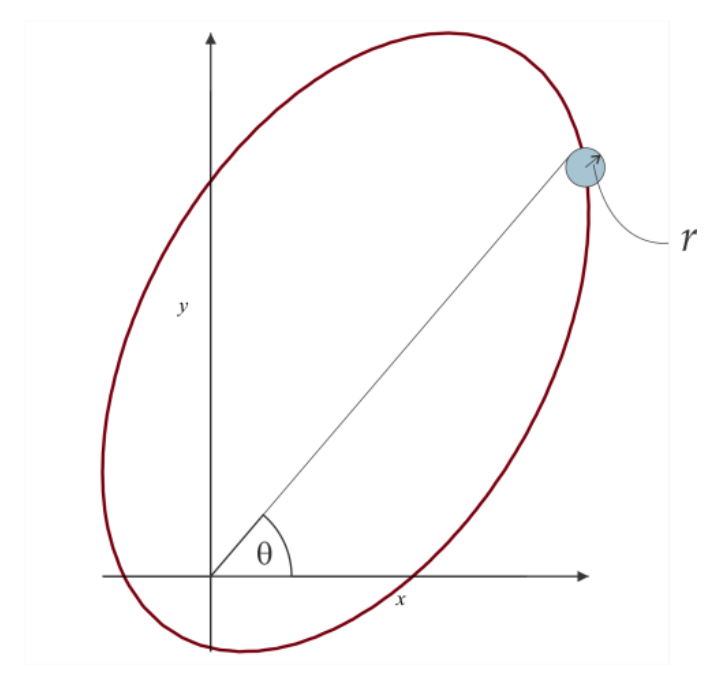
a. Calculate the semimajor and semiminor axis of the ellipse.
b. Calculate the zenith angle of perigee.
c. Determine where is the elevation angle (altitude of the upper tangent of the moon) when the moon looks largest to the observer.
Решение
1. Polar version — (a)
Rewrite the orbit equation using polar coordinate
Thus, if we let
10 points
the equation of the orbit can be written as
10 points
Determine semi major and semi minor axis of the orbit
Since is equivalent to
then, the semi major axis is 5, and (5 points) the semi minor axis is 3 (5 points).
1. Polar version — (b) (20 т.)
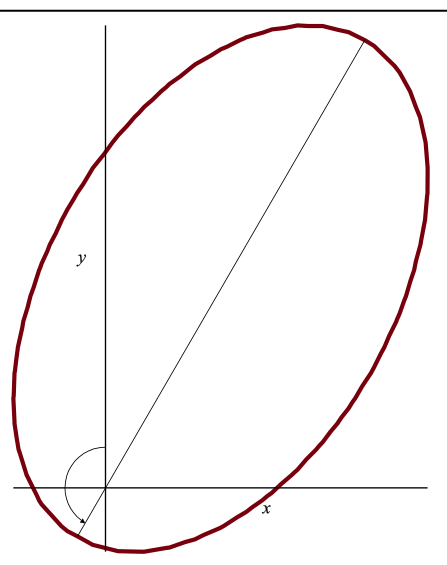
Determine the zenith angle at perigee
At the perigee, . Thus, the zenith angle at the perigee is
1. Polar version — (c)
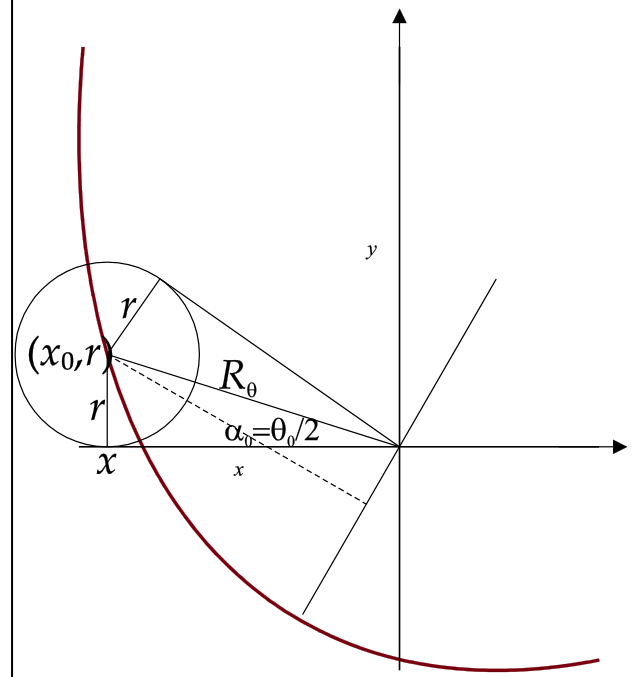
Characterize the coordinates of the moon when it looks largest to the observer.
Let be the point where it looks largest to the observer. Since the distance between the moon and the observer decreases as it moves from apogee towards perigee, then the moon looks largest to the observer at the planet when it closest to the planet while the whole of the moon still can be seen in full. Hence, .
10 points
Determine the coordinates of the point.
Let the coordinate be .
Rewrite it as a quadratic equation in .
Solving for , we get
20 points
Then choose the smaller one
10 points
Find . Hence
10 points
2. Cartesian version — (a)
Notice the standard version of the orbits
Simplify the equation by introducing new variables
10 points
Write the orbit equation in terms new variables
10 points
Determine semi major and semi minor axis of the orbit
Since is equivalent to
The semi major axis is 5 (5 points)
The semi major axis is 3 (5 points)
2. Cartesian version — (b) (20 т.)
Determine the zenith angle at perigee
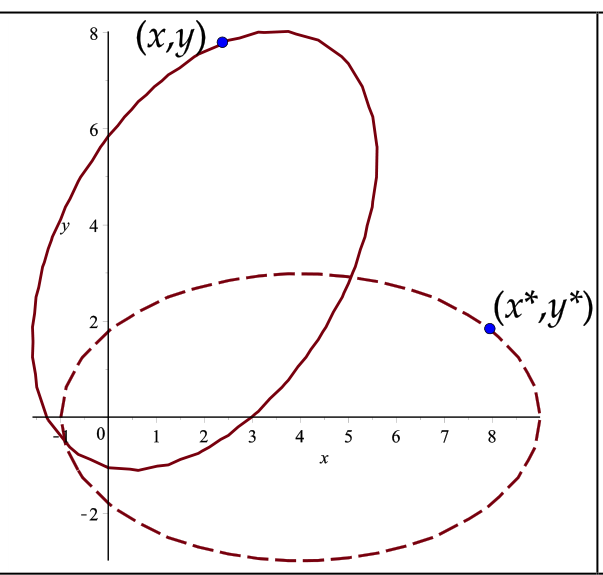
Since the original ellipse may be obtained from standard ellipse
by counterclockwise rotation respect to the origin, the the zenith angle at perigee is equal to
2. Cartesian version — (c)
Characterize the coordinates of the moon when it looks largest to the observer.
Let be the point where it looks largest to the observer. Since the distance between the moon and the observer decreases as it moves from apogee towards perigee, then the moon looks largest to the observer at the planet when it closest to the planet while the whole of the moon still can be seen in full. Hence, .
10 points
Find .
Rewrite it as a quadratic equation in .
Solving it for we get
20 points
Then choose the smaller one
10 points
Find . Hence
10 points
3. Cartesian version — (a)
Notice the standard version of the orbits
Simplify the equation by introducing new variables
10 points
Write the orbit equation in terms new variables
10 points
Determine semi major and semi minor axis of the orbit
Since is equivalent to
The semi major axis is 5 (5 points)
The semi major axis is 3 (5 points)
3. Cartesian version — (b) (20 т.)
Notice the standard version of the orbits
Since the original ellipse may be obtained from standard ellipse
by counterclockwise rotation respect to the origin, the the zenith angle at perigee is .
3. Cartesian version — (c)
Identify and characterized the coordinates when the planet looks largest.
Since the distance between the moon and the observer decreases as it moves from apogee towards perigee, then the moon looks largest to the observer at the planet when it closest to the planet while the whole of the moon still can be seen in full. Hence, it is at necessary that . Let the coordinates be .
10 points
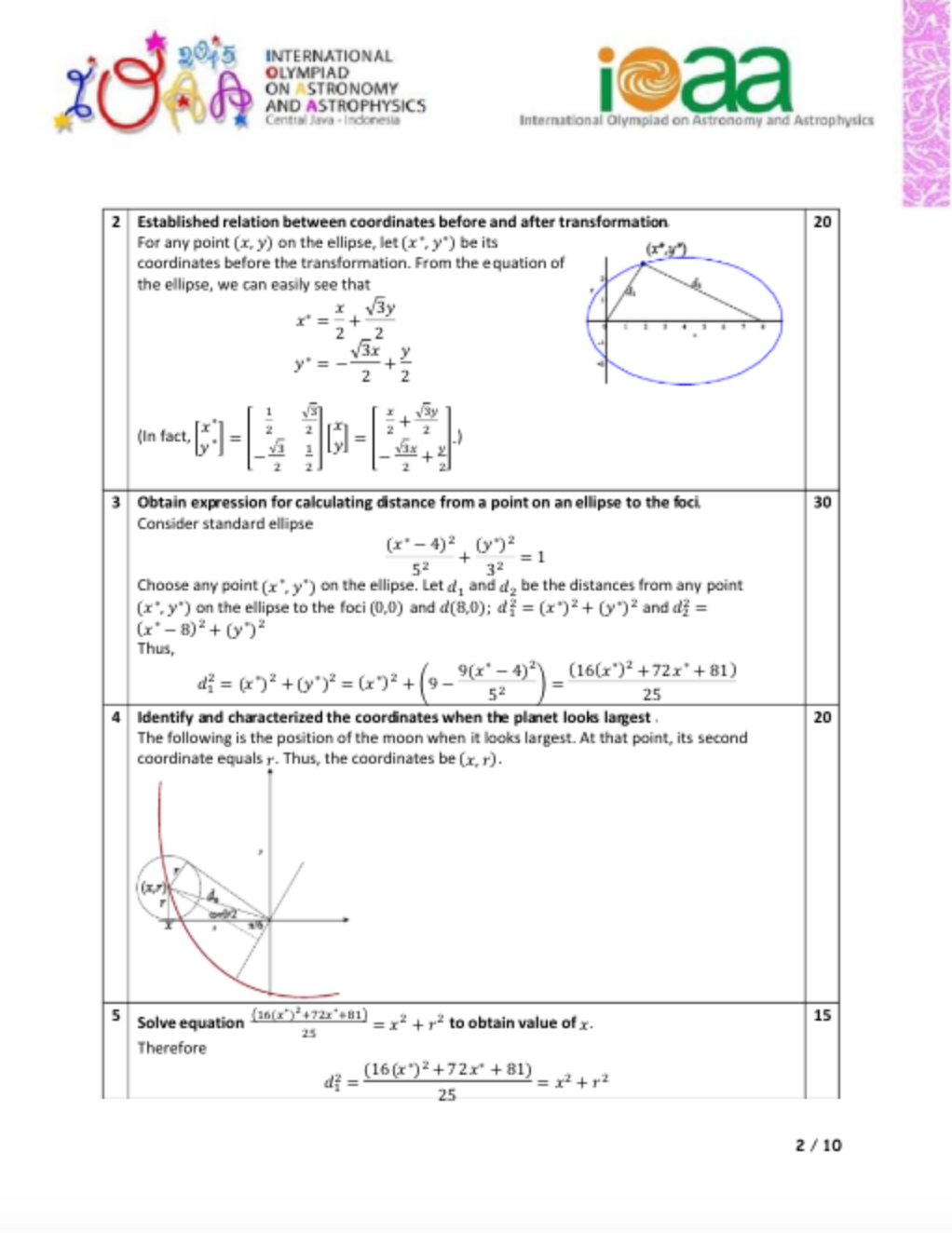
Obtain expression for calculating distance from a point on an ellipse to the foci to set up an equation
Consider standard ellipse
Choose any point on the ellipse. Let and be the distances from any point on the ellipse to the foci and ; and .
Thus,
Therefore
where . Therefore, we can obtain the value of by solving the above equation for .
10 points
Solve equation to obtain value of .
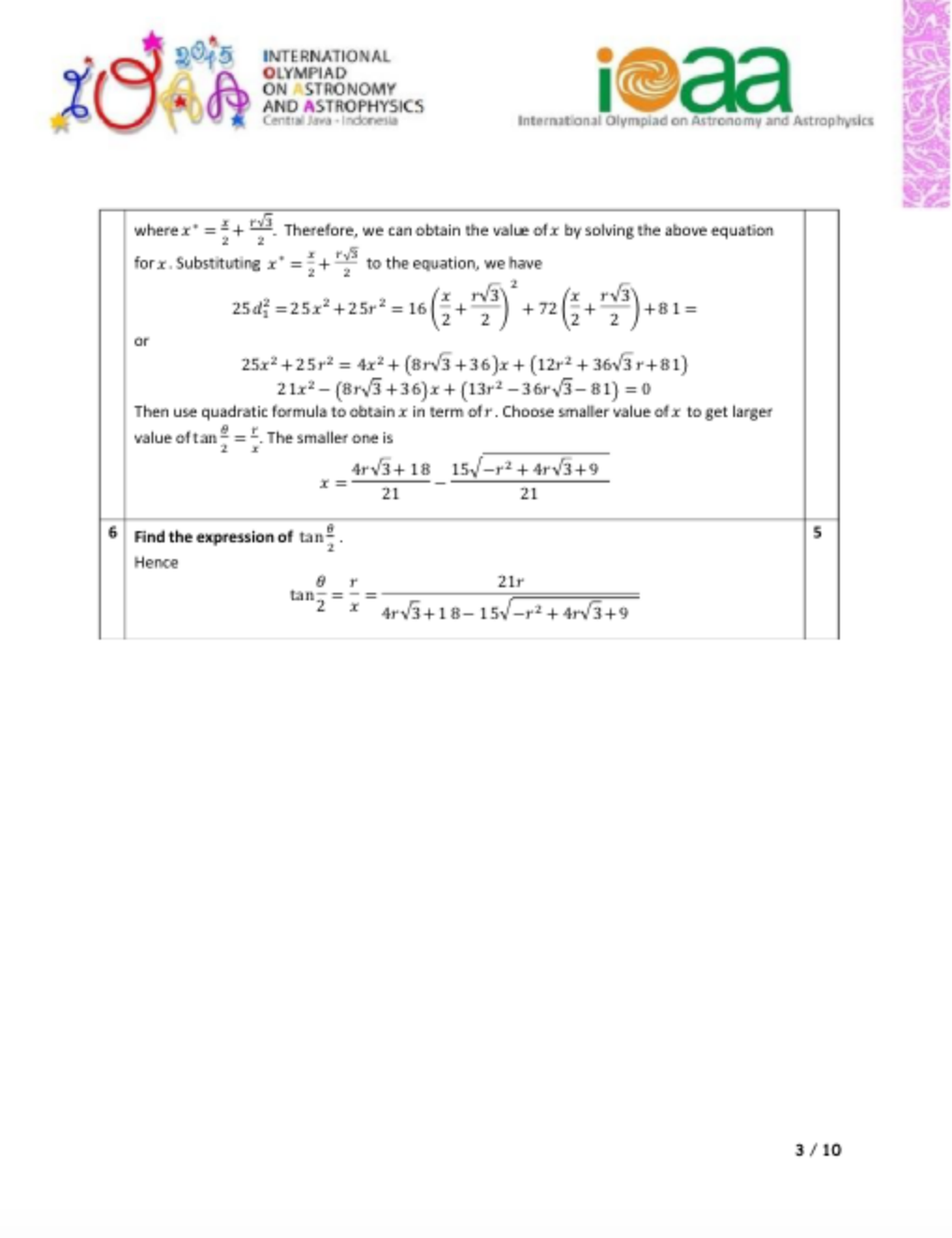
Substituting to the equation, we have
or
Then use quadratic formula to obtain in term of . Choose smaller value of to get larger value of . The smaller one is
20 points
Find the expression of . Hence
10 points
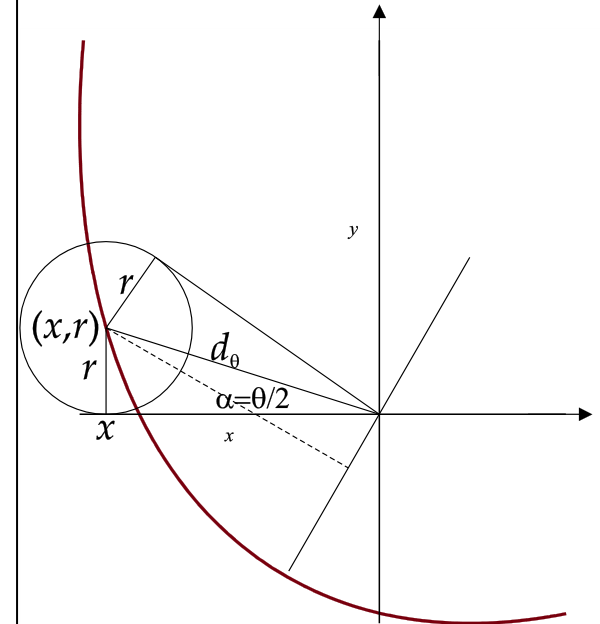
Earlier image edition — marking scheme
| Step | Points |
|---|---|
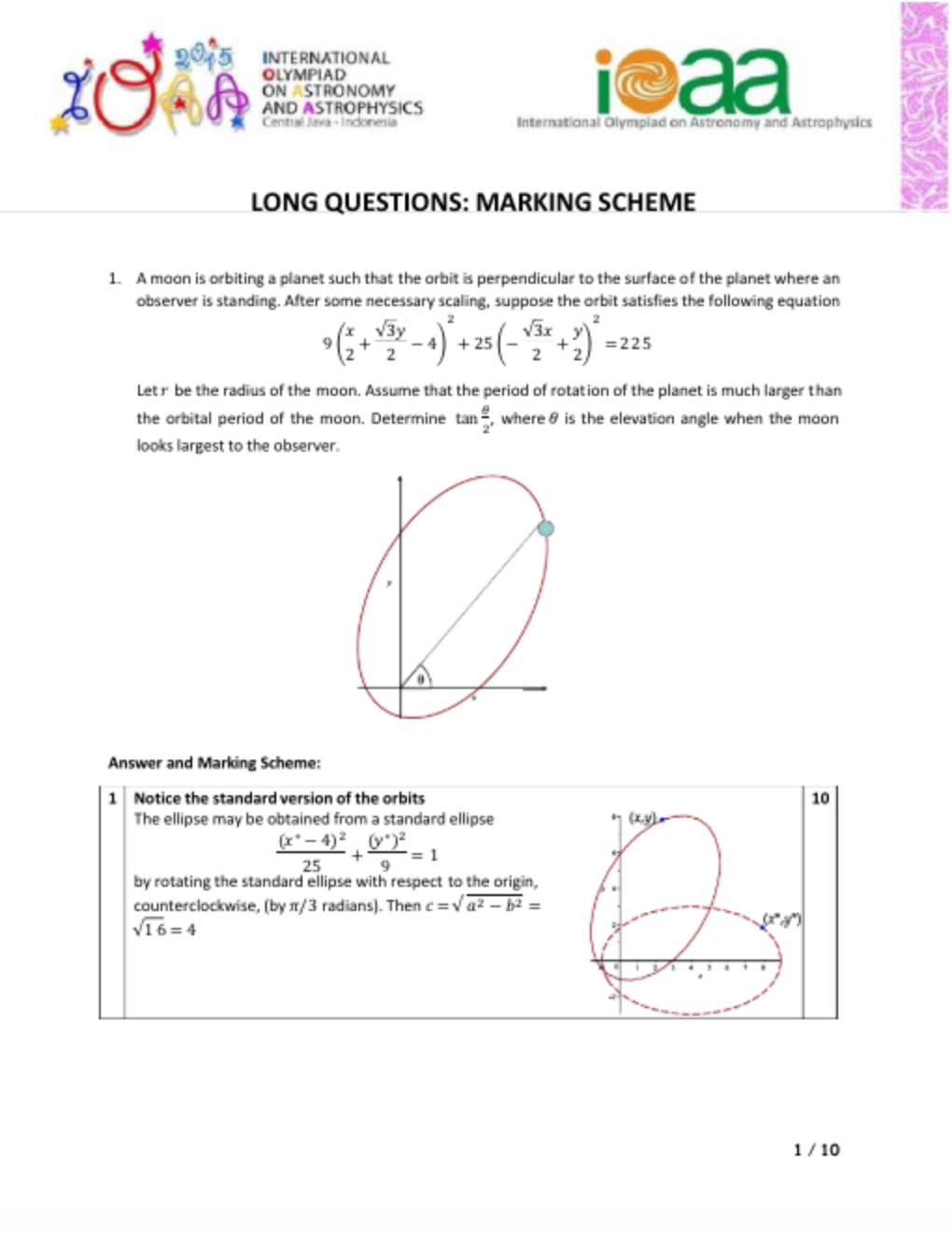
| 1 Notice the standard version of the orbits | 10 |
| 2 Established relation between coordinates before and after transformation | 20 |
| 3 Obtain expression for calculating distance from a point on an ellipse to the foci | 30 |
| 4 Identify and characterized the coordinates when the planet looks largest. | 20 |
| 5 Solve equation to obtain value of . | 15 |
| 6 Find the expression of . | 5 |
The ellipse may be obtained from a standard ellipse
by rotating the standard ellipse with respect to the origin, counterclockwise, (by radians). Then .
For any point on the ellipse, let be its coordinates before the transformation. From the equation of the ellipse, we can easily see that
Earlier image edition — original page 1
Earlier image edition — original page 2
Earlier image edition — original page 3
Оригинал в Архива: Long_problem_Final_EN.pdf · официални решения: Long Problem Solution-Marking Scheme [Revised] - 310715 - 13.58.pdf · допълнителни данни: long_sol_1.png · допълнителни данни: long_sol_2.png · допълнителни данни: long_sol_3.png · допълнителни данни: long_sol_4.png · допълнителни данни: long_sol_5.png · допълнителни данни: long_sol_6.png · допълнителни данни: long_sol_7.png · допълнителни данни: long_sol_8.png · допълнителни данни: long_sol_9.png · допълнителни данни: long_sol_10.png · допълнителни данни: 9th IOAA Constants Table 20150729.pdf · допълнителни данни: constants.pdf · допълнителни данни: instructions.docx