IOAA 2015, Теория, кратки задачи, английски — Задача 5
SHORT PROBLEMS
Условие
An observer is trying to determine an approximate value of the orbital eccentricity of a man-made satellite. When the satellite was at apogee, it was observed to have moved by in a short time. When the radius vector connecting Earth and the satellite is perpendicular to the major axis (true anomaly is equal to ), within the same duration of time, it was observed to have moved by . Assume that the observer is located at the center of the Earth. Find an approximate value of the eccentricity of the satellite’s orbit.
Решение
Answer and Marking Scheme:
1 Identify expression for .
[30]
We know that . Hence
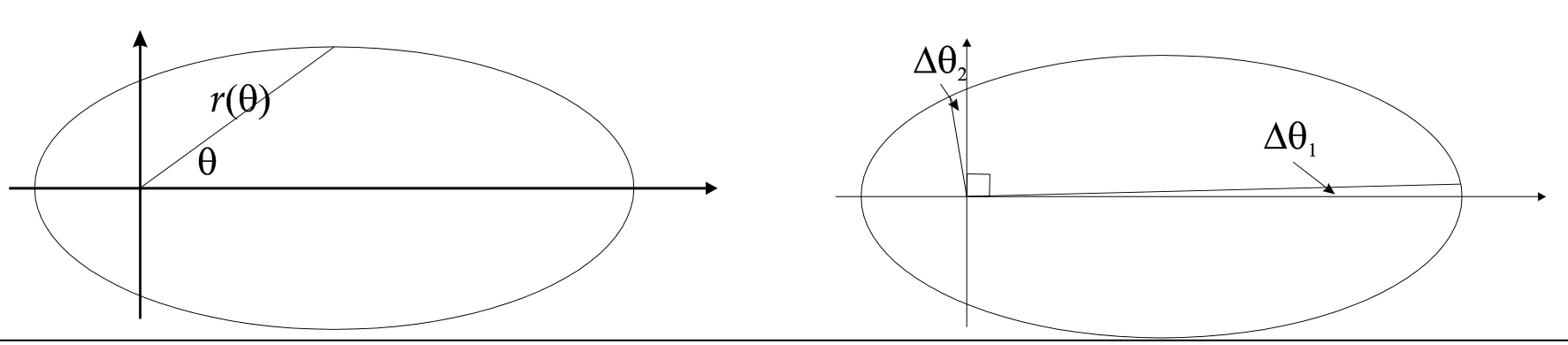
2 Estimate area of sectors using area of triangles.
[20]
Estimate the area of swept out sectors as the area of sectors of circles
3 Use Kepler’s second law to find a relation between the ratio and the eccentricity .
[30]
Use Kepler’s second law to obtain that
Thus,
4 Obtain an estimate value of the eccentricity.
[20]
Thus, the eccentricity is
13. Earlier marking-scheme variant
- Two protons collide to produce deuteron, positron, and neutrino in the center of a star. Write down the reaction equation and calculate the minimum temperature needed for this reaction. Assume that the neutrino mass is negligible.
Answer
1 [20]
2 [20]
3 [20]
4 [20]
5 [20]
Оригинал в Архива: Short_problem_Final_EN.pdf · официални решения: Short Problem Solution-Marking Scheme 30.07.pdf · допълнителни данни: Short_Problem_Solution.docx