IOAA 2021, Теория — Задача 14. Formation of the Venus-2
Theory — Q14-1 / Q14-2, English (Official), International Olympiad on Astronomy and Astrophysics 14 · 35 т.
Условие
A comet of mass is heading ("falls") radially towards the Sun. It is known that the total mechanical energy of the comet is zero. The comet crashes into Venus, whose mass is . We further assume that the orbit of Venus, before the collision, is circular with radius . After the crash, the comet and Venus form a single object, called "Venus-2".
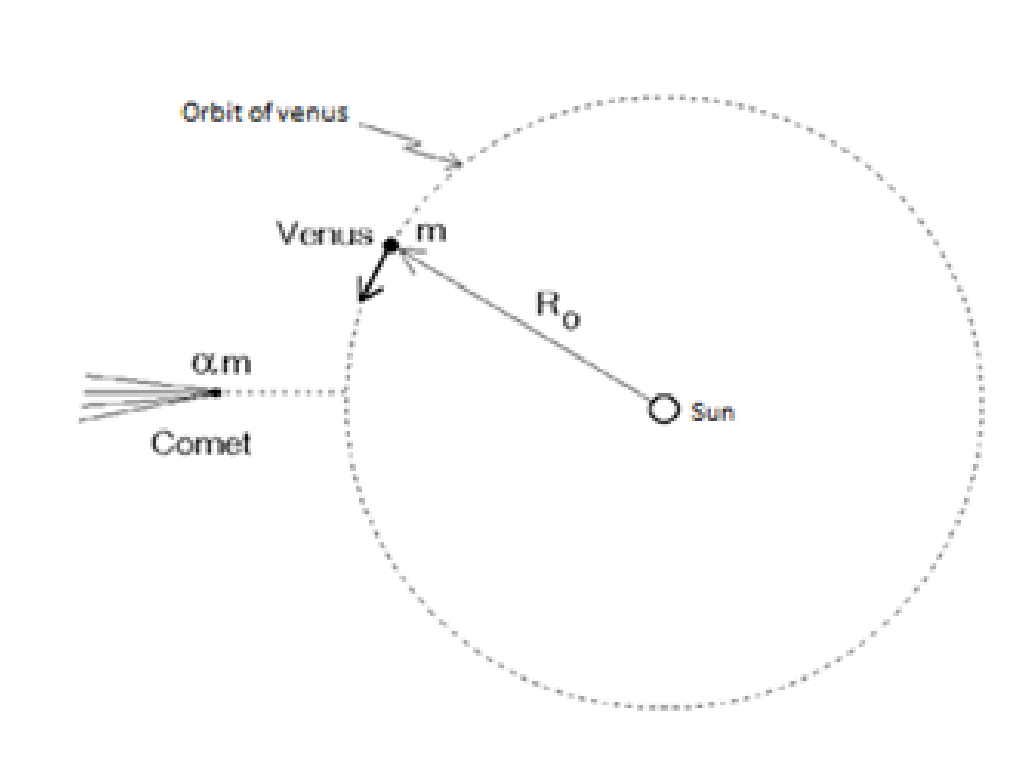
14.1 Find the expression in terms of and for the orbital speed, , of Venus before the collision. [1 т.]
14.2 Find an expression for the total mechanical energy of Venus in its orbit before colliding with the comet. [1 т.]
14.3 Find an expression for the radial velocity, , the angular momentum, , of "Venus-2" immediately after the collision. [10 т.]
14.4 Find an expression for the mechanical energy of the combined object "Venus-2" and express it in terms of energy before the collision, and . [5 т.]
14.5 Show that the post-collision orbit of "Venus-2" is elliptical and determine the semi-major axis of the orbit. [5 т.]
14.6 Determine if the year for the inhabitants of "Venus-2" has been shortened or lengthened because of collision with the comet. Write the ratio between the period of Venus-2 and Venus. [3 т.]
14.7 What should be the value of such that the post-collision orbit of Venus-2 would make it crash in the Sun? We will call this as [5 т.]
14.8 A comet with collided with Venus. Calculate the percentage change in the magnitude of Venus' velocity () and the change in the direction of the velocity vector () immediately after the collision. [5 т.]
Отговори
- 14.1
- 14.2
- 14.3
- 14.4
- 14.5
- 14.6
- 14.7
- 14.8
Решение
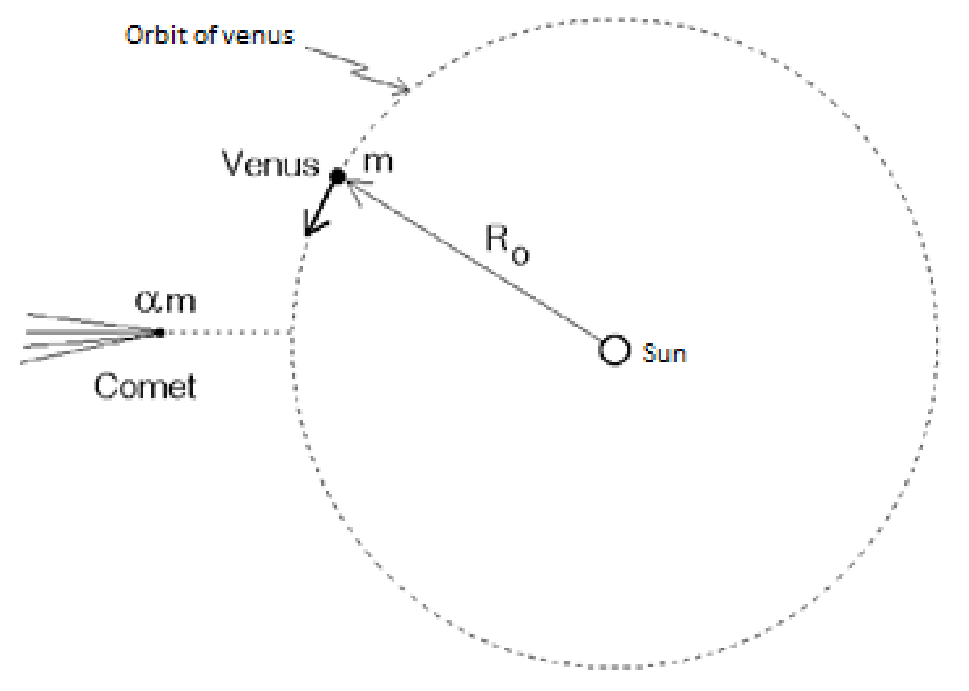
14.1 Let be the mass of the Sun.
[1 point]
14.2 The mechanical energy of Venus (before the collision) is:
[1 point]
14.3 Since the comet moves radially towards the Sun, it has no angular momentum (with respect to the origin in the Sun). Then the angular momentum of Venus is the same as that of Venus-2.
[2 points]
This allows us to find the angular component of the velocity of Venus, , just after collision. The angular momentum just after collision is:
[1 point]
Since angular momentum is conserved, it follows that
The comet has zero energy, so
[2 points]
where is the velocity of the comet just before collision. It follows that
[1 point]
The collision is inelastic, so total energy is not conserved. Also notice that the mass of Venus-2 is . [2 points]
We apply conservation of linear momentum. Along the radial direction:
[1 point]
where is the velocity of Venus-2 just after collision. It follows that
[1 point]
14.4 The mechanical energy of Venus-2 (evaluated just after collision) is
[4 points]
[1 point]
14.5 The Venus-2 orbit is no longer a circle. Since the energy is negative, it must be elliptical. It follows that [1 point]
[2 points]
where is the semi-major axis of Venus-2. Now solving:
[2 points]
14.6 Using Kepler's third law:
[2 points]
[1 point]
For , the year is shorter; for , the year is longer; and for , the year remains unchanged.
14.7 For Venus-2 to collide with the Sun, the perihelion radius of the post-collision orbit should be . [1 point]
Let .
We apply conservation of angular momentum right after collision and when Venus-2 is at perihelion:
where is the speed at perihelion. Solving:
Conservation of energy at the two instants:
[3 points]
[1 point]
14.8 For the post-collision orbit:
[1 point]
[3 points]
Thus,
[0.5 points]
[0.5 points]
Official source discrepancies
The separately archived revised TQ14 key is used. Its last derivation prints delta v = -0.259 v0 followed by positive delta v/v0 = 25.9%; both signs are retained. The older combined key ends on original page25 with different 14.8 numbers (18.35%, 34.74 degrees), and is not blended into this revised solution.
Оригинал в Архива: TQ-14-Q.pdf · официални решения: TQ14_solution_revised.pdf · допълнителни данни: TQ-14-A.pdf · допълнителни данни: Standard-Table-of-constants.docx.pdf · допълнителни данни: TQ-G.pdf · допълнителни данни: data.pdf