IOM 2016, Експеримент — Задача 1. Titrimetric determination of glucose and sucrose in a mixture
The 1st Metropolises Olympiad. Chemistry. Practical task on Analytical Chemistry; Practical task on Organic Chemistry · 6 септември 2016 г. · 20 т.
General Directions
- safety rules follow ones adopted at the International Chemistry Olympiad, no eating or drinking in the lab.
- violating safety rules you get one warning only; offend again: you are disqualified.
- the exam includes two parts. One student in each team starts with the Organic chemistry task, whereas the other with the Analytical chemistry task.
- time 2 h 15 min to complete each part, 15 min break in between. 30 min warning before the end of each part. You will be guided to the break area and back to the lab.
- when entering the lab search for the table with your student code.
- your student code get sure this is present on every page.
- answers only in the answer boxes in the booklet, nothing else will be graded. Relevant calculations have to be shown.
- use only the pen, pencil and calculator provided.
- more chemicals needed? Ask your lab assistant. No penalty for this with an exception of the hereunder.
- questions concerning safety, apparatus, chemicals, toilet break: ask your lab assistant.
- chemical waste carefully pour in the sink at your working place.
- official English version available on request for clarification only. Ask your lab assistant.
- after the stop signal put your booklet aside and leave it at your working table.
- You must stop your work immediately after the stop signal has been given. A 5 min delay will result in zero points for the current task.
During the Practical exam some of the glassware and plastics are expected to be used several times. Clean it carefully.
Specific directions for the Analytical chemistry task
- problem and answers booklet for the Analytical chemistry task 8 pages (incl. cover sheet and Periodic table of elements)
Reagents
| Reagent | Quantity | Placed in | Labeled |
|---|---|---|---|
| On each working place | |||
| Sample (a mixture of glucose and sucrose) | To be determined | 50 mL Volumetric flask | Sample and your student code |
| Hydrochloric acid, 2 M | 15 mL | 30 mL Amber glass vial with ground joint cap | HCl 2 M |
| Sodium thiosulfate, 0.1 M | 100 mL | 125 mL Plastic bottle with screw cap | |
| Sodium hydroxide solution, 2 M | 15 mL | 30 mL Amber glass drop bottle | NaOH 2 M |
| Sodium hydroxide solution, 0.1 M | 125 mL | 125 mL Plastic bottles with screw cap | NaOH 0.1 M |
| Starch (0.5-1%) | 10 mL | 30 mL Amber glass drop bottle | Starch |
| Distilled water | 500 mL | 500 mL wash bottle | - |
| On the table of common use | |||
| Iodine (0.05 M solution in , 2.4% KI) | 1 L (to be shared by 4 students) | Volumetric flask and burette | |
| Methyl Red | 10 mL (to be shared by 4 students) | 30 mL Amber glass drop bottle | Methyl red |
| Sodium hydroxide solution, 0.1 M | 125 mL | 125 mL Plastic bottles with screw cap | NaOH 0.1 M |
Labware and equipment
| Item | Quantity |
|---|---|
| On each working place | |
| Laboratory stand with burette clamp | 1 |
| 50 mL beaker | 1 |
| 25 mL cylinder | 1 |
| 100 mL beaker | 1 |
| 5 mL pipette | 2 |
| 20 mL Bulb (Mohr) pipette | 1 |
| Pipette filler | 1 |
| 25 mL burette | 1 |
| Glass funnel | 1 |
| 100 mL Erlenmeyer (conical flat-bottom) flask | 2 |
| 50 mL Volumetric flask | 2 |
| Gloves | 1 pair |
Specific directions for the Organic chemistry task
The Organic chemistry booklet repeats the General Directions of page 2 and adds:
- problem and answers booklet for the Organic chemistry task 8 pages (incl. cover sheet and Periodic table of elements)
- each extra Portion of the aldehyde or 2,4-dinitrophenylhydrazine: a penalty of 1point out of 40.
List of Chemicals
| Reagent | Quantity | Placed in | Labeled |
|---|---|---|---|
| On each working place | |||
| 2,4-Dinitrophenylhydrazine | 200 mg each, 2 vials | small amber glass vial | 2,4-DNPH |
| Sulfuric acid, concentrated | 1 mL each, 2 bottles | plastic bottle with screw cap | |
| Aldehyde solution, 1 mmol in ethanol | 4 mL each, 2 bottles | 30 mL plastic bottle with screw cap | Aldehyde 1 and Aldehyde2 |
| Ethanol | 30 mL | large amber glass vial | Ethanol |
| Distilled water | 500 mL | 500 mL wash bottle | - |
Labware and equipment (Organic chemistry task)
| Item | Quantity |
|---|---|
| On each working place | |
| Glass weighing bottle labeled “Product 1 and your student code” | 1 |
| Glass weighing bottle labeled “Product 2 and your student code” | 1 |
| Lab stand with a clamp and ring | 1 |
| 50 or 100 mL beaker | 2 |
| Magnetic stirrer | 1 |
| Stirring bar | 2 |
| Glass filter | 2 |
| Adapter | 1 |
| 250 mL round bottom flask | 1 |
| Water-jet pump | 1 |
| 2 mL pipette | 2 |
| 5 mL pipette | 2 |
| Pipette filler | 1 |
| Spatula | 1 |
| 25 mL measuring cylinder | 1 |
| Filter paper | 3 |
| Glass rod | 1 |
| Tweezers | 1 |
| pH indicator papers | 1 |
| Balances | 1 |
| On the tables for the common use | |
| Filter paper | |
| Gloves |
Условие
| Question | 1 | 2 | 3 | 4 | 5 | 6 | 7 | Total |
|---|---|---|---|---|---|---|---|---|
| Techn. points | 20 | 20 | 1 | 1 | 1 | 3 | 4 | 50 |
Concentration of reducing sugars is determined by iodometric back titration. The iodine excess is titrated by a standard thiosulfate solution using starch as an indicator. The glucose concentration is determined in the initial mixture, whereas the sucrose concentration is found as from the total amount of reducing sugars determined in the same mixture subjected to hydrolysis.
Procedure
Dissolve the given sample in the 50 mL volumetric flask labeled «Sample and your student code» in distilled water (from the wash bottle) and bring up to the mark with water. Take an aliquot of this solution for sucrose hydrolysis. Use the remaining solution for titrimetric determination of glucose (glucose determination and hydrolysis can be done simultaneously).
A. Iodometric determination of a reducing sugar concentration (back titration)
Using pipette place 5.00 mL of the analyzed sugar solution (prior to and after hydrolysis) into a conical titration flask and add 12.5 mL of the standard iodine solution from the burette of common use. Then, using measuring cylinder add 25 mL of 0.1 M NaOH solution with agitation. Store the solution for 10 min allowing complete oxidation of the sugar. Add 1.50 mL of 2 M HCl and titrate the iodine excess with the standard thiosulfate solution till pale-yellow coloration appears. Then add 2-3 drops of 1 % starch solution and continue titrating with agitation till blue coloration disappears.
1. Write down the volumes of thiosulfate solution used for glucose titration:
| Titration number | , mL | , mL | , mL |
|---|---|---|---|
| 1 | |||
| 2 | |||
| 3 | |||
| Your accepted volume, mL: |
[20 т.]
B. Sucrose hydrolysis
Using 20 mL bulb (Mohr) pipette transfer an aliquot of the solution from the volumetric flask labeled «Sample and your student code» into the 100 mL beaker and add 10 mL of 2 M hydrochloric acid solution with measuring cylinder or 5 mL pipette. Heat the beaker with the mixture on the magnetic stirrer for 8–10 min at about 70°C.
Notes.
- Since the magnetic stirrer heats up slowly, adjust the regulator first to full power, and then to about ¼ of full power.
- Avoid boiling the solution. Temperature of 70 °C can be distinguished by condensate formation on the beaker walls.
When finished with heating, cool the beaker down to room temperature under tap water and neutralize the mixture with 2M NaOH solution in the presence of Methyl Red till yellow coloration appears (Note. The Methyl Red indicator is located at the table of common use). Transfer the reaction mixture in the other volumetric flask and bring up to the mark with water. Use the obtained solution for the determination of the total amount of reducing sugars as described in Section A.
2. Write down the volumes of thiosulfate solution used for glucose and sucrose titration:
| Titration number | , mL | , mL | , mL |
|---|---|---|---|
| 1 | |||
| 2 | |||
| 3 | |||
| Your accepted volume, mL: |
[20 т.]
3. Write down the reaction equation for glucose oxidation (use molecular formulae, pay attention to stoichiometry!). [1 т.]
4. Write down the reaction equation for sucrose hydrolysis (use molecular formulae for sugars). [1 т.]
5. Write down the equation of iodine reaction with alkali. [1 т.]
6. Calculate the amount of glucose in the given sample
Formula for calculation of the glucose concentration (mol/L, in 50 mL flask), based on the titration results:
Glucose amount in the given sample ___________ mg. [3 т.]
7. Calculate the amount of sucrose
Formula for calculation of the sucrose concentration (mol/L, in 50 mL flask), based on the titration results:
Sucrose amount in the given sample ___________ mg. [4 т.]
Отговори
- 3.
- 4.
- 5.
- 6.
- 7.
Решение
1., 2.
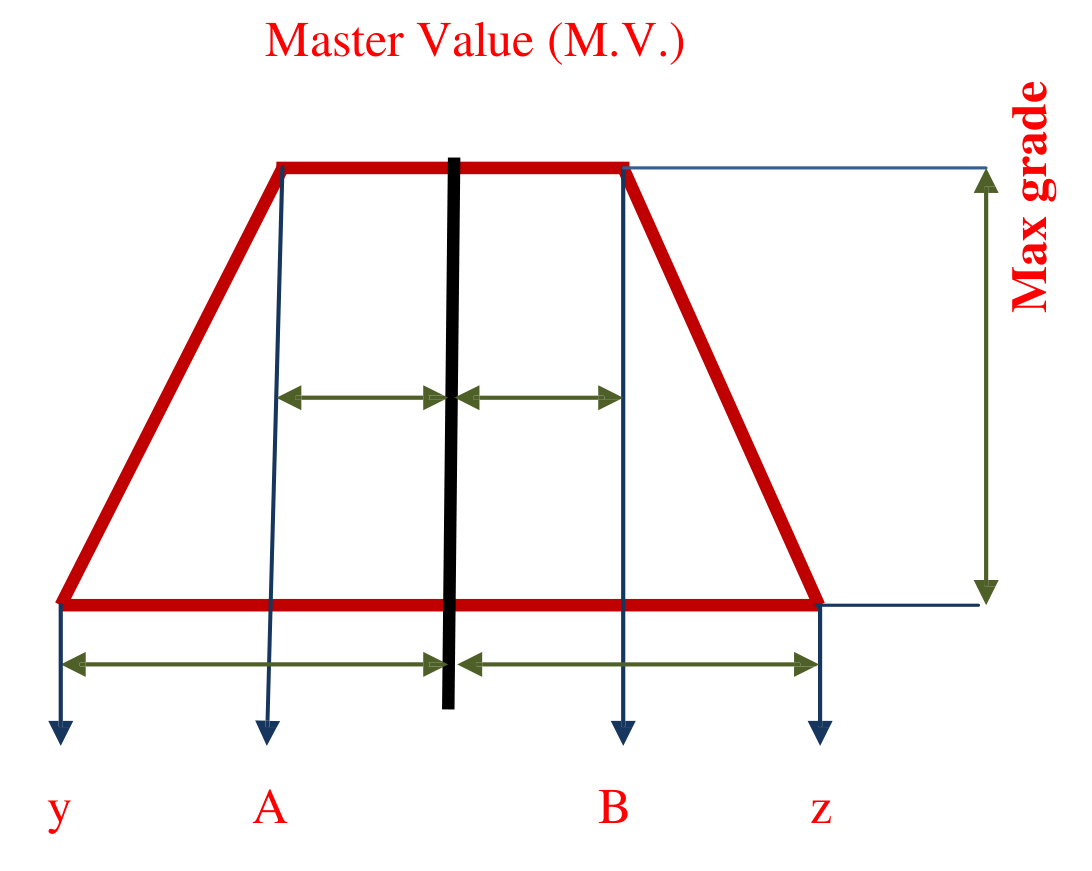
| Question | M.V., mL | A, mL | B, mL | y, mL | z, mL | Max grade |
|---|---|---|---|---|---|---|
| 1 | See on a separate sheet | M.V.-0.25 | M.V.+0.25 | M.V.-2.00 | M.V.+2.00 | 20p |
| 2 | See on a separate sheet | M.V.-0.40 | M.V.+0.40 | M.V.-2.00 | M.V.+5.00 | 20p |
If , then Grade = Maxgrade
If , then Grade = 0, If , then Grade = 0
If , then Grade = Max grade × (Value – y)/(A – y)
If , then Grade = Max grade × (z – Value)/(z – B)
Value is the result reported by the student.
3.
or
1p
4.
(glucose) + (fructose)
1p
5.
1p
6.
where and are the volume and concentration of the added solution, is the volume og thiosulfate solution accepted at the first titration, is the concentration of thiosulfate solution, and is the volume of glucose aliquot (5 mL).
2p
(, where the flask volume is () is taken in mL, and )
1p (0p if any mistake)
7.
Glucose concentration after sucrose hydrolysis (after transferring 20 mL of the solution into the second 50 mL volumetric flask):
The ration of iodine and glucose amounts at the second titration (after sucrose hydrolysis):
– ½, finally leading to the hereunder formula:
2p
(, where the flask volume is () is taken in mL, and )
2p
Оригинал в Архива: Problems.pdf · официални решения: Solutions.pdf