Съдържание
УсловиеStandardization of permanganate solution with potassium hexacyanoferrateTitration of the sample solution with potassium permanganate (without prior reduction)Titration of the sample solution with potassium permanganate with prior reduction of Fe(III)2. Answer the theoretical questions.ОтговориРешениеIOM 2017, Експеримент — Задача 1. Titrimetric determination of free iron in a water sample
The 2nd Olympiad of Metropolises. Chemistry. Practical Problems · 5 септември 2017 г. · 20 т.
General directions
- Lab safety: follow the general rules accepted in chemistry labs; no eating or drinking in the lab.
- Violation of lab safety rules: you get one warning only; offend again: you are disqualified.
- The exam includes two tasks: on Analytical and Organic chemistry. You can start your work with any task. 15 min for reading the set before you start to work.
- Time: 4 h 30 min to complete all the tasks. 30 min warning before the end.
- When entering the lab search for the table with your Student code.
- Your student code: get sure this is present on every page.
- Answers: only in the answer boxes in the booklet, nothing else will be graded. Relevant calculations have to be shown when asked for.
- Use only the pen and calculator provided.
- More chemicals needed? Ask your lab assistant. No penalty for this.
- Questions concerning safety, apparatus, chemicals, toilet break: ask your lab assistant.
- Chemical waste carefully pour in the sink at your working place.
- Official English version: available on request for clarification only. Ask your lab assistant.
- After the stop signal: put your booklet aside and leave it at your working place.
- You must stop your work immediately after the stop signal has been given. A 5 min delay will result in zero points for the current task.
- During the Practical exam, some items of the glassware are expected to be used several times. Clean these carefully.
- Booklet with the tasks on Organic and Analytical chemistry and answer boxes: 15 pages (incl. the cover sheet and Periodic table of elements).
Reagents
| Reagent | Quantity | Placed in | Labeled |
|---|---|---|---|
| Task 1 | |||
| On each workplace | |||
| Water sample containing / mixture | 90 mL | 120 mL container | Sample |
| Solid | 3.16 g | 50 mL volumetric flask | |
| Sulfuric acid 3M | 200 mL | Two 100-mL red-capped containers | |
| solution | 50 mL | 120 mL container | |
| Reinhardt-Zimmermann solution | 40 mL | 60 mL container | R-C mixture |
| Phenylanthranilic acid, 0.1% solution | 4 mL | Dropper | Indicator |
| Granulated zinc | 2 granules | 150 mL beaker | None |
| On the table of common use | |||
| Hydrochloric acid (1:1 v/v) | 100 mL (to be shared by 7 students) | 120 mL containers of common use | HCl (1:1) |
| Task 2 | |||
| On each working place | |||
| Pinacol | 15 g | Pear-shaped round bottom flask, 100 mL | None |
| Sulfuric acid, 25% solution | 70 mL | Plastic container, 100 mL | 25% |
| Methylene chloride | 20 mL | Plastic container, 100 mL | |
| Calcium chloride | 2 g | Plastic container, 100 mL |
Glassware and equipment
| Item | Quantity |
|---|---|
| Task 1 | |
| On each working place | |
| Wash bottle with distilled water | 1 |
| Laboratory stand with burette clamp | 1 |
| 25 mL beaker | 1 |
| 60 mL container (without cap) | 1 |
| 150 mL heat-proof beaker (with zinc) | 1 |
| Watch glass | 1 |
| 25 mL cylinder | 1 |
| 10 mL cylinder | 1 |
| 5 mL bulb (Mohr) pipette | 1 |
| 10 mL pipette | 1 |
| 25 mL burette | 1 |
| Plastic funnel | 1 |
| 200 mL Erlenmeyer (conical flat-bottom) flask | 2 |
| 50 mL volumetric flask | 2 |
| 100 mL volumetric flask | 1 |
| Task 2 | |
| On each working place | |
| Laboratory stand (blue) | 2 |
| Flask clamp | 1 |
| Condenser clamp | 1 |
| Ring for separation funnel | 1 |
| Hot-plate magnetic stirrer | 1 |
| Magnetic stir-bar | 2 |
| White flask support | 1 |
| Adjustable lab jack lift support | 1 |
| Wurtz adapter | 2 |
| Thermometer | 1 |
| Condenser | 2 |
| Foil (a piece) | 1 |
| Joint clips | 3 |
| Pear-shaped round-bottom flask, 100 mL (with the substance) | 1 |
| Pear-shaped round-bottom flask, 100 mL (empty) | 1 |
| Pear-shaped round-bottom flask (receiver), 50 mL (empty) | 3 |
| Pear-shaped round-bottom flask (receiver), 50 mL (with your Student code) with a stopper | 1 |
| Chemical funnel | 1 |
| Separatary funnel | 1 |
| Glass beaker, 250 mL | 1 |
| Plastic beaker, 150 mL | 1 |
| Vigreux fractionating column | 1 |
| Glass bend adapter | 1 |
| Distilling receiver cow | 1 |
| Teflon sleeve for 14/23 ground tapered joints | 20 |
| Filter paper | 2 |
| Glass ground joint stopper | 4 |
| Pasteur pipette | 2 |
| On the table of common use | |
| Foil | |
| Refractometer Refracto 30GS | |
| Problems 1 and 2 | |
| On each working place | |
| Rubber finger protectors for handling hot items | 1 pair |
| Pipette filler | 1 |
| On the table of common use | |
| Kitchen paper roll | |
| Filter paper | |
| Gloves (choose your size) |
Условие
| Question | 1.1 | 1.2 | 1.3 | 1.4 | 1.5 | 1.6 | 1.7 | 1.8 | 2.1 | 2.2 | 2.3 | 2.4 | Total |
|---|---|---|---|---|---|---|---|---|---|---|---|---|---|
| Points | 13 | 13 | 14 | 1 | 1 | 1 | 1 | 1 | 1 | 1 | 2 | 1 | 50 |
| Result |
Control of water quality is an important issue for modern metropolises. Iron is one of the regulated components. In this task you will titrimetrically determine the total iron (II and III) content in a model river water sample. To do so, you will carry out oxidation of Fe(II) with permanganate. You will perform two determinations: one after preliminary reduction of Fe(III) with zinc to Fe(II), and another one without reduction (only Fe(II) is titrated). Beforehand, you will have to standardize the working permanganate solution.
Standardization of permanganate solution with potassium hexacyanoferrate
Dissolve the weighed amount of solid in the 50 mL graduated flask in ca. 25 mL of 3 M solution. Bring up to the mark with water and mix thoroughly.
Fill the burette with solution (use the funnel). Note: you are provided with dry and clean burettes and pipettes. Do not spend solutions for rinsing the glassware.
Transfer with the volumetric pipette a 5.00 mL aliquot of the prepared hexacyanoferrate solution into the conical flask. Add with the cylinder 15 mL of 3 M solution and 15 mL of water. Mix the solution and titrate it with solution. Add the titrant dropwise swirling the flask constantly. Repeat the titration until the results differ by less than 0.1 mL (the number of titrations is not graded).
1.1. Write down the volumes of permanganate solution used for hexacyanoferrate titration:
| Titration number | , mL | , mL | , mL |
|---|---|---|---|
| 1 | |||
| 2 | |||
| 3 | |||
| Your accepted volume, mL: |
[13 т.]
Titration of the sample solution with potassium permanganate (without prior reduction)
Pipette 5.00 mL of the standardized potassium permanganate solution into a 100 mL volumetric flask and bring it up to the mark with distilled water. Mix the solution thoroughly. Wash the burette and fill it with the prepared potassium permanganate solution.
Pipette a 10.0 mL aliquot of the sample solution into a conical titration flask, add 5 mL of the Reinhardt-Zimmermann solution, 10 mL of 3M solution, 10 mL of water, and 5 drops of the Phenylanthranilic acid solution. Titrate the prepared mixture with the solution till light-orange coloration appears. Repeat the titration as necessary.
Note: titrate the prepared mixtures immediately. Prepare the next portion of the sample just before the titration.
1.2. Write down the volumes of the permanganate solution used for titration:
| Titration number | , mL | , mL | , mL |
|---|---|---|---|
| 1 | |||
| 2 | |||
| 3 | |||
| Your accepted volume, mL: |
[13 т.]
Titration of the sample solution with potassium permanganate with prior reduction of Fe(III)
Transfer with the 10.0 mL pipette 30.0 mL of the sample (from the 120 mL container) into the 150 mL glass beaker containing zinc granules. Add with a cylinder 10 mL of HCl (1:1 v/v). Cover the beaker with the watch glass and keep heating for 30 min. Cool the beaker under tap water down to nearly room temperature.
Transfer the solution from the beaker into the 50 mL volumetric flask (thoroughly wash the beaker containing the non-dissolved zinc granules with water). Bring the solution in the flask up to the mark and mix. Pipette a 10.0 mL aliquot of the prepared solution into the conical flask; add 5 mL of the Reinhardt-Zimmermann solution, 10 mL of 3M solution, 10 mL of water and 5 drops of the Phenilanthranilic acid solution. Swirl the flask and titrate the mixture with the potassium permanganate solution until the color changes from lemon-yellow to light-orange. Repeat the titration as necessary.
Note: titrate the prepared mixtures immediately. Prepare the next portion of the sample just before the titration.
1.3. Write down the volumes of the permanganate solution used for titration of the sample (with reduction of Fe(III)):
| Titration number | , mL | , mL | , mL |
|---|---|---|---|
| 1 | |||
| 2 | |||
| 3 | |||
| Your accepted volume, mL: |
[14 т.]
1.4. Calculate the concentration of solution in mol/L (mass of the trihydrate is 3.16 g).
= [1 т.]
1.5. Write down the ionic reaction equation occurring upon standardization of the permanganate solution: [1 т.]
1.6. Calculate the concentrations of non-diluted and diluted potassium permanganate (mol/L) based on the titration results:
(initial) =
(diluted) = [1 т.]
1.7. Write down two reactions occurring upon heating of the acidic sample solution with zinc:
[1 т.]
1.8. Calculate the concentration of iron(II) and iron(III) (mg/L) in the sample based on the titration results:
Calculations:
Concentration of iron(II) ___________ mg/L
Concentration of iron(III) ___________ mg/L [1 т.]
2. Answer the theoretical questions.
2.1. Natural water often contains a considerable amount of chloride ions. Write down the competing reaction equation that interferes with the titrimetric determination of Fe(II) with permanganate in the presence of chloride: [1 т.]
2.2. Free chlorine can be obtained by the reaction of manganese dioxide with hydrochloric acid. Write down the balanced equation of this reaction: [1 т.]
2.3. Permanganate reacts extremely slowly with diluted hydrochloric acid solutions in the absence of iron. However, the reaction accelerates upon addition of a Fe(II) salt, and the characteristic chlorine odor appears. Suggest a scheme of reactions explaining the catalytic action of Fe(II) in the system (use the properties of manganese compounds you have written in i. 2.2):
No catalyst:
In the presence of Fe(II): [2 т.]
2.4. To get rid of the interfering effect of chloride ions (i. 2.1) you have added the Reinhardt-Zimmermann solution containing Mn(II) ions to the titrated solution (the manganese action is due to decreasing the redox potential of ). Addition of fluoride ions is an alternative method to avoid the interfering action of chloride ions on the titration process. Write down the reaction equation explaining a possible mechanism of the protecting action of fluoride (take into account your scheme in i. 2.3): [1 т.]
Отговори
Titration of the sample solution with potassium permanganate with prior reduction of Fe(III), 1.4. 0.15 mol/L
Official answer: c = 0.150 M.
Titration of the sample solution with potassium permanganate with prior reduction of Fe(III), 1.5.
Titration of the sample solution with potassium permanganate with prior reduction of Fe(III), 1.7. Zn + 2H+ = Zn2+ + H2; Zn + Fe3+ = Zn2+ + Fe2+
As printed in the official answers; the second equation is printed unbalanced in charge (Zn + Fe3+ = Zn2+ + Fe2+).
2. Answer the theoretical questions., 2.2.
Решение
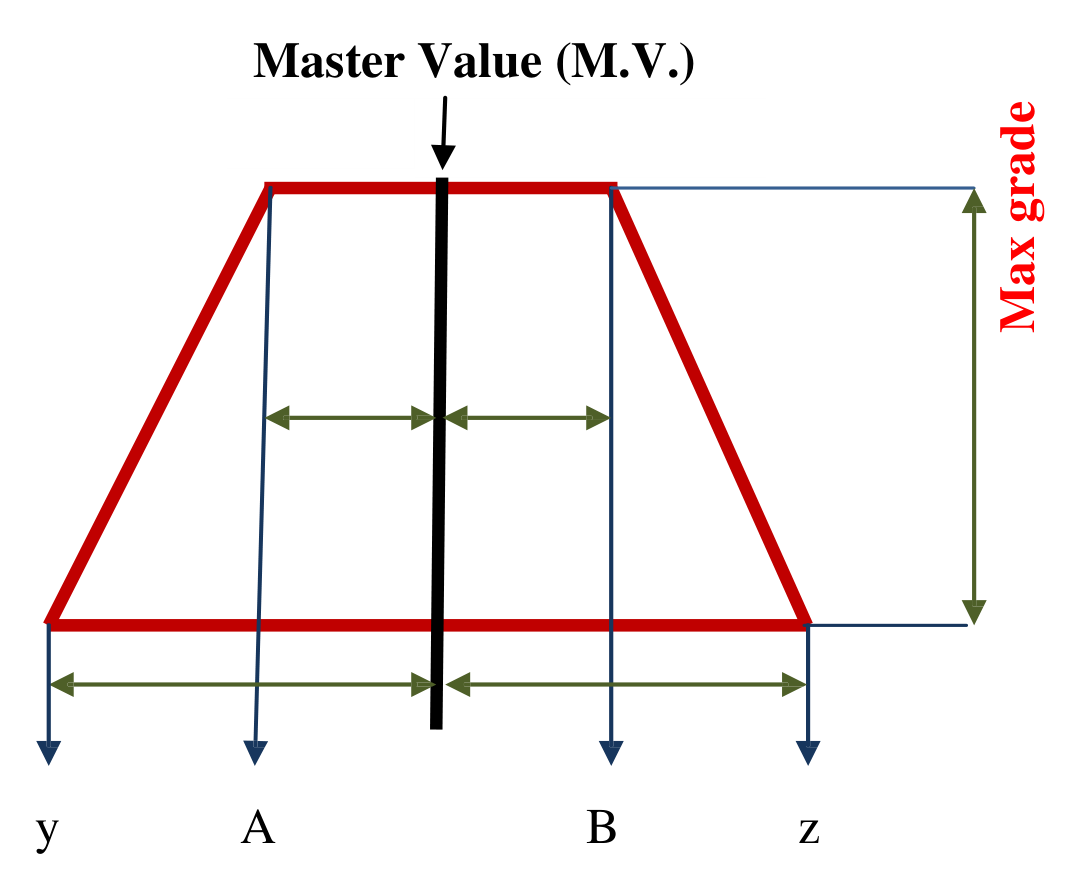
| Question | M.V., mL | A, mL | B, mL | y, mL | z, mL | Max grade |
|---|---|---|---|---|---|---|
| 1.1 | See on a separate sheet | M.V.-0.1 | M.V.+0.1 | M.V.-1.0 | M.V.+1.0 | 13 points |
| 1.2. | See on a separate sheet | M.V.-0.15 | M.V.+0.15 | M.V.-1.00 | M.V.+3.00 | 13 points |
| 1.3 | See on a separate sheet | M.V.-0.3 | M.V.+0.3 | M.V.-2.0 | M.V.+2.0 | 14 points |
If , then Grade = Maxgrade
If , then Grade = 0, If , then Grade = 0
If , then Grade = Max grade × (Value – y)/(A – y)
If , then Grade = Max grade × (z – Value)/(z – B)
Value is the result reported by the student.
1.4. = 0.150 M
1.5.
1.6. (initial) = , where 5 is equivalence factor.
(diluted) = (initial)
1.7.
1.8. Without the reduction:
After reduction:
2.1. (или до HOCl)
2.2.
2.3. No catalyst: see equation 2.1.
In the presence of Fe(II):
2.4.
– no reaction
Оригинал в Архива: Problems.pdf · официални решения: Solutions.pdf