IOM 2018, Експеримент — Задача 1. Task 1. Multicolor chromium (12 marks).
The 3rd Metropolises Olympiad. Chemistry. Practical exam · 4 септември 2018 г. · 50 т.
General directions
- Lab safety: follow the general rules accepted in chemistry labs; no eating or drinking in the lab.
- Violation of lab safety rules: you get one warning only; offend again: you are disqualified.
- The exam includes two tasks: on Analytical and Inorganic chemistry. You can start your work with any task. 15 min for reading the set before you start to work.
- Time: 4 h 30 min to complete all the tasks. 30 min warning before the end.
- When entering the lab search for the table with your Student code.
- Your student code: get sure this is present on every page.
- Answers: only in the answer boxes in the booklet, nothing else will be graded. Relevant calculations have to be shown when asked for.
- Use only the calculator provided.
- More chemicals needed? Ask your lab assistant. No penalty for this.
- Questions concerning safety, apparatus, chemicals, toilet break: ask your lab assistant.
- Chemical waste carefully pour in the sink at your working place.
- Official English version: available on request for clarification only. Ask your lab assistant.
- After the stop signal: put your booklet aside and leave it at your working place.
- You must stop your work immediately after the stop signal has been given. A 2 min delay will result in zero points for the current task.
- During the Practical exam, some items of the glassware are expected to be used several times. Clean these carefully.
- Booklet with the tasks on Inorganic and Analytical chemistry and answer boxes: 14 pages (incl. the cover sheet and Periodic table of elements).
Reagents
| Reagent | Quantity | Placed in | Label |
|---|---|---|---|
| Task 1, at every workplace | |||
| Potassium dichromate | 10 g | Bottle with blue cap, 50 mL | |
| Hydrochloric acid, concentrated | 47 mL | Bottle with blue cap, 50 mL | HCl |
| Ethanol | 11 mL | Bottle with blue cap, 50 mL | 11 ml |
| 20 mL | Bottle with blue cap, 50 mL | 20 ml | |
| Zink, granules | 175 g | Bottle with blue cap, 50 mL | Zn |
| Ammonia aqueous solution | 250 mL | Bottle with blue cap, 250 mL | aq |
| Ammonium chloride | 72 g | Bottle with blue cap, 250 mL | |
| Task 2 | |||
| At every workplace | |||
| Weighted sample of the complex | To be determined | Beaker, 25 mL | STUDENT CODE |
| Standard solution of cerium(IV) sulfate | 50 mL | Bottle with blue cap, 50 mL | 0.0094 M |
| Hydrogen peroxide, 0.1% | 50 mL | Bottle with blue cap, 50 mL | |
| Sulfuric acid, 2 M | 100 mL | Bottle with blue cap, 100 mL | |
| Mohr’s salt solution | 100 mL | Bottle with blue cap, 250 mL | Mohr’s salt |
| Potassium hydroxide, 0.1 M | 50 mL | Bottle with blue cap, 50 mL | KOH |
| Sodium hydroxide, standard solution | 100 mL | Bottle with blue cap, 100 mL | NaOH 0.0119 M |
| Per two participants | |||
| Phenylanthranilic acid | 20 mL | Dropper | PAA |
| Phenolphthalein | 20 mL | Dropper | Phenolphthalein |
| Manganese dioxide (), suspension | 40 mL | Dropper | |
| On the table of common use | |||
| Formaldehyde (20%) | 250 mL | Bottle with blue cap, 250 mL | HCHO (20%) |
Glassware and equipment
| Item | Quantity |
|---|---|
| Tasks 1 and 2 | |
| At every workplace | |
| Support stand with two clamps, ring and burette clamp | 1 |
| Magnetic stirrer with heating | 1 |
| Wash-bottle with distilled water | 1 |
| Permanent marker | 1 |
| Goggles | 1 |
| On the table of common use | |
| Gloves (choose the appropriate size) | |
| Paper towels | |
| Task 1 | |
| At every workplace | |
| Reflux condenser | 1 |
| Crystallizing dish | 1 |
| Separatory funnel | 1 |
| Adaptor for separatory funnel | 1 |
| Petry dish with your Student code | 1 |
| Glass rod | 1 |
| Spoon-spatula | 1 |
| Round-bottom flask, 500 mL | 1 |
| Funnel, 100 mm with your Student code | 1 |
| Funnel, 75 mm | 1 |
| Beakers, 600 mL with numbers and your Student code | 3 (I, II, III) |
| Tube with charcoal | 1 |
| Piece of foil | 1 |
| Filter paper | 2 |
| On the table of common use | |
| Adaptor with Bunsen valve | |
| Squeezers | |
| Balances | |
| Under the fume hood of common use | |
| Support stand with rings for filtration | |
| Air blower with glass tubes for the solution bubbling | |
| Task 2, at every workplace | |
| Burette, 25 mL | 1 |
| Volumetric flask, 100 mL | 1 |
| Glass funnel, 36 mm (for filling the burette) | 1 |
| Beaker, 25 mL (under the burette and for formaldehyde) | 1 |
| Erlenmeyer flask (conical, flat-bottom), 250 mL | 2 |
| Graduated pipette, 10 mL | 2 |
| Cylinder, 10 mL | 2 |
| Cylinder, 50 mL | 1 |
| Red pipette filler (3-way bulb) | 1 |
| Watch glass | 2 |
| Fingertips to handle hot glassware and foil | 3 |
Условие
| Question | a | b | c | d | e | f | Total |
|---|---|---|---|---|---|---|---|
| Points | 4 | 4 | 10 | 2 | 28 | 2 | 50 |
| Result |
Long time ago, in 1797, the Frenchman Nicolas-Louis Vauquelin discovered a new element in a mineral mined in Ural Mountains region, Russia. The mineral, crocoite , was also called «Siberian red lead», «red lead-ore». The element found in it, chromium, got its name due to variety of colors found in its compounds (Greek χρϖμα - colour). Doing this task you will enjoy discovering the amazing and diverse world of chromium complex compounds.
Procedure
- Carefully check the reagents and glassware located at your workplace.
- Place the bottle with the concentrated ammonia solution and the 600 ml beaker labeled “participant code – I” into the crystallizing dish (1, hereunder the numbers refer to fig. 1 and 2). Fill the crystallizing dish with ice. Place ammonium chloride into the beaker.
- Fix the round-bottom flask (3) on the stand (2). Fix the reflux condenser (4) on the stand over the round-bottom flask (adjust its position so that it can easily enter the flask), but do not insert it into the flask! The distance between the flask and condenser should be such that you can easily place the 75 mm funnel into the flask. Take the hose attached to the lower joint (inlet) of the condenser and connect it to the tap water source. Direct the other hose into the sink. Open the water tap slowly and carefully. Make the water flow moderate.
- Place the given portion of potassium dichromate into the round-bottom flask (3) through the funnel. Remove the funnel and insert the reflux condenser (4) into the flask (3) leaving a small gap between the pieces of glassware. Pour through the condenser the given portion of the concentrated hydrochloric acid first, and then that of ethanol labeled « 11 ml». Once all the ethanol is introduced into the flask, immediately insert the reflux condenser into the flask and attach the tube with charcoal (5) to the upper end of the condenser as shown in fig, 1. Both add the alcohol and fit the condenser to the flask as fast as possible, since the reaction is exothermic and accompanied by the release of highly volatile substances and gases. The reaction is completed once the reaction mixture color changes to green. As soon as all the gaseous products are condensed in the flask, remove the tube with charcoal, remove the reflux condenser, turn off the water supply and disconnect the hose from the tap water source. Place free ends of both hoses into the sink. Slightly cool down the flask under tap water (down to relatively high temperature, still bearable to hand) and fix it back on the stand.
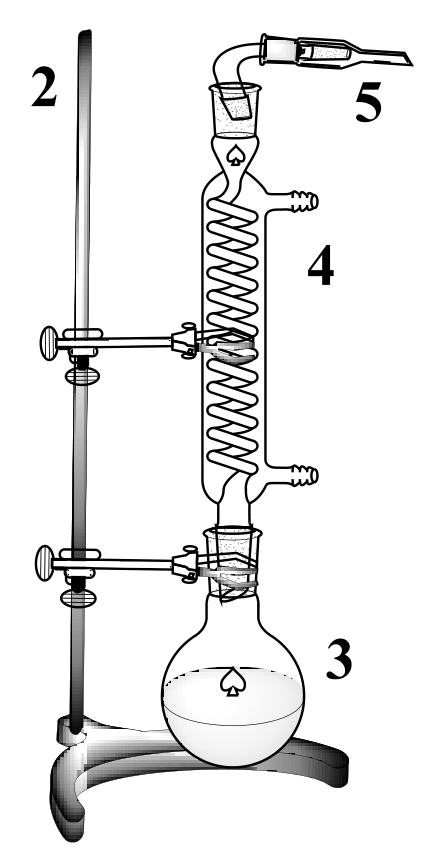
a. Write down equation of the reaction proceeding and the formula of the complex particle formed. [4 т.]
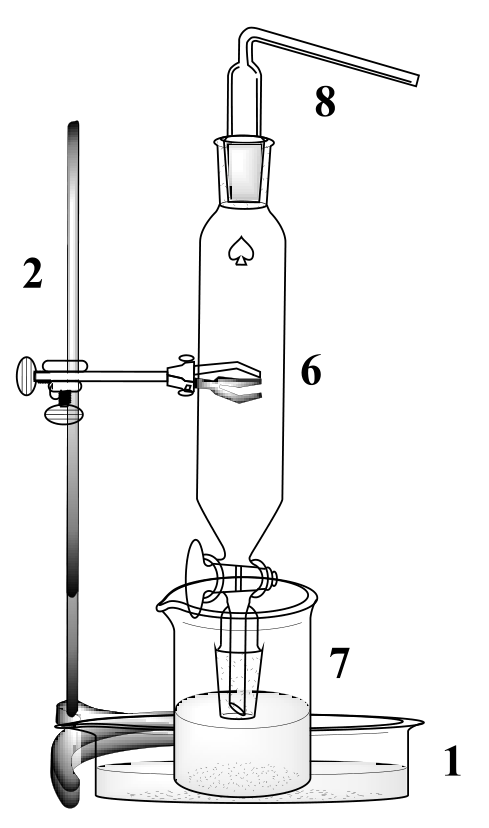
- Assemble the apparatus for the second synthesis step (fig. 2). Place all the given granulated zinc into the separatory funnel (6). Fix the funnel on the stand (2) over the beaker (7, labeled “participant code – I”) situated in the crystallizing dish (1) with ice. Using the 75 mm funnel, transfer the solution obtained at the first synthesis step into the separatory funnel (6). To ensure complete transfer of the obtained compound, add 14 ml of water to the round-bottom flask (3) and pour out the obtained solution into the separatory funnel (6). (Attention! Measure water by using the 50 ml graduated cylinder only). Attach the Bunsen valve (8, overpressure relief valve). Deliver the round-bottom flask (3) to your laboratory assistant.
Attention! The Bunsen valves are located on the table of common use. Start doing this part of the protocol only when you get sure that there is a Bunsen valve available.
Wait till the reaction is complete, which can be distinguished by the reaction mixture color change from green to intensive light-blue.
b. Write down the equation of the reaction proceeding and the formula of the complex particle formed at this synthesis step. [4 т.]
- As soon as the light-blue color of the solution is stabilized, carefully pour the chilled ammonia solution into the beaker containing ammonium chloride. Cover the beaker using the piece of foil with a hole; fix the foil pressing it by hand. Place the tip of the separatory funnel into the beaker through the foil hole. Get sure that the tip is immersed into the ammonia solution so that the liquid from the funnel enters the solution having no contact with air. However, avoid the contact of the funnel tip with the ammonium chloride crystals. Open the stopcock of the separatory funnel to mix the solutions. Lift up the Bunsen valve to let the solution pour out. Perform all the subsequent steps under fume hood only. Do not stir the beaker contents! Decant the supernatant liquid into the other beaker labeled “participant code – II”. Cover the latter beaker with foil. Place the glass tube into the beaker through the hole in foil and blow air through the mixture to bring the reaction to completion, which is manifested by the solution color change to dark-red as well as by pink fine crystal precipitate formation. Do not continue air blowing for more than 20 min. Deliver the beaker labeled “participant code – I” to your lab assistant.
The complex cation of the reaction product can be presented by two identical high symmetry polyhedra with a common vertex. The coordination environment of the central atom includes ligands of two types of: of the first type (one ligand), which is oxygen-containing (charged bridged ligand); and of the second type, which are molecular ligands. Beside the counterions, the compound includes uncharged particles increasing the oxygen content by a factor 2. Long-term storage is accompanied by slow disappearance of the uncharged particles from the substance you have received.
c. Write down the equations of the proceeding reactions and the formulae of the complex particles formed at these synthesis steps. Draw the structural formula of the complex cation of the final reaction product. [10 т.]
- Prepare a paper filter for the 100 mm funnel. When the reaction is completed, filter the obtained precipitate into the beaker labeled "participant code-III". Wash the precipitate with alcohol (labeled " 20 ml") and place the filter with the product into the Petri dish labeled with your student code.
d. Weigh the filter with the product and write down the value.
Mass of the Petri dish with the filter and the product = _______ g
Mass of the Petri dish = _______ g
Mass of the filter with the product = _______ g [2 т.]
Deliver the Petri dish with the product and the beaker labeled “participant code – III” to your lab assistant.
e. Your product will be dried by the organizers and then re-weighted, whereas its quality will be checked spectrophotometrically. [28 т.]
f. Calculate the approximate value of the reaction yield using the determined mass of the filter with the reaction product and knowing that the mass of the initial potassium dichromate was 10 g. Assume that the mass of the wet filter is 10 g.
Calculation:
Yield = _______ % [2 т.]
Решение
| Question | a | b | c | d | e | f | Total |
|---|---|---|---|---|---|---|---|
| Points | 4 | 4 | 10 | 2 | 28 | 2 | 50 |
| Result |
a. Write down equation of the reaction proceeding and the formula of the complex particle formed.
(2 points)
(2 points)
b. Write down the equation of the reaction proceeding and the formula of the complex particle formed at this synthesis step.
(2 points)
(2 points)
c. Write down the equations of the proceeding reactions and the formulae of the complex particles formed at these synthesis steps. Draw the structural formula of the complex cation of the final reaction product.
or
(2 points)
or
(2 points)
(2 points)
(2 points)
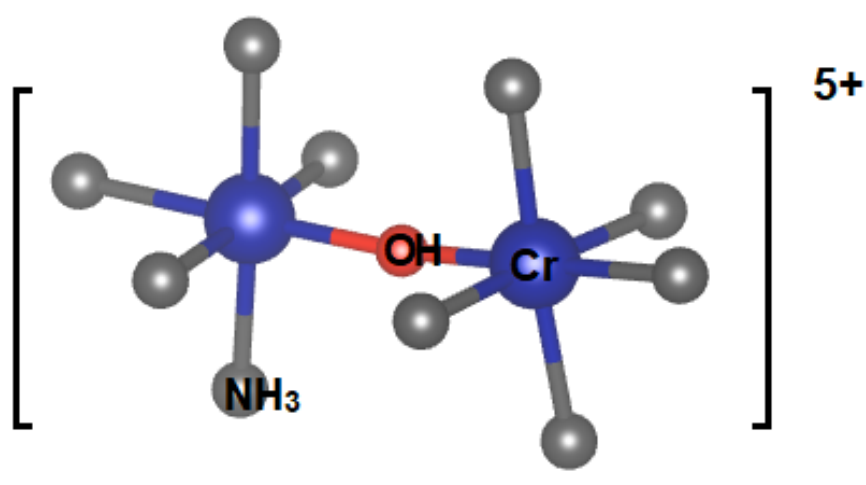
[Structural formula of the complex cation — see the figure] (2 points)
d. Weigh the filter with the product and write down the value. (2 points)
Mass of the Petri dish with the filter and the product = _______ g
Mass of the Petri dish = _______ g
Mass of the filter with the product = _______ g
e. Your product will be dried by the organizers and then re-weighted, whereas its quality will be checked spectrophotometrically.
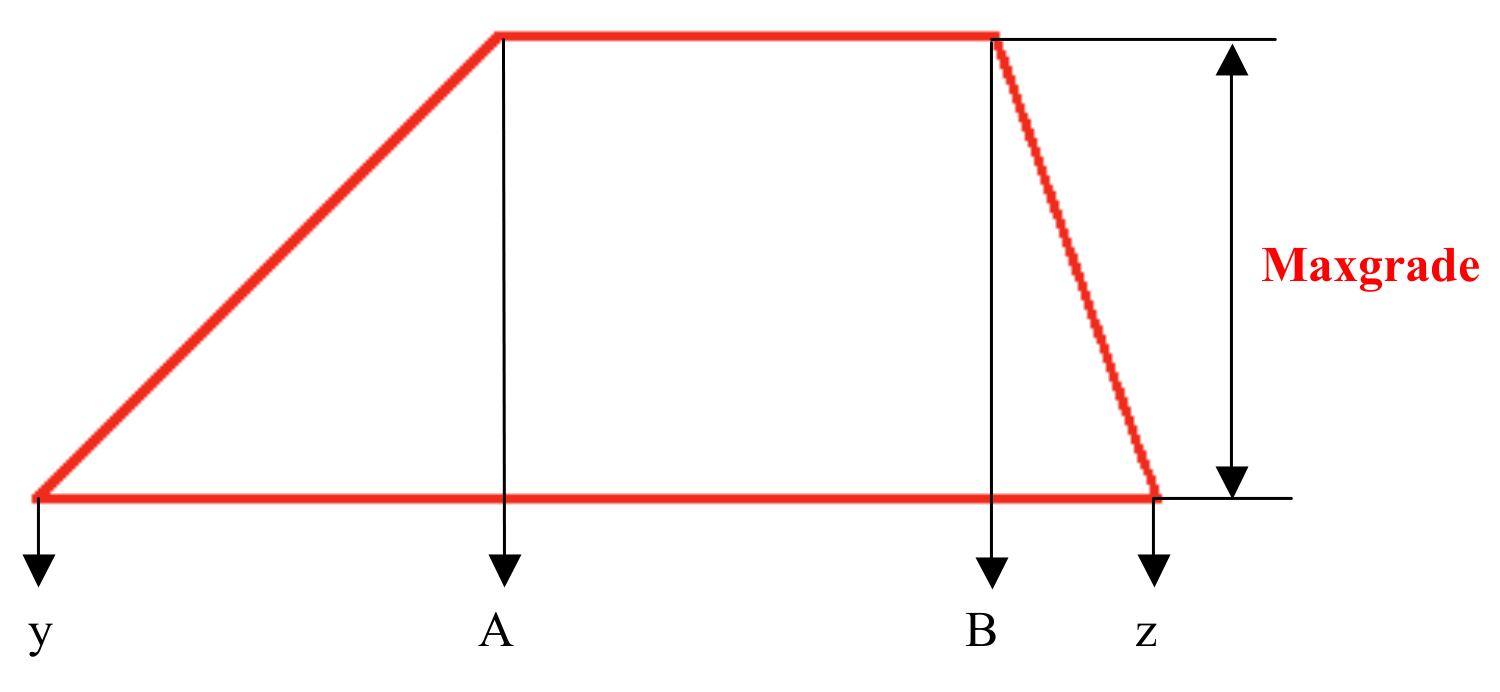
The grading scheme takes into account two values re-measured by the Jury: mass of the product (m, g) and its purity, which is evaluated using spectrophotometry. A correcting factor α based on the latter is applied to a student’s points obtained for the yield.
| Parameter | A | B | y | z | Max grade |
|---|---|---|---|---|---|
| Mass | 2.8 g | 4 g | 0 g | 4.2 g | 28 points |
If A Value B, then Grade = Maxgrade
If Value y, then Grade = 0, If Value z, then Garde = 0
If y Value A, then Grade = Maxgrade × (Value – y)/(A – y)
If B Value z, then Grade = Maxgrade × (z – Value)/(z – B)
Values are the results re-measured by the Jury.
The correcting factor is α = 1, if a pure product was obtained and the spectrum coincides with the reference spectrum of a pure substance, also pre-tested by X-ray diffraction.
α = 0.5, if a no single phase product was obtained.
α = 0, if the product was not synthesized or another compound was obtained
Students result = Grade of mass * Correcting factor (α)
f. Calculate the approximate value of the reaction yield using the determined mass of the filter with the reaction product and knowing that the mass of the initial potassium dichromate was 10 g. Assume that the mass of the wet filter is 10 g.
Calculation:
mole
mole
g.
Yield = m(product)/16.541=______ % (2 points)
Оригинал в Архива: Problems.pdf · официални решения: Solutions.pdf