IPhO 1985, Теория и експеримент — Задача 3. Problem 3
Problems and solutions of the 16th IPhO Portorož, Slovenia, (Former Yugoslavia), 1985 · 10 т.
Условие
In a space research project two schemes of launching a space probe out of the Solar system are discussed. The first scheme (i) is to launch the probe with a velocity large enough to escape from the Solar system directly. According to the second one (ii), the probe is to approach one of the outer planets, and with its help change its direction of motion and reach the velocity necessary to escape from the Solar system. Assume that the probe moves under the gravitational field of only the Sun or the planet, depending on whichever field is stronger at that point.
a) Determine the minimum velocity and its direction relative to the Earth’s motion that should be given to the probe on launching according to scheme (i).
b) Suppose that the probe has been launched in the direction determined in a) but with another velocity. Determine the velocity of the probe when it crosses the orbit of Mars, i. e., its parallel and perpendicular components with respect to this orbit. Mars is not near the point of crossing, when crossing occurs.
c) Let the probe enter the gravitational field of Mars. Find the minimum launching velocity from the Earth necessary for the probe to escape from the Solar system.
Hint: From the result a) you know the optimal magnitude and the direction of the velocity of the probe that is necessary to escape from the Solar system after leaving the gravitational field of Mars. (You do not have to worry about the precise position of Mars during the encounter.) Find the relation between this velocity and the velocity components before the probe enters the gravitational field of Mars; i. e., the components you determined in b). What about the conservation of energy of the probe?
d) Estimate the maximum possible fractional saving of energy in scheme (ii) with respect to scheme (i). Notes: Assume that all the planets revolve round the Sun in circles, in the same direction and in the same plane. Neglect the air resistance, the rotation of the Earth around its axis as well as the energy used in escaping from the Earth’s gravitational field.
Data: Velocity of the Earth round the Sun is 30 km/s, and the ratio of the distances of the Earth and Mars from the Sun is 2/3.
Отговори
a) 12.3 km/s
In the direction of the Earth’s orbital motion (ϑ = 0); va' = vE(√2 − 1).
b)
c) 5.5 km/s
d) 0.8
Решение
a) The necessary condition for the space-probe to escape from the Solar system is that the sum of its kinetic and potential energy in the Sun’s gravitational field is larger than or equal to zero:
where is the mass of the probe, its velocity relative to the Sun, the mass of the Sun, the distance of the Earth from the Sun and the gravitational constant. Using the expression for the velocity of the Earth, , we can eliminate and from the above condition:
(1p.)
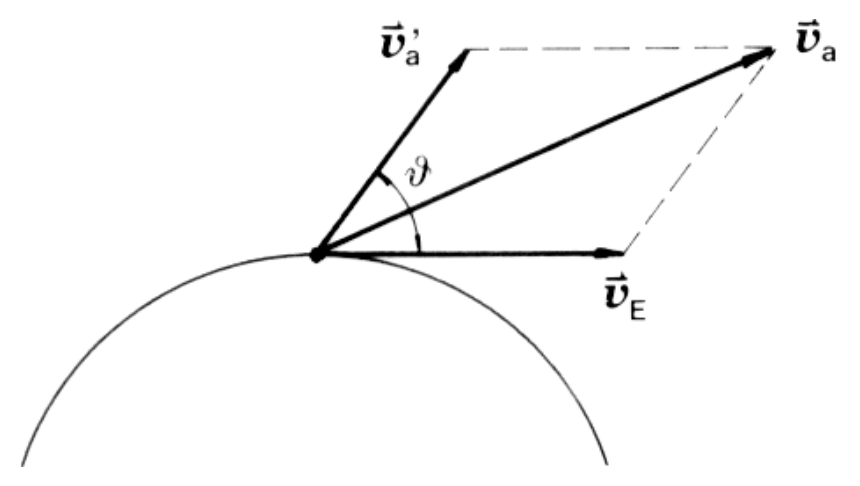
Let be the velocity of launching relative to the Earth and the angle between and (Fig. 7). Then from and it follows:
and
The minimum velocity is obtained for :
(1p.)
b) Let and be the velocities of launching the probe in the Earth’s and Sun’s system of reference respectively. For the solution (a), . From the conservation of angular momentum of the probe:
(1p.)
and the conservation of energy:
(1p.)
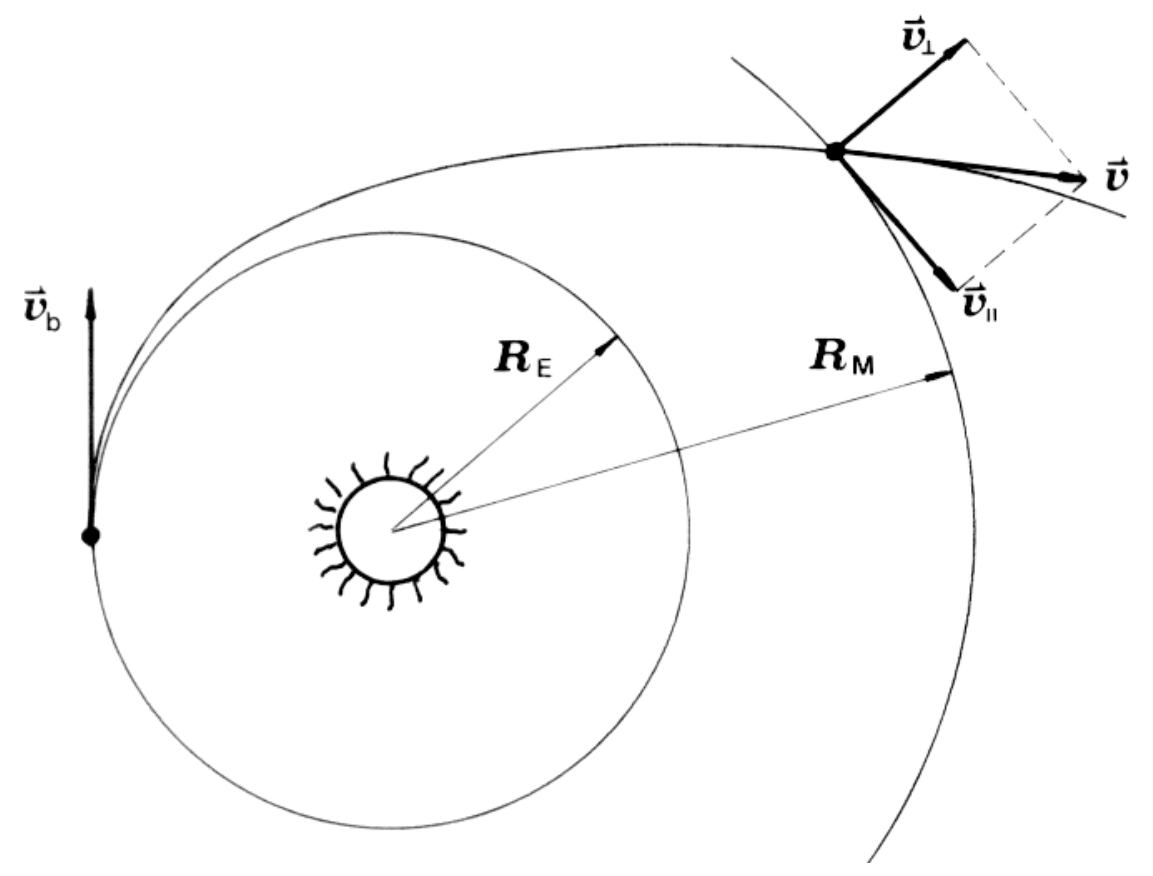
we get for the, parallel component of the velocity (Fig. 8):
and for the perpendicular component:
(1p.)
where .
c) The minimum velocity of the probe in the Mars’ system of reference to escape from the Solar system, is , in the direction parallel to the Mars orbit ( is the Mars velocity around the Sun). The role of Mars is therefore to change the velocity of the probe so that it leaves its gravitational field with this velocity.
(1 p.)
In the Mars’ system, the energy of the probe is conserved. That is, however, not true in the Sun’s system in which this encounter can be considered as an elastic collision between Mars and the probe. The velocity of the probe before it enters the gravitational field of Mars is therefore, in the Mars’ system, equal to the velocity with which the probe leaves its gravitational field. The components of the former velocity are and , hence:
(1p.)
Using the expressions for and from (b), we can now find the relation between the launching velocity from the Earth, , and the velocity , :
The velocity of Mars round the Sun is , and the equation for takes the form:
(1p.)
The physically relevant solution is:
(1p.)
d) The fractional saving of energy is:
where and are the energies of launching in scheme (i) and in scheme (ii), respectively. (1 p.)
Оригинал в Архива: ipho85.pdf