NBPhO 2023, Теория и експеримент — Задача 6. String-coupled masses
Nordic-Baltic Physics Olympiad 2023 · 5 т.
Условие
— Aleksi Kononen.
Two small masses are connected and hung between walls by weightless strings as pictured below. The acceleration due to gravity is . All oscillatory motion is assumed to have a small amplitude and the system is always in one of its normal modes (i.e. the oscillations are sinusoidal).
i) Find , the angular frequency of in-phase oscillations (by which the oscillation phases of the both masses are always equal), perpendicular to the plane of the figure. [2 т.]
ii) Find , the angular frequency of anti-phase oscillations (by which the oscillation phases of the both masses are always opposite), in terms of .
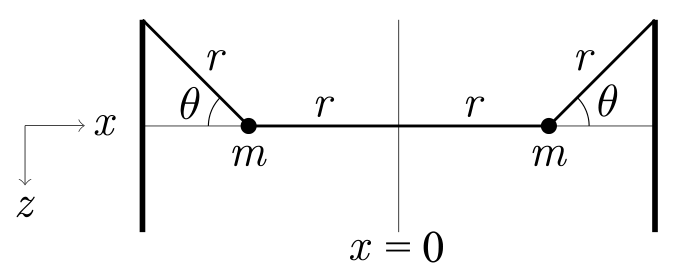
[3 т.]
Решение
— Solution by Aleksi Kononen and Jaan Kalda, grading schemes by Aleksi Kononen.
i) (2 т.)
For in-phase oscillations, the string connecting the masses always remains parallel to the -axis. In that case, the motion is confined to the -plane and is identical to a pendulum with length hung from the axis of rotation:
Grading:
- Stating , or stating that the connecting string remains parallel to the -axis (0.6 pts)
- Realising the effective pendulum length is , i.e. the axis of rotation is the line connecting the wall points (0.8 pts)
- Correct expression for (0.6 pts)
ii) (3 т.)
Now suppose one of the balls moves along the axis to a distance and the other ball — by . The length of the horizontal string remains constant, hence , where denotes the displacement of the ball in -direction. For small displacements, we can neglect the smallest term , hence . The length of the slanted string remains also constant, hence , where denotes the vertical displacement. Neglecting here the smallest terms and , we obtain , hence
Now we can write down energy conservation law: , where dot denotes the time derivative. Differentiating this over time we obtain
so that
Grading:
- Equation for a cylinder surface (0.4 pts)
- Equation for a sphere surface (0.4 pts)
- Both surface equations correct and coordinates consistent (0.2 pts)
- Realising - and -terms are negligible, and not discarding (0.2 pts)
- Solving in terms of (0.5 pts)
- Energy conservation between and (0.3 pts)
- Solving relation between and (0.6 pts)
- Correct expression for (0.3 pts)
- correctly in terms of (0.1 pts)
Alternative solution: Let one of the masses (mass A) be displaced by and the other by . Let be the tension in the two outermost strings (equal magnitudes by symmetry) and in the connecting string. Newton’s law along the -axis for mass A then yields
i.e.
Without oscillations, and . Let us write and , i.e.
Let us make some estimates. Clearly, . The maximum of occurs when the mass swings by its lowest point with velocity , where its trajectory has a radius of curvature . Moreover, small normal mode oscillations imply for some amplitude , i.e. . Finally, assume holds for some . We have
i.e. quadratically smaller in than . Thus, and
(The result shows , i.e. the assumption holds.) Grading:
- Force equation, either along or full vector form (0.4 pts)
- Solving relation between and in terms of tension forces (0.4 pts)
- Unperturbed values for and (0.4 pts)
- Reasonable estimate of (0.6 pts)
- Showing is quadratically smaller than (0.8 pts)
- Correct expression for (0.3 pts)
- correctly in terms of (0.1 pts)
- Remark: Accept solution with assumption without estimates
Оригинал в Архива: NBPhO_2023_problems.pdf · официални решения: NBPhO_2023_solutions.pdf