NBPhO 2023, Теория и експеримент — Задача 7. A stack of papers
Nordic-Baltic Physics Olympiad 2023 · 8 т.
Условие
— Taavet Kalda and Jaan Kalda.
There is a pack of identical sheets of papers lying on an infinite horizontal table. The coefficient of friction between the surface of the table, and between two sheets of paper are both equal to . Each sheet has dimensions , with . Sandra is trying to fetch the bottom-most sheet by pulling from a shorter edge of it with a constant velocity (while all the sheets lie almost exactly on top of each other, she managed to get hold of an edge of the bottom-most sheet).
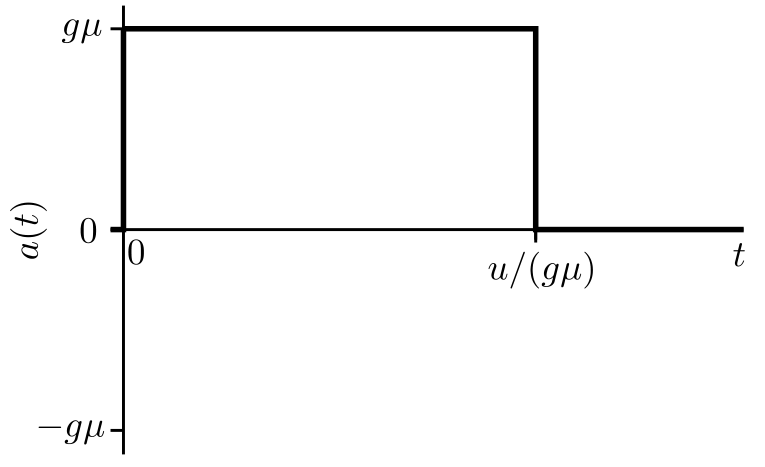
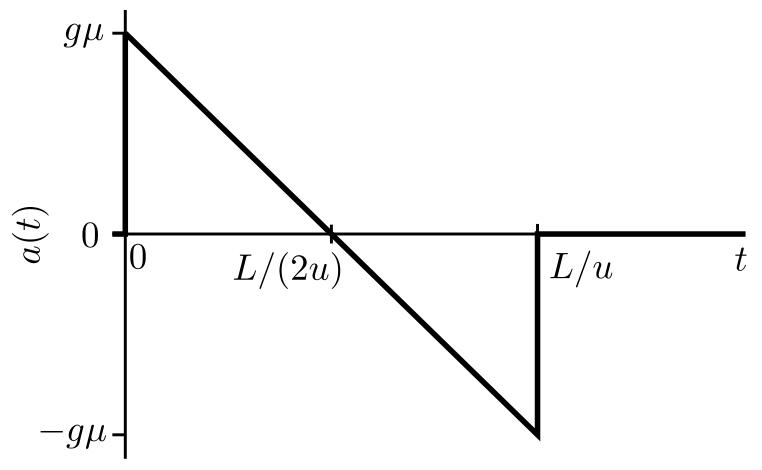
i) Sketch a qualitative graph of how the acceleration of the pack (excluding the bottom-most sheet) depends on time when
(a) the speed is very small.
(b) the speed is very big. [2 т.]
ii) What is the minimal speed by which it is possible to pull the bottom-most sheet out (i.e. separating it completely from the remaining pack)? [3 т.]
iii) Assuming , what is the speed of the remaining pack at the moment when the bottom-most sheet gets out of the pack (i.e. there is no longer overlapping areas)? [1 т.]
iv) Considering still , what is the minimal distance between the pack of papers and the edge of the table such that the pack would not slide over the edge of the table? ( is the maximal allowed travel distance of the pack.) [2 т.]
Решение
— Solution by Taavet Kalda, grading schemes by Martin Rahe, Isak Fleig and Joonas Kalda.
i) (2 т.)
Clearly, when is very small, the pack gets dragged along with the bottom-most sheet, so the speed of the pack starts from 0, and ends up with . Further, there is almost no slippage between the pack and the bottom sheet. The acceleration of the top sheet is then as long as its being accelerated, and 0 otherwise. The acceleration lasts for a duration of .
Conversely at very large , the bottom-most sheet gets pulled out so fast that the pack ends with very little speed. As the sheets gets pulled from under, the acceleration of the pack drops from to over a duration of .
Grading:
- Correct initial accelerations (0.2 pts)
- Correct final accelerations (0.2 pts)
- Correct durations of acceleration (0.4 pts)
- Correct graph shapes (0.6 pts)
- Physical explanations for the graph shapes (0.6 pts)
(half of the points in each subsection are given for part (a) and half for part (b))
ii) (3 т.)
The problem is most conveniently analysed in a frame moving with the bottom-most sheet with speed . In the new frame, and . Let the centre-point of the bottom-most sheet be and let’s track the movement of the pack using its right-most edge which will start at with a speed of and lose contact with the bottom sheet at .
When the pack is in contact with the bottom sheet and in the process of slipping, the pack has a normal force of with the bottom-most sheet, and with the table. Friction force will then result in a net force of . The acceleration of the pack is thus . Note that this equation is that of a spring with a negative spring coefficient (which we will still denote with a positive value, only that the force repels from the equilibrium). Nevertheless, conservation of energy still holds, . The most critical point to overcome is at (after that the force starts helping the pack), which makes sense because then most of the bottom-most paper is out from underneath the pack, and the friction force from the table is dominant. The condition for this is simply or in other words, . This gives
Grading:
- switching to the reference frame of the bottom-most sheet (0.4 pts)
- Correct normal forces with bottom-most sheet and table (0.6 pts)
- Correct net force on pack (0.2 pts)
- Identifying the spring coefficient (0.3 pts)
- Conservation of energy equation (0.5 pts)
- Identifying critical point (0.6 pts)
- Deriving (0.4 pts)
iii) (1 т.)
As before, conservation of energy holds. This means that when the bottom sheet is separated at , the potential energy is the same as when so the speed of the pack is still . Surprisingly, the final speed of the pack in the table frame is therefore 0.
Grading:
- Potential energy when the sheet is separated is the same as when Sandra starts pulling (0.6 pts)
- Correct final speed in the bottom-most sheet reference frame (0.2 pts)
- Correct final speed in the table reference frame (0.2 pts)
iv) (2 т.)
The goal is to find the overall distance by which the pack slides in the table frame. Equivalently, we can find the duration for which it slides, because then it will have shifted by in the paper frame, and the paper frame has shifted by with respect to the table frame. The overall shift is then .
The equation of motion for the pack was with . The solution for this is, instead of sine and cosine, hyperbolic sine and cosine. Seeing from the initial conditions, a possible solution could be . This indeed gives and such that satisfies the equation of motion. We find the values for and from the initial conditions at so that and . From here, we get
Now, from the form of , it’s clear that it will pass at , and reach at . Therefore, and the minimal distance between the paper pack and the edge has to be
Grading:
- Stating the formula (0.2 pts)
- Stating the equation of motion (0.2 pts)
- Solution for the equation of motion (0.4 pts)
- Correct values for and (0.6 pts)
- Justification for (0.3 pts)
- Correct result for the minimal distance (0.3 pts)-
Оригинал в Архива: NBPhO_2023_problems.pdf · официални решения: NBPhO_2023_solutions.pdf