OWAO 2024, Практически тур — Задача 1. Scattering of Stones
2024 ⋄ Practical Round ⋄ Problems · 20 т.
Указания
The practical round is 5 hours long and accounts for 30 % of the total grade.
The maximum score for each problem is 20 points. The round total is 60 points.
Paper and electronic versions of problems are identical. The necessary files can be downloaded from the testing system.
Please present your solution as an electronic report, containing information about your work, plots and tables, intermediate and final results, and conclusions.
Please include your participant code (string like
AA-1) at the beginning of each report.Submit your report in PDF format. If necessary, also attach working files (images, source code, etc.). ZIP format archives are accepted. The maximum file upload size is 10 MB.
During the practical round, you can use:
- browser, e. g. Google Chrome/Chromium,
- text editor, e. g. Microsoft Word/LibreOffice Writer/Google Docs,
- spreadsheet editor, e. g. Microsoft Excel/LibreOffice Calc/Google Sheets.
You may also use:
- development tools, e. g. Python & Jupyter Notebook,
- graphic editors, e. g. Paint/GIMP,
- other applications for data processing, analysis, report generation, including online applications (Google Colab, Desmos, etc.).
This is an individual competition. You must not use collaborative tools and functions.
You may find and use documentation for the software and libraries used but not reference literature on astronomy, physics and mathematics.
Please remember that the jury may not understand your language. It is expected that solutions are written in plain English. Use mathematical expressions, numbers and images.
Some problems are quite difficult. Remember that partial solutions are also scored.
A list of constants is given on page 8.
Go to https://my.sirius.online/, log in with your email and password, and select the Practical round. The countdown will begin after you click the Start button.
Good luck!
Условие
There are various spectral types of asteroids. Multiband photometry data can be used to determine the type of a particular asteroid. The article by Choi et al. (2023) provides photometric data (, , , ) for several thousand asteroids, as well as describes a method for determining their types. The catalog of photometric data is provided in a separate table ast.dat. The description of the columns is indicated in the file itself.
We will use a simplified version of the method. First of all, the standardized magnitudes are transformed to the reflectances in magnitude by subtracting the solar colors:
Next, the coefficient of least-squares linear regression is estimated:
We assume that the errors in both color indexes are distributed according to the same law, so we use the simple estimation — Deming linear regression:
Further, the so-called principal component (PC) is estimated for each asteroid. For the -th asteroid
Based on the values of PC and , the spectral types of asteroids can be approximately determined. The taxonomy boundaries are given in Table 1 below.
We will only work with asteroids whose magnitude uncertainties are less than or equal to 0.05 in all photometric bands.
Please include your participant code at the beginning of your report.
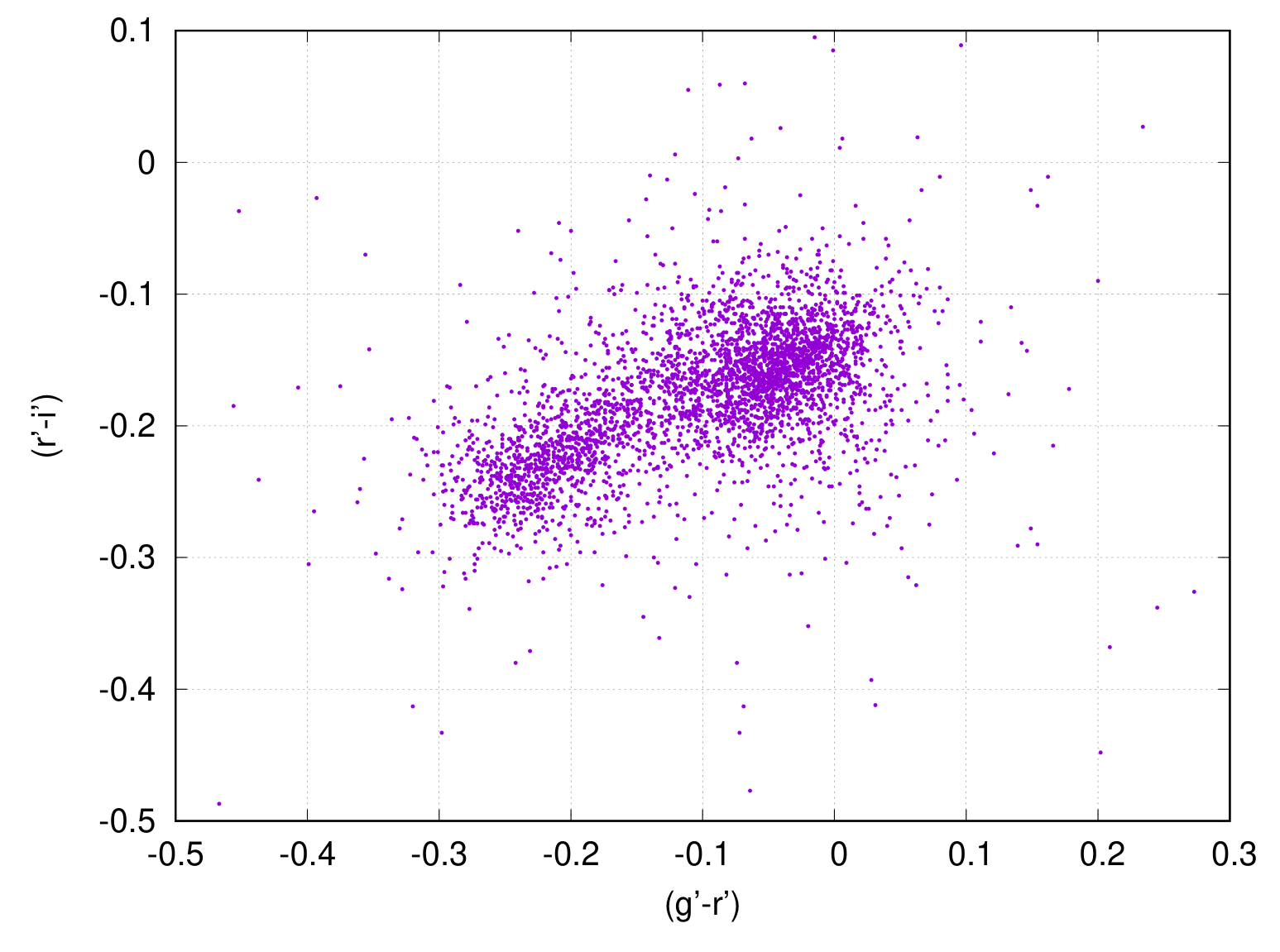
a) Plot the dependence on for suitable asteroids. How many objects are on the graph?
b) Determine the coefficient of Deming linear regression in the versus color plane.
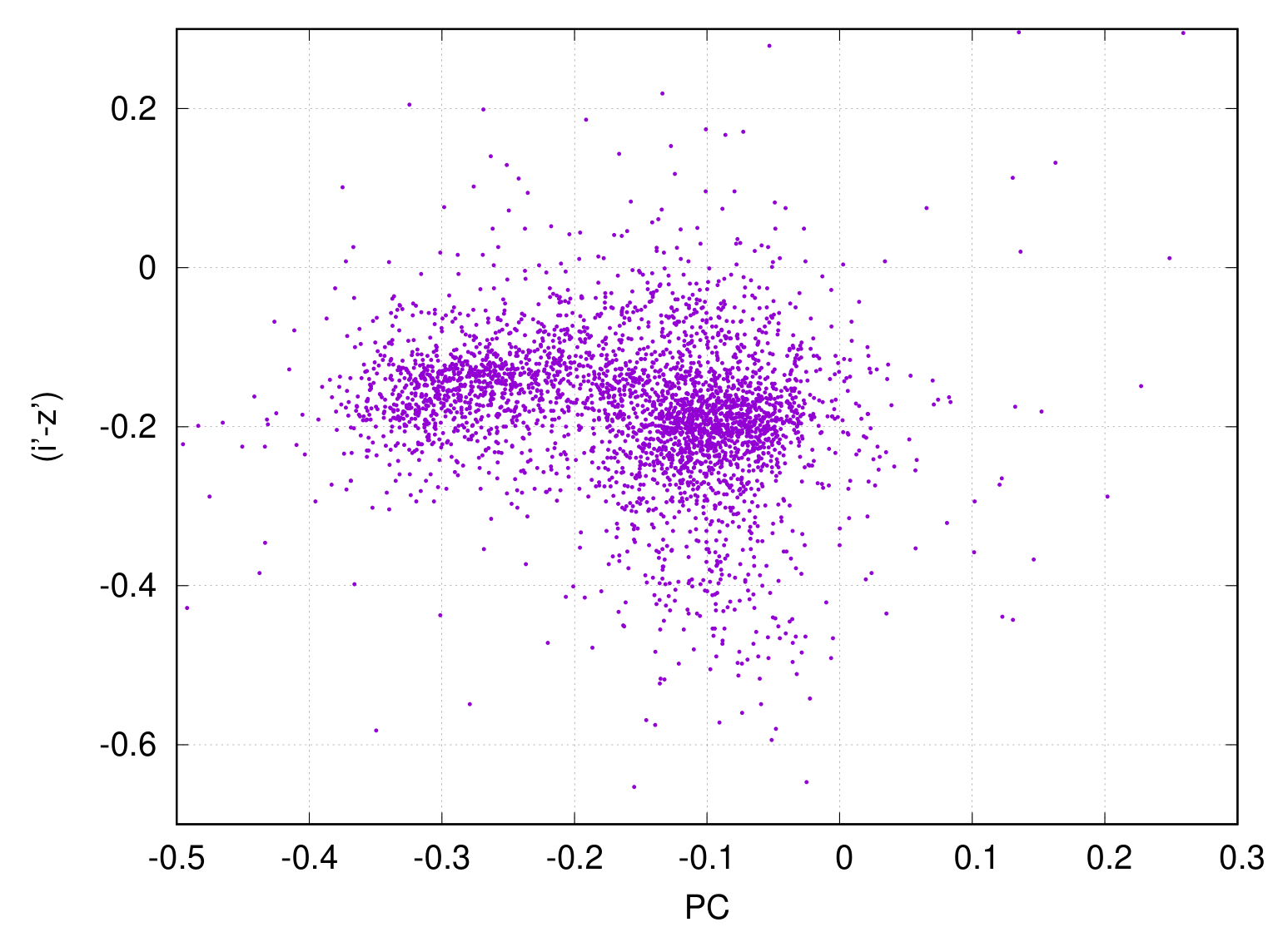
c) Plot the dependence on PC for the same asteroids.
d) What spectral type does asteroid 8 Flora belong to?
e) How many asteroids belong to each type listed in the table?
Table 1: Parametric boundaries for different spectral types of asteroids
| Type | Boundaries |
|---|---|
| L & D | |
| S | |
| V | |
| C | |
| X | |
Отговори
a) 3504
Official solution: the filtered catalog contains n = 3504 suitable objects (of 6793).
b) 0.4
Official solution: a = 0.400, θ = arctan(0.400) = 21.8°.
d) S-type (silicaceous)
e) L & D: 606; S: 1439; V: 207; C: 582; X: 401; Other: 269
Due to rounding errors the numbers may slightly differ (official solution).
Решение
Solution:
a) The original catalog lists 6793 asteroids. We leave only objects with the magnitude uncertainties less than or equal to in all photometric bands, as prescribed. The filtered catalog contains suitable objects.
The dependence of on is shown in Figure 1.
b) First, we list the values of all calculated quantities needed for estimating the coefficient .
Next, we calculate an estimate of the angular regression coefficient
Note that the simple least squares method, assuming errors in only one of the coordinates, leads to a significantly different result and is not applicable for this problem.
c) Using the value of Deming regression angle obtained above, we calculate the principal component for each asteroid:
The dependence of on PC is shown in Figure 2.
d) For 8 Flora , . This asteroid belongs to S-type (silicaceous).
e) Due to rounding errors in the previous stages, the number of asteroids may slightly differ from the one shown in the table.
| Type | L & D | S | V | C | X | Other |
|---|---|---|---|---|---|---|
| 606 | 1439 | 207 | 582 | 401 | 269 | |
| % | 17 | 41 | 6 | 17 | 11 | 8 |
The spectral types in question approximately correspond to SMASS II taxonomic system. Note that in the filtered catalog, the most numerous were the S-type (silicaceous) asteroids; approximately 17 % of the real asteroids are of this type. In reality, among all known asteroids, the most numerous objects (about 77 %) are the C-type asteroids (carbonaceous), but they comprise only 17 % in the catalog in this problem. The V-type (volcanic-type or vestoids) asteroids were the least common in our sample, in reality they also comprise approximately 6 % of the main-belt asteroids. The X-group collects together several types of asteroids with similar spectra, namely metallic asteroids, ones with high albedo and asteroids with red spectra. L & D-type correspond to the asteroids with very steep red slope in spectra.
Marking Scheme:
- Question (a)
- plot — 2 pt.
- — 3 pt. OR — 2 pt., — 1 pt.
- Question (b) 3. — 5 pt. For every deviation step of 0.01, 1 point is deducted, e. g. the answer is worth 2 pt.
The score for this question cannot be negative.
- Question (c): plot — 3 pt.
- Question (d): spectral type with justification — 2 pt.
- Question (e): correct number for each spectral type — 1 pt. × 5 = 5 pt.
Константи
Universal
| Speed of light | |
| Planck constant | |
| Boltzmann constant | |
| Gas constant | |
| Proton mass |
Astronomical
| Astronomical unit | |
| Parsec | |
| Hubble constant |
Sun
| Radius | |
| Mass | |
| Absolute magnitude | (bol.) |
| Effective temperature | |
| Luminosity |
Earth
| Radius | |
| Sidereal day | |
| Obliquity of ecliptic | |
| Surface gravity | |
| Orbital period | |
| Orbital eccentricity | |
Mars
| Radius | |
| Sidereal day | |
| Obliquity (axial tilt) | |
| Orbital semi-major axis | |
| Orbital period | |
| Orbital eccentricity | |
Оригинал в Архива: OWAO-2024-prob-P.pdf · официални решения: OWAO-2024-sol-P.pdf