WoPhO 2012, Теория — Задача 3.1. The calm weather
Theoretical 3: Tornado
Внимание: Бележка към темата
The official solutions (Ver. 1.1, June 2012) label their sub-parts differently from the problem sheet: under [Q.2], (a) answers question 2(c), (b) answers 2(b), (c) answers 2(d) and (d) answers 2(e); under [Q.3], (a) answers question 2(a), and (b)–(e) answer 3(a)–3(d). The solutions are reproduced with their printed labels.
Условие
| CONSTANTS AND DATA: | ||
|---|---|---|
| Gravitational acceleration | : | |
| Air density | : | |
| Molar mass of dry air | : | |
| Universal gas constant | : | |
| Sea level pressure | : | |
| Standard sea level temperature | : | |
| Heat capacity ratio of air | : |
Introduction
Tornado is one of the deadliest atmospheric phenomena known to man. It is a violent vortex (rotating column) of air connecting the base of cumulonimbus cloud and the ground. A distinct feature of the tornado is its funnel-like core or condensation funnel (Region II) which is made of small water droplets that condense as they are sucked into the core as shown in Fig. 1(b). This region is defined by the core radius which generally increases with altitude forming the signature funnel-shape of the tornado.
Region I is the region outside tornado core. Region I and II have different velocity distribution profile as we will explore later.
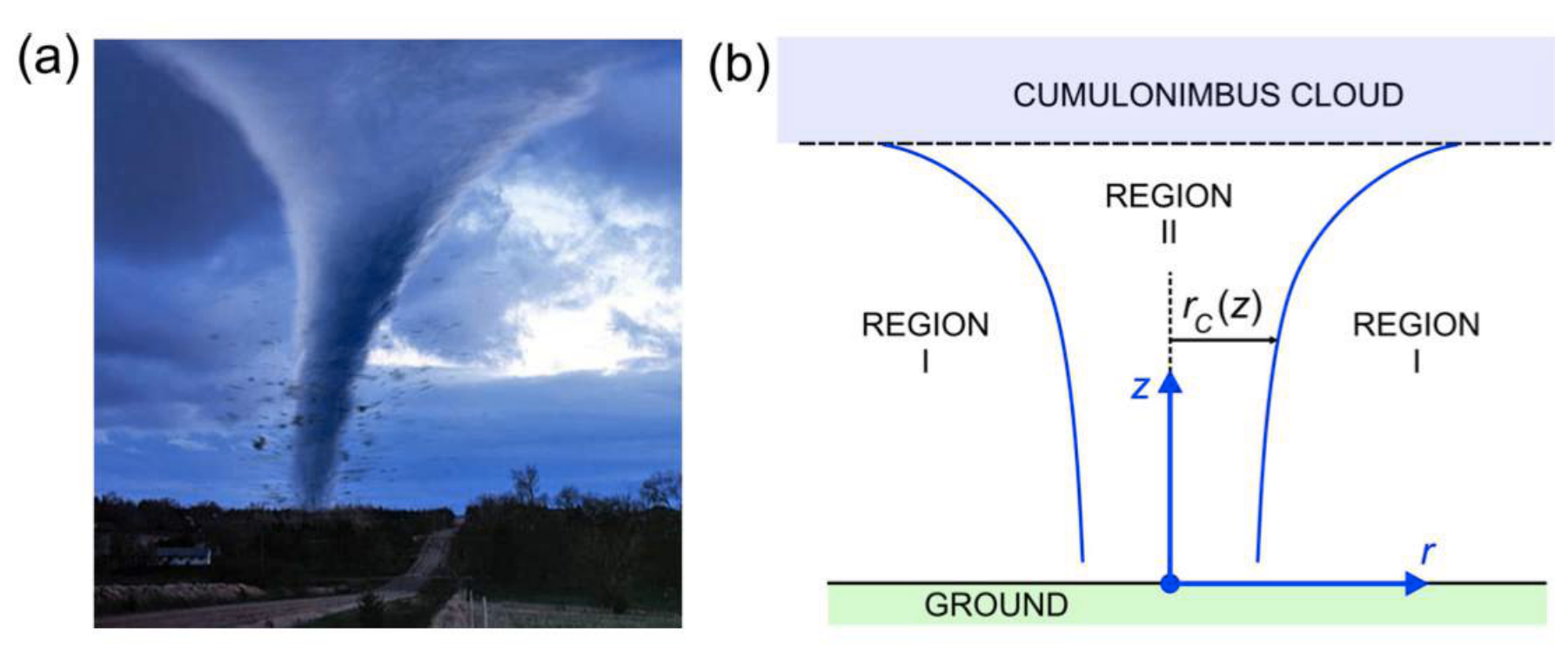
Let us explore the interesting physics of tornado. Using a simple model as shown in Fig. 1(b) and few basic principles, you will try to estimate the rotating speed of tornado, calculate the pressure and temperature inside the tornado and most interestingly derive the equation for the shape of a tornado .
Cumulonimbus cloud is a towering vertical cloud that is very tall, dense, and involved in thunderstorms and other rainy weather.
Questions
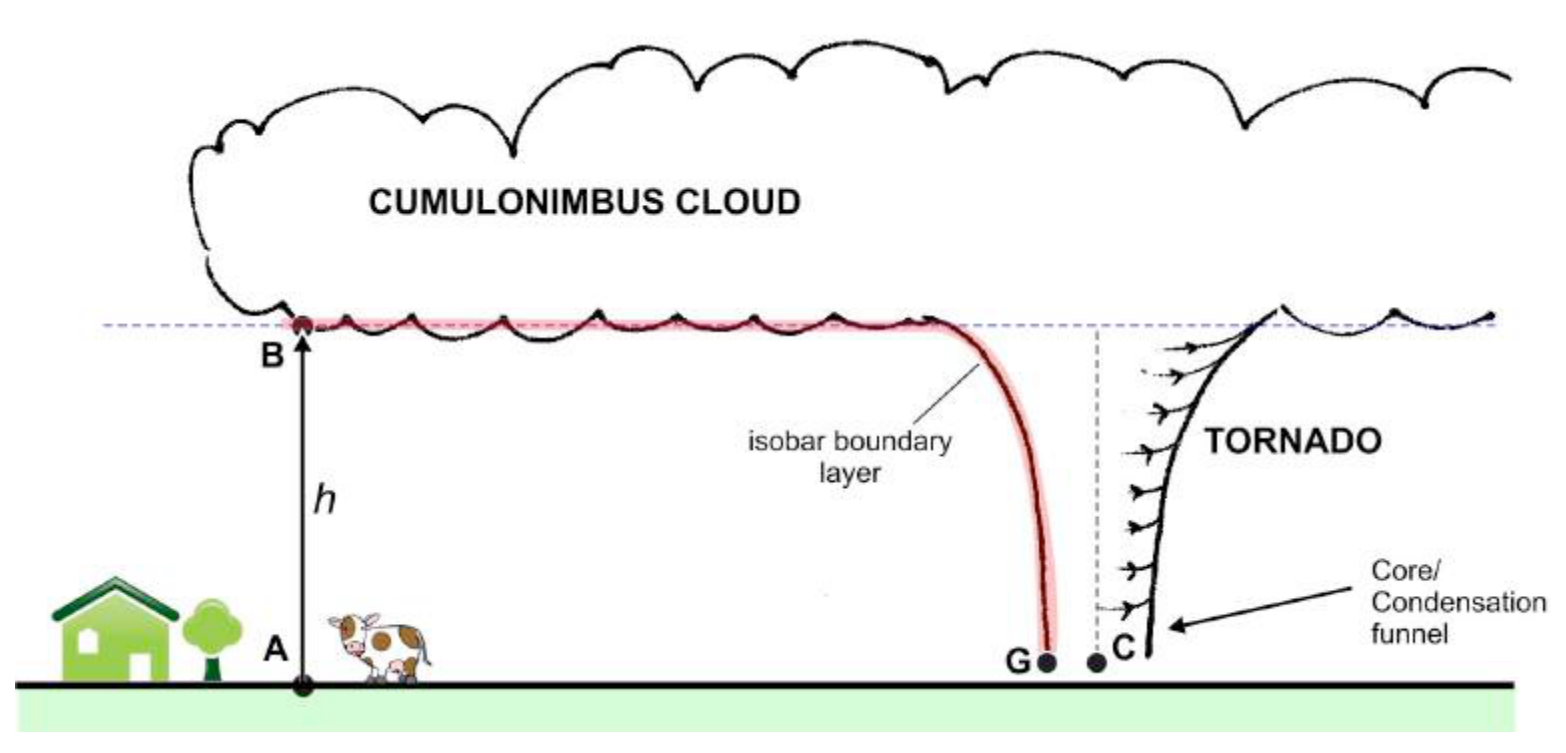
We will investigate the atmospheric pressure of the troposphere (the lowest part of the atmosphere) where most of the weather phenomena including tornado occurs. Let us start from a calm weather location at point A far away from the tornado. At point A the pressure is and temperature (see Constants and Data).
(a) Assuming ideal gas law, constant gravity acceleration and a constant temperature . Show that the atmospheric pressure as a function of altitude is:
Express in terms of the constants listed in “Constants and Data”. [0,8 т.]
(b) Now we consider a situation where the air density, , is constant. Derive the pressure as a function of altitude: ! The temperature drops with altitude at a linear rate of . Find ! [1 т.]
(c) Using your result in (b) calculate the pressure at point B on the base of the cumulonimbus! (use ) [0,2 т.]
Отговори
(a)
(c) 88700 Pa
Official value Pa, computed in the solution with K/m; the printed exponent carries a minus sign although the number corresponds to a positive exponent.
Решение
(a) Since it is a calm weather (no wind) we assume the atmosphere is in hydrostatic condition. Consider a column of air as shown below. The atmospheric pressure is higher at lower altitude since it needs to support more column of air above.
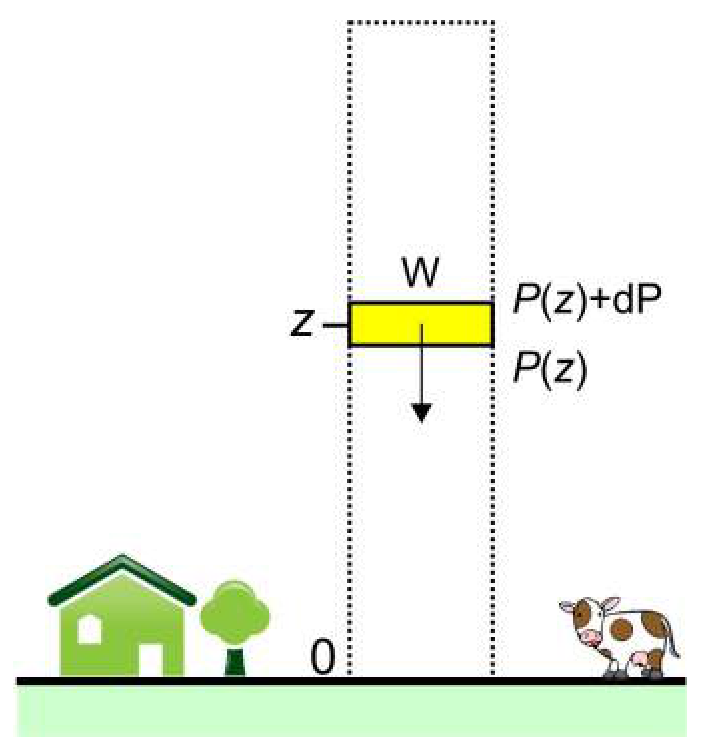
At equilibrium:
Using ideal gas law:
where kg/mol, is the molar mass of the air. Now we have:
Assuming constant temperature , solving this yields:
(b) Now the temperature varies with altitude: . Eq. (3) becomes :
Finally:
(c) At point B we have:
Thus the pressure is lower by 11.3% at the base of the cumulonimbus cloud compared to the ground.
Оригинал в Архива: WoPhO_2012_Q13.pdf · официални решения: WoPhO_2012_S13.pdf