IAO 2002, Теория, Група β, английски — Задача 4
Theoretical round. Problems to solve — Group B · 22 октомври 2002 г.
Бележки от източника
The supplied key refers to a drawing for problem 2 but contains none. The B4 key prints “5 parameters” before concluding 16; the printed wording is retained. The printed B5 formula V_per·a(1−e)/2 and its numerical results are retained without correction.
Условие
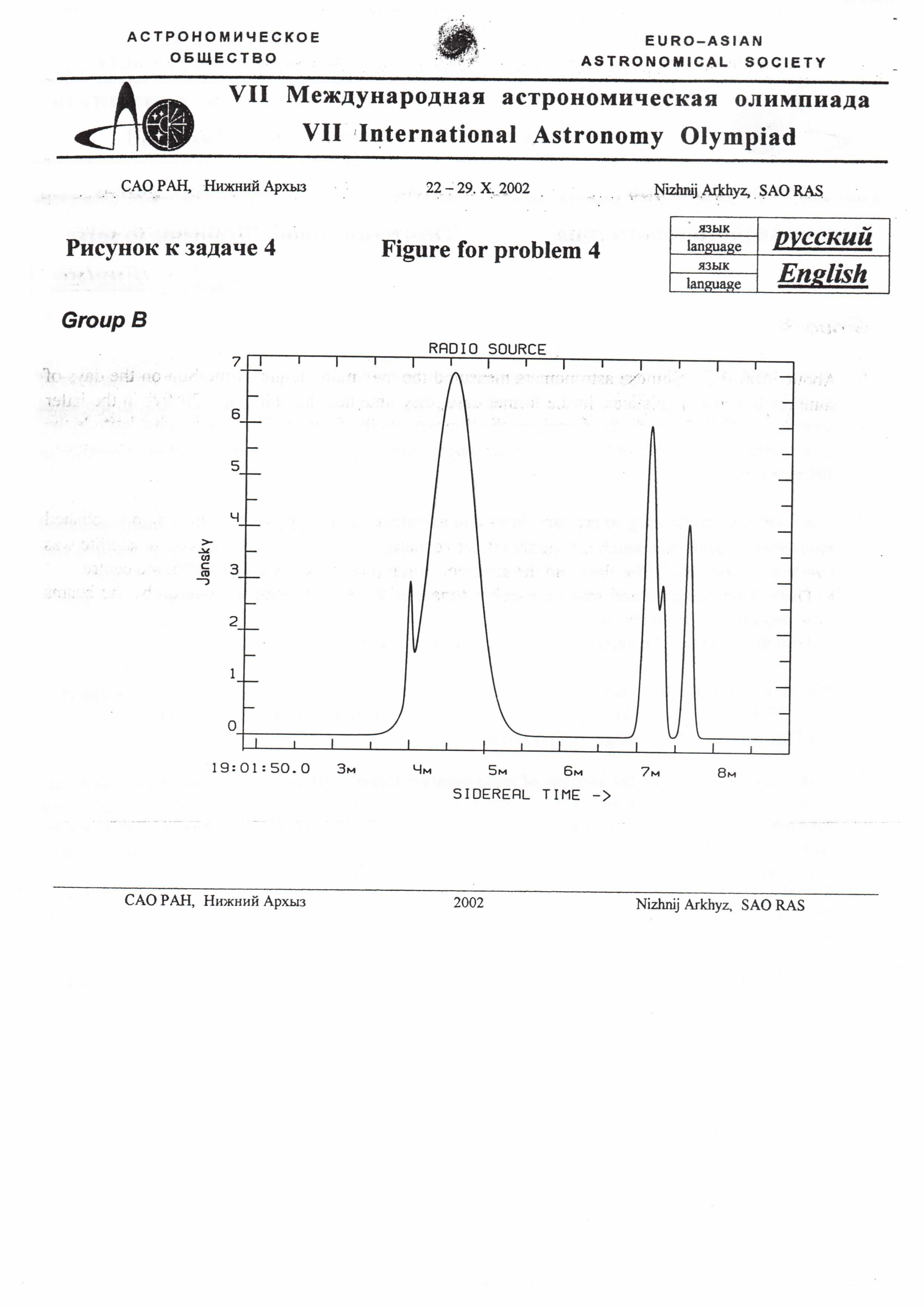
In the figure, you can see the intensity of radio emission (wavelength is about 21 cm) versus coordinate. Observational data has been obtained with a radio telescope and reduced. All interferences from atmosphere and receivers have been removed. One can measure several parameters from this profile. Please, state (without defining exactly the types of the parameters) how many parameters of this radio source can be measured in this record. Please, indicate these values in the figure.
A small optical telescope has been used to study this object. It was discovered that the fluxes in the radio and optical frequencies were equal. Which photons' number is more, radio or optical? By how many times is it more?
Решение
The profile is a curve combining 5 lines. Each line is a Gaussian characterized by 3 parameters: position of maximum on the horizontal axis, amplitude (height over zero) and half maximum width, describing its size. There are 5 lines in the Figure. It gives 5 parameters, and 1 additional parameter is a number of Gaussians. So 16 parameters.
Energy of each photon equals to . Therefore, for equal flux of energy, we observe more photons with lower energy, i.e. lower frequency (or longer wavelength cm), than photons of visible light ( nm) approximately in 380 000 times ≈400 thousand times. Corresponding ration of numbers of photons is larger in the same times.
Answers: 16 parameters, number of radio photons is larger in 400 thousand times.
Оригинал в Архива: betatheo.jpg · официални решения: commonsol.jpg · допълнителни данни: alphasol.jpg · допълнителни данни: betatheodata.jpg · допълнителни данни: betasol.jpg